Which animals have the biggest appetites? The answer depends on what you measure. A blue whale can consume tons of food during a productive feeding day, while a sea otter eats an astonishing amount compared with its own body weight. A panda makes its mark by spending much of the day working through bamboo.
These animals reveal something more interesting than a contest over who has the largest dinner. Their eating habits show how different bodies solve the same problem: getting enough energy from the food available around them. Some gather leaves one mouthful at a time. Others capture thousands of tiny prey in a single feeding event.
This countdown follows ten remarkable eaters, from familiar land animals to ocean giants. You will discover what they eat, how they collect it, and why their feeding habits deserve attention.
How this list works: The order is an editorial countdown, not a scientific ranking based on one measurement. It combines total food intake, feeding effort, and appetite relative to body size. Think of it as a tour of extraordinary feeding strategies rather than a universal record book.
What Does “Biggest Appetite” Actually Mean?
Before comparing a hummingbird with an elephant, choose your measuring stick. Otherwise, impressive facts can become misleading comparisons.
Total food mass asks how many kilograms or pounds an animal consumes over a stated period. This favors large animals. A whale eating a huge quantity of krill belongs in a different category from a tiny mammal finding enough insects to survive.
Food relative to body weight changes the picture. Imagine an animal weighing 20 kilograms that eats 5 kilograms daily. Its intake equals 25 percent of its body weight. That calculation describes proportion, not how many calories the animal receives or how efficiently it digests the meal.
Time spent feeding measures effort. An animal can spend hours collecting small bites without eating the greatest total mass. Handling food, selecting useful parts, and chewing all contribute to the feeding schedule.
Even these measures need context. Fresh leaves contain water; shellfish include shells; prey varies in energy content. A feeding-season estimate should not automatically become an annual daily average. The most useful question is therefore not simply “Who wins?” but “What makes this animal’s appetite remarkable?”
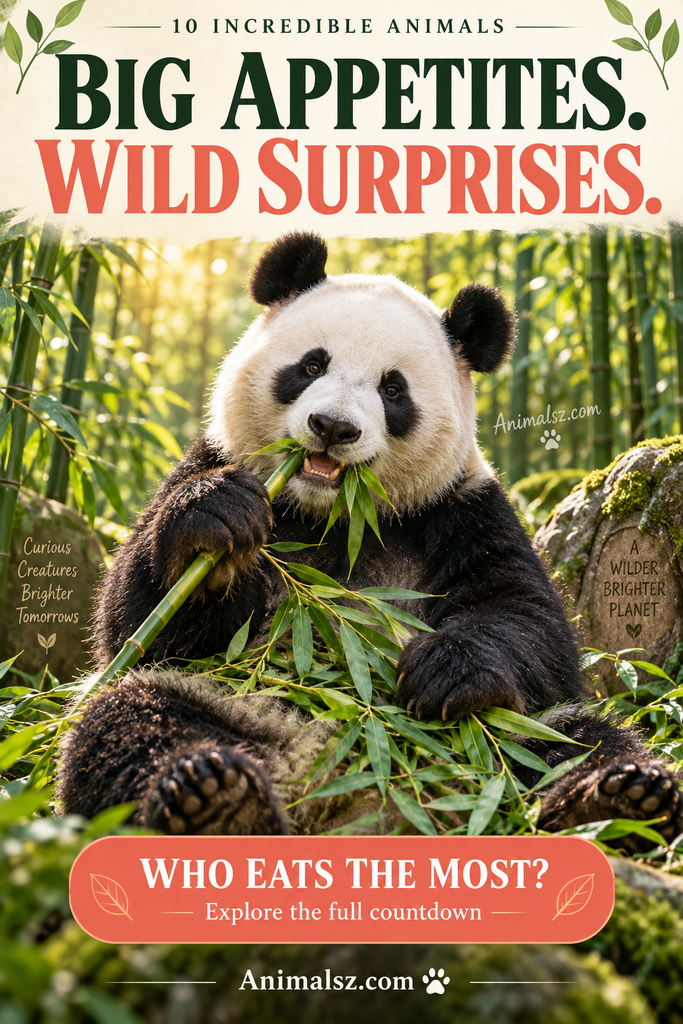
10. Giant Panda: A Daily Bamboo Commitment
Watch a giant panda eat and the process looks almost leisurely. It settles into position, holds a stalk, strips away material, and chews. Repeat that routine for hours, however, and the scale of the commitment becomes clear.
Bamboo dominates the panda’s diet. San Diego Zoo Wildlife Alliance reports that pandas spend at least twelve hours daily eating it. Their enlarged wrist bone, often called a pseudo-thumb, helps them grip and manipulate stalks while powerful jaws do the harder work. Read the giant panda feeding guide from San Diego Zoo Wildlife Alliance.
The panda earns its place through feeding time and specialization. Its meal is not a single spectacular event; it is an ongoing routine built around processing plant material.
That makes panda footage especially rewarding to watch closely. Notice the coordination between the paws and mouth, rather than just the pile of bamboo. A familiar, apparently simple behavior becomes a demonstration of how precisely an animal handles its food.
Appetite highlight: A substantial part of the day is devoted to eating one dominant food source.
9. Anna’s Hummingbird: Small Bird, Frequent Refueling
A hummingbird at a flower looks like a jewel suspended in midair. Behind that elegant view is an active animal repeatedly finding and collecting food.
Anna’s hummingbirds take nectar from many flowering plants, but nectar is not their entire menu. They also capture small insects from vegetation, flowers, spider webs, and the air. The Cornell Lab of Ornithology documents this varied feeding behavior, including visits to sources of tree sap. Explore Anna’s hummingbird feeding habits with the Cornell Lab of Ornithology.
Its inclusion here is about the pace and demands of feeding, not a claim that this species holds a universal body-weight record. The important contrast is between its small size and the repeated effort visible during foraging.
Next time you watch one, look beyond the flowers. A quick movement away from a blossom may be part of catching a tiny insect. That change of perspective turns a familiar garden visitor into a much more versatile feeder.
Appetite highlight: Frequent food gathering supports an exceptionally active way of life.
8. Common Shrew: A Tiny Hunter on a Tight Schedule
The common shrew is easy to overlook among roots and fallen leaves. Its pointed snout, tiny eyes, and small body do not suggest a heavyweight eater. Its feeding schedule tells another story.
The Wildlife Trusts describes common shrews as needing to eat every two to three hours. They search the undergrowth for prey such as earthworms, spiders, and insect pupae, and can be active during both day and night. Learn about the common shrew from The Wildlife Trusts.
This is a good example of why appetite cannot be judged from size alone. A shrew’s meals are small in absolute terms, but frequent access to food is central to its routine.
There is no need to inflate the story with an unsupported claim that every shrew eats several times its weight. The verified feeding interval is remarkable enough. Imagine organizing an entire day around another necessary meal every few hours, with each meal hidden somewhere beneath the vegetation.
Appetite highlight: Small meals become a demanding, repeated search for food.
7. Sea Otter: A Serious Seafood Appetite
A sea otter floating on its back may look relaxed, but maintaining that life in cold coastal water requires substantial feeding. Its dense fur and high metabolism help it stay warm.
According to Alaska’s Department of Fish and Game, sea otters eat about 25 percent of their body weight per day. Their prey includes animals such as sea urchins, crabs, clams, and mussels. Read the sea otter species profile from Alaska’s Department of Fish and Game.
For a simple mathematical illustration, 25 percent of a hypothetical 40-kilogram otter would be 10 kilograms of food. That example explains the proportion; it is not a measured daily ration for every otter.
The comparison also shows why weighing food is only one part of the story. A shellfish meal involves more than swallowing a soft, ready-to-eat portion. Finding, retrieving, and handling prey are part of the feeding job too.
Appetite highlight: An impressive daily food intake relative to the animal’s own weight.
6. Giraffe: A Towering Browser With Countless Bites
A giraffe does not need dramatic lunges or rapid chases to make this list. Its feeding story unfolds high in the branches, where gathering leaves requires repeated, careful mouthfuls.
San Diego Zoo Wildlife Alliance reports that giraffes may eat up to 75 pounds, or 34 kilograms, of food daily. Their flexible tongues and lips help them gather leaves around thorns. As ruminants, they also bring swallowed food back to the mouth for further chewing. Discover more about giraffe diets from San Diego Zoo Wildlife Alliance.
The fascinating feature is how the animal’s reach and feeding tools work together. Height opens access to branches, while the mouth does the selective work of collecting food.
If you watch a giraffe browsing, follow one bite from branch to jaw. It offers a better explanation of the animal’s appetite than simply calling it a giant leaf-eating machine. The large daily total is assembled from many individual choices and mouthfuls.
Appetite highlight: A large plant intake collected through patient, selective browsing.
5. Hippopotamus: The Nighttime Grass Eater
Hippos are strongly associated with water, but their usual feeding routine leads onto land. After spending daytime hours in water, they commonly emerge in the evening to graze.
San Diego Zoo Wildlife Alliance gives an average intake of around 88 pounds, or 40 kilograms, of food per night and describes grazing periods of roughly six hours. Despite that substantial quantity, the intake is modest relative to a hippo’s enormous body. Explore hippo feeding behavior with San Diego Zoo Wildlife Alliance.
That detail is exactly why this countdown uses several definitions of appetite. Hippos look like obvious champions, yet their proportions tell a more nuanced story. Large body size does not automatically mean the highest food intake as a percentage of weight.
Their feeding behavior also changes how we picture them. The animal seen resting in a river is only one part of the daily routine; the land-based grazing shift is equally important.
Appetite highlight: A substantial nighttime grass meal, rather than constant feeding underwater.
4. White Rhinoceros: Built to Gather Grass
The white rhinoceros combines an imposing body with a feeding style that is surprisingly methodical. Its broad, square mouth is well suited to gathering grass close to the ground.
Rhino species do not all eat in the same way. White rhinos are grazers, while other species rely more heavily on browsing vegetation. Treating every rhino as an identical feeder misses an important difference in how these animals use their habitats. Read about rhinoceros diets at San Diego Zoo Wildlife Alliance.
For the white rhino, the mouth is the detail to notice. It helps explain why this animal can work steadily across a grassy feeding area. The horn attracts attention, but the lips tell the clearer story about dinner.
Its position in this countdown recognizes a large herbivore’s feeding commitment, not a verified claim that it always eats more than the hippo or giraffe. Individual size, food conditions, and measurement methods would matter in a strict comparison.
Appetite highlight: A specialized grazing mouth serving a very large plant eater.
3. African Savanna Elephant: Gathering Food on a Grand Scale
An elephant’s trunk makes feeding look effortless: reach, grasp, pull, lift, and place. Yet repeating that sequence supplies one of the most substantial plant-based diets on land.
San Diego Zoo Wildlife Alliance describes elephant consumption of approximately 165 to 330 pounds, or 75 to 150 kilograms, of vegetation daily. Foods can include grasses, leaves, bark, roots, and fruit. Its overview also notes the long hours elephants devote to eating. These are broad elephant figures, not a fixed requirement for every African savanna elephant. Learn about elephant diets from San Diego Zoo Wildlife Alliance.
The impressive feature is the combination of quantity and versatility. The same trunk can gather loose vegetation or manipulate a branch, making it an adaptable collecting tool.
An elephant also reminds us to separate food availability from appetite. A hungry animal cannot eat vegetation that is absent or inaccessible. The size of a daily meal depends on the landscape as well as the animal.
Appetite highlight: Large quantities of varied vegetation gathered with remarkable dexterity.
2. Humpback Whale: Many Small Prey, One Feeding Event
Humpback whales demonstrate a completely different route to a large meal. Instead of selecting leaves or catching one insect, they can capture concentrations of small prey through filter feeding.
Their diet includes krill and small fish. Baleen plates help separate food from seawater. NOAA also describes feeding techniques that use bubbles, sound, the seafloor, or pectoral fins to influence prey. Feeding patterns vary, and many humpbacks build substantial fat reserves during productive feeding periods. Explore humpback whale feeding with NOAA Fisheries.
The key idea is concentration. A mouthful of mostly empty water would not offer the same reward as a mouthful containing densely packed prey. That makes where and how a whale feeds as interesting as the size of its mouth.
When watching a feeding sequence, look for the relationship between the whale and the prey patch. The spectacle is more than a wide-open mouth; it is a coordinated encounter between a large predator and many small animals.
Appetite highlight: Capturing numerous small prey during powerful feeding events.
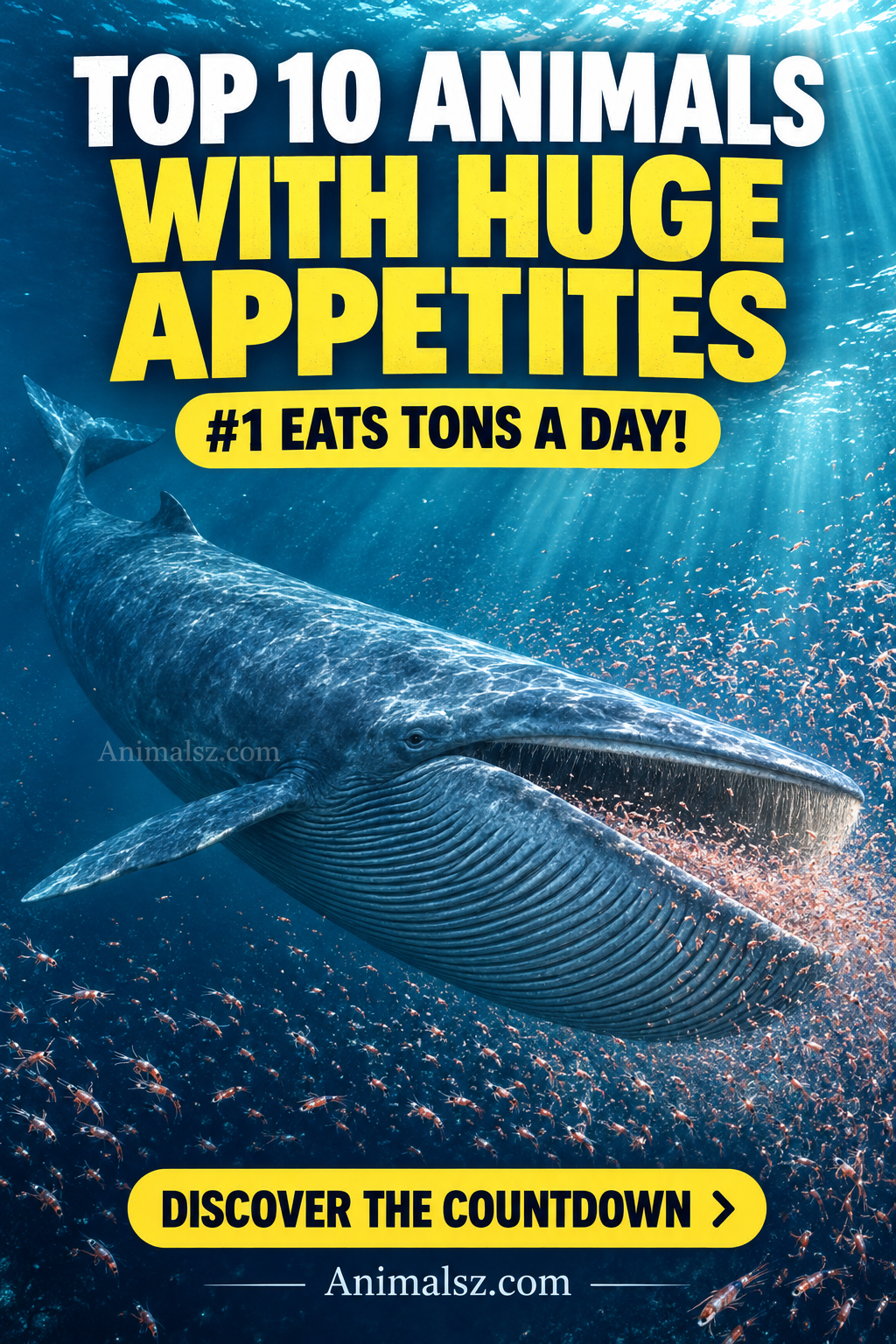
1. Blue Whale: An Appetite Measured in Tons
The blue whale provides the most dramatic finale to this countdown. Its enormous body is supported primarily by tiny, shrimp-like crustaceans called krill.
Like humpbacks, blue whales use baleen to retain prey while expelling water. During a feeding lunge, their expandable throat region allows them to engulf a large volume before filtering the contents. Read the blue whale species guide from NOAA Fisheries.
How much do they eat? Published estimates differ with the population, individual, season, and research method. Smithsonian Ocean discusses research estimating about 16 metric tons of krill for a blue whale during a feeding day. That is a context-dependent estimate, not a guaranteed daily intake for every blue whale throughout the year. Read Smithsonian Ocean’s explanation of whale food consumption.
The memorable point remains extraordinary: huge quantities of very small animals can support a giant. Understanding the prey matters just as much as admiring the predator.
Appetite highlight: The capacity to consume tons of krill under productive feeding conditions.
How to Compare These Hungry Animals Fairly
Imagine designing your own animal appetite leaderboard. Start by writing one precise question at the top: daily kilograms, percentage of body weight, or feeding hours. Keep that measure consistent all the way down the list.
Next, specify the kind of animal being measured. “An adult of this species” is more useful than a vague label covering several species, sexes, and ages. Where possible, separate typical values from exceptional observations.
Then check the time period. A meal, a feeding day, and a year are different units. Multiplying an exceptional day by 365 would produce a dramatic number, but not necessarily a meaningful one.
Finally, ask what was weighed. Was it food swallowed, food offered, edible tissue, or whole prey? These distinctions are easy to miss when a fact travels from a research report into a short video caption.
You do not need to remove the wonder to improve the accuracy. Often the more careful version is more interesting. “This small mammal needs repeated meals” tells us about a lifestyle; “this animal is always hungry” tells us very little.
Why Appetite Stories Are Worth Looking at Closely
Food gives us a useful way to notice animal behavior. A mouth, tongue, trunk, or paw becomes easier to understand when you see what the animal does with it. Instead of memorizing a label, you can follow an action.
Try a simple observation exercise while watching the accompanying countdown. For each animal, identify the food, the collecting tool, and the main obstacle. Is the challenge finding hidden prey, reaching a branch, handling a shell, or locating a dense concentration of food?
Then ask what the video leaves out. Ten seconds can show a bite beautifully, but it cannot reveal a full daily feeding budget. A close-up may hide the distance traveled beforehand. A dramatic lunge may be only one moment in a much longer search.
This approach works especially well for family learning. Children can describe what they actually see before guessing why it happens. Adults can help distinguish an observation from a conclusion. “The panda holds bamboo” is visible; “this panda eats more than every other bear” would need separate evidence.
The result is a richer kind of wildlife curiosity: enjoying spectacular footage while asking better questions about the life behind it.
Frequently Asked Questions About Animals With Big Appetites
Which animal eats the most food?
Blue whales are standout examples when comparing the total mass consumed by an individual during a productive feeding day. Their krill intake can reach tons. A precise record claim needs a defined population, period, and measurement method, so this article does not present one universal daily record.
Which animal eats the most compared with its weight?
There is no single answer established by this mixed countdown. Sea otters are a striking example, with daily intake around a quarter of body weight. Declaring a worldwide winner would require comparable data from many more species, including small mammals, birds, and invertebrates.
Why do pandas spend so much time eating?
Their diet centers on bamboo, which they must gather and process in substantial amounts. Long feeding sessions are part of that specialization. Eating time is therefore the panda’s standout feature here, rather than a claim that it consumes the greatest food mass in the animal kingdom.
Do hummingbirds live on nectar alone?
No. Anna’s hummingbirds also eat small insects and can visit tree sap. A flower-feeding photograph captures only part of the menu. Nectar is visually associated with hummingbirds, but it should not be mistaken for a complete description of everything they consume.
Do hippos eat fish because they live in water?
Their usual feeding pattern is grazing on land, especially at night. Spending much of the day in water does not make fish their normal staple. This is a useful reminder that the place an animal rests and the place it feeds can be different.
Do all rhinos eat the same plants?
No. White rhinos are primarily grazers, while other rhino species have different feeding preferences. Species-level identification matters. The broad phrase “rhino food” can hide meaningful differences between an animal gathering grass and one selecting leaves or other browse.
Why do websites give different whale food totals?
They may describe different whales, research methods, or time periods. Some figures represent estimates for active feeding days; others are broader summaries. Units also matter: metric tons and U.S. short tons are different. Read the context before comparing two impressive numbers.
Is this an official scientific top ten?
No. It is an educational editorial countdown that follows the companion video. The animals illustrate several kinds of remarkable appetite. Their numbered positions should not be read as evidence that each species consistently consumes more than the species immediately below it.
Which Appetite Surprised You Most?
The biggest animals deliver impressive food totals, but the smallest creatures can offer equally memorable stories. A shrew’s feeding schedule, a hummingbird’s varied menu, and a sea otter’s proportional intake all invite us to think beyond the size of a meal.
Each feeding strategy offers a different window into the everyday work of staying alive.
Choose your favorite example and explain what makes it remarkable: quantity, proportion, persistence, or technique. That answer will say much more than simply calling the animal hungry.
For more accessible wildlife discoveries, explore Animalsz.com and follow Animal Explorer Zone. Which animal would you most like to watch during its next meal?
Top 10 Animals With the Biggest Appetites.