
Top 10 Creepiest Creatures Found in Caves
Meta Description
Discover the top 10 creepiest creatures found in caves. Learn how blind salamanders, ghostly beetles, giant spiders, and other mysterious cave animals survive in total darkness.
Top 10 Creepiest Creatures Found in Caves


Introduction
Deep beneath mountains and forests lies a hidden world that few people ever see. Caves are among the most mysterious places on Earth. With no sunlight, limited food, and constant darkness, these underground environments have forced animals to evolve in extraordinary ways. Many cave-dwelling species have completely lost their eyesight, developed pale or transparent skin, and rely on highly sensitive senses to navigate and hunt.
Scientists call these highly specialized cave animals troglobites, meaning they spend their entire lives underground. Because caves are isolated ecosystems, many species exist nowhere else on Earth. Some have remained almost unchanged for millions of years, making them living windows into evolution.
While many cave creatures are harmless, their ghostly appearance and unusual adaptations often make them look like monsters from a science-fiction movie. Long legs, eyeless faces, glowing bodies, and translucent skin are common traits among animals that have evolved without sunlight.
In this countdown, we’ll explore ten of the creepiest creatures ever discovered inside caves. You’ll learn where they live, how they survive, and why these remarkable animals continue to fascinate scientists around the world.
Number 10: Cave Beetle
Overview
The cave beetle may not be the largest creature underground, but its ghostly appearance makes it one of the strangest. Living exclusively in dark caves across parts of Europe, this insect has evolved over thousands of years to survive where almost nothing else can.
Unlike surface beetles, cave beetles rarely encounter sunlight. As a result, their bodies have become pale because they no longer produce protective pigments. Their eyesight has also diminished significantly, while their antennae have become much more sensitive.
Habitat
Cave beetles live in cool, damp limestone caves where humidity remains high throughout the year. They hide beneath rocks, inside cracks, and among decomposing organic matter carried into caves by water.
Diet
Rather than hunting, cave beetles feed on decaying leaves, fungi, bacteria, and dead insects. Because food is extremely scarce underground, they have evolved slow metabolisms that allow them to survive long periods with little nourishment.
Amazing Adaptations
- Nearly blind
- Long sensory antennae
- Pale, almost transparent body
- Extremely slow metabolism
- Perfectly adapted for life without sunlight
Fun Fact
Some cave beetles spend their entire lives without ever seeing daylight.
Number 9: European Cave Spider
Overview
If you’ve ever walked into a cave and noticed a huge spider web stretching across the entrance, there’s a good chance it belonged to the European cave spider. Although it looks intimidating, this fascinating species is generally shy and avoids humans.
Its exceptionally long legs allow it to move effortlessly across rocky cave walls while waiting patiently for insects to become trapped in its web.
Habitat
European cave spiders prefer cave entrances where humidity is high but small flying insects are still abundant. They may also inhabit abandoned mines, tunnels, and old underground structures.
Hunting Strategy
Instead of chasing prey, the spider spins large circular webs that capture moths, flies, mosquitoes, and other insects entering the cave.
Once prey becomes trapped, the spider quickly immobilizes it using silk before feeding.
Why It Looks So Creepy
- Long thin legs
- Large body
- Massive webs
- Silent movements in darkness
Despite its frightening appearance, its venom poses little risk to healthy humans.
Interesting Fact
Young spiders often leave caves temporarily before returning as adults to reproduce.
Number 8: Texas Blind Salamander
Overview
The Texas blind salamander looks almost unreal. Its pale pink body, tiny nonfunctional eyes, and bright red external gills give it an almost alien appearance.
Found only in underground aquifers in central Texas, this rare amphibian spends its entire life beneath the Earth’s surface.
Habitat
These salamanders inhabit crystal-clear underground rivers connected to cave systems. The water remains cool and stable throughout the year, creating ideal conditions for survival.
Diet
Because food is scarce underground, Texas blind salamanders feed on:
- Small aquatic insects
- Tiny crustaceans
- Snails
- Worms
They locate prey by detecting subtle water movements instead of using vision.
Incredible Adaptations
- Eyes covered by skin
- Sensitive smell and touch
- Bright external gills for breathing underwater
- Slow metabolism
- Permanent underground lifestyle
Conservation
Because they exist in such a limited range, pollution and groundwater depletion pose serious threats to this remarkable species. Protecting underground water systems is essential for its survival.
Conclusion of this part
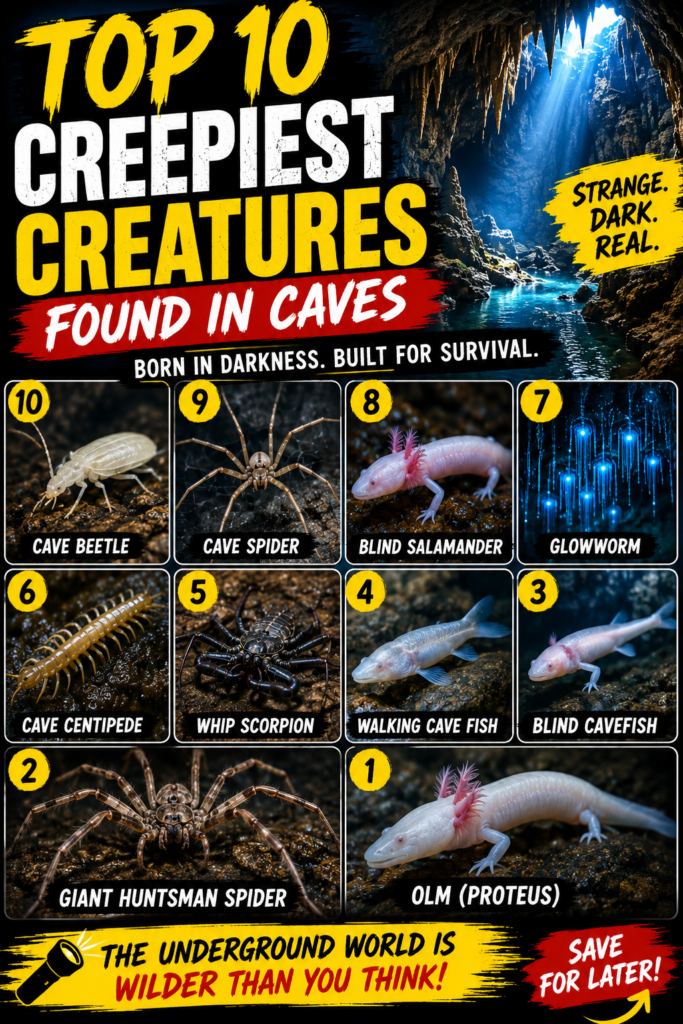
The first three animals on our list show just how extraordinary cave evolution can be. From the pale cave beetle to the web-spinning European cave spider and the ghostly Texas blind salamander, these creatures have mastered life in total darkness.


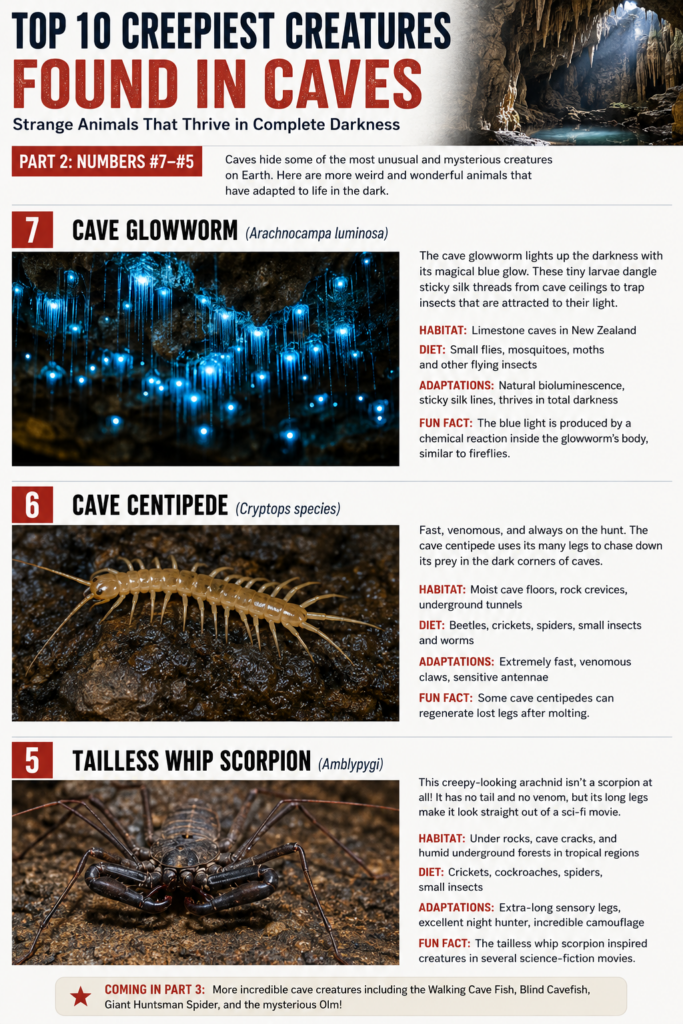
Number 7: Cave Glowworm
The cave glowworm is one of the most mesmerizing creatures found underground. Thousands of these tiny larvae cling to cave ceilings, creating brilliant blue lights that make the cave resemble a star-filled night sky. While the display is breathtaking, it hides a deadly secret.
Glowworms produce sticky silk threads that hang beneath them like fishing lines. The blue glow attracts flying insects, which become trapped in the sticky strands. Once an insect is caught, the glowworm pulls it upward and feeds on it.
Habitat
These glowworms are best known from limestone caves in New Zealand, where cool temperatures and high humidity provide ideal conditions.
Diet
- Small flies
- Mosquitoes
- Moths
- Other flying insects
Amazing Adaptations
- Natural bioluminescence
- Sticky silk hunting lines
- Ability to survive in total darkness
- Creates one of nature’s most spectacular cave displays
Fun Fact
The blue light is produced through a chemical reaction inside the glowworm’s body, similar to the light created by fireflies.
Number 6: Cave Centipede
Long, fast, and armed with venomous claws, the cave centipede is one of the most fearsome predators found underground. Although it usually measures only a few inches long, it can overpower prey much larger than itself.
Using its dozens of legs, it races across cave walls and rocky floors in search of insects, spiders, worms, and other small animals. Its powerful front claws inject venom that quickly immobilizes prey.
Habitat
Cave centipedes prefer moist cave floors, rock crevices, and underground tunnels with high humidity.
Diet
- Beetles
- Crickets
- Spiders
- Small cave insects
- Worms
Amazing Adaptations
- Extremely fast movement
- Venomous hunting claws
- Sensitive antennae
- Excellent navigation in darkness
Fun Fact
Some cave centipedes can regenerate damaged legs after molting.
Number 5: Tailless Whip Scorpion
Despite its frightening appearance, the tailless whip scorpion is harmless to humans. It has no venom and no stinger, yet it remains one of the most alien-looking animals on Earth.
Its first pair of legs has evolved into incredibly long sensory organs that constantly sweep the ground, allowing it to “feel” its surroundings in complete darkness. Once prey is located, it captures it using powerful, spiny pedipalps.
Habitat
These unusual arachnids hide beneath rocks, inside cave cracks, and in humid underground forests throughout tropical regions.
Diet
- Crickets
- Cockroaches
- Spiders
- Small insects
Amazing Adaptations
- Extremely long sensory legs
- Lightning-fast reflexes
- Excellent night hunter
- Incredible camouflage
Fun Fact
The tailless whip scorpion inspired creatures in several science-fiction and fantasy movies because of its unusual appearance.
Number 4: Cave Angel Fish


The Fish That Walks
Hidden inside remote caves in northern Thailand lives one of the world’s most extraordinary fish. Unlike ordinary fish, the cave angel fish can climb slippery rocks beneath underground waterfalls by using its fins almost like legs.
Scientists were amazed when they discovered this rare species because its walking motion resembles that of early land animals. Its powerful fins and unique skeletal structure allow it to move against rushing water—something very few fish can do.
Habitat
This remarkable species inhabits fast-flowing cave streams where sunlight never reaches. The water is cool, highly oxygenated, and flows over smooth limestone rocks.
Diet
- Tiny aquatic insects
- Insect larvae
- Small crustaceans
- Organic debris carried by cave streams
Amazing Adaptations
- Walks using its fins
- Strong pelvic bones
- Excellent grip on wet rocks
- Thrives in complete darkness
Fun Fact
The cave angel fish has become an important species for scientists studying how ancient fish may have first evolved to walk on land.
Number 3: Mexican Tetra


A Fish That Doesn’t Need Eyes
The blind cavefish is one of evolution’s most fascinating success stories. Living for thousands of years in total darkness, it gradually lost its eyesight because vision was no longer useful.
Instead, this fish developed an incredibly sensitive lateral line system that detects tiny movements and pressure changes in the water, allowing it to swim, hunt, and avoid obstacles with astonishing accuracy.
Habitat
Blind cavefish inhabit underground rivers and flooded cave systems in Mexico.
Diet
- Small crustaceans
- Aquatic insects
- Worms
- Organic matter
Amazing Adaptations
- No functional eyes
- Enhanced vibration sensing
- Exceptional navigation skills
- Efficient metabolism
Fun Fact
Blind cavefish are frequently studied by scientists to understand genetics, evolution, and eye development.
Number 2: Giant Huntsman Spider


One of the World’s Largest Spiders
With a leg span reaching nearly 30 centimeters (12 inches), the giant huntsman spider is among the largest spiders ever discovered. Unlike web-building spiders, it actively hunts its prey, using incredible speed and agility.
Its flattened body allows it to squeeze into narrow cracks inside caves before suddenly rushing out to capture insects and other small animals.
Habitat
Caves, rocky crevices, and forested limestone regions of Southeast Asia.
Diet
- Insects
- Cockroaches
- Small lizards
- Other spiders
Amazing Adaptations
- Huge leg span
- Lightning-fast movement
- Excellent camouflage
- Powerful hunting instincts
Fun Fact
Despite its intimidating appearance, giant huntsman spiders generally avoid humans and prefer to escape rather than attack.
Number 1: Olm


The King of Cave Creatures
The olm, often called the “baby dragon,” is perhaps the most mysterious cave animal on Earth. This ghostly white salamander spends its entire life in underground rivers beneath the mountains of Europe.
Without sunlight, the olm evolved translucent skin, tiny nonfunctional eyes hidden beneath its skin, and extraordinary senses of smell, hearing, and touch. It can detect the faintest vibrations in the water, helping it locate prey in complete darkness.
Perhaps most astonishing of all, an olm can survive for years without eating because its metabolism is incredibly slow. Some individuals are believed to live for more than 100 years, making them among the longest-lived amphibians on Earth.
Habitat
Underground limestone cave rivers and flooded caverns.
Diet
- Small crustaceans
- Snails
- Worms
- Aquatic insects
Amazing Adaptations
- Lives entirely underground
- Barely visible eyes
- External feathery gills
- Can survive years without food
- Exceptional lifespan
Fun Fact
Because of its dragon-like appearance, local legends once claimed that olms were the offspring of dragons hiding deep beneath the mountains.
Conclusion


The hidden world beneath our feet is home to some of the most extraordinary animals on Earth. Unlike creatures living on the surface, cave-dwelling species have evolved in complete darkness for thousands—or even millions—of years. As a result, many have lost their eyesight, developed pale or translucent skin, slowed their metabolism, and enhanced their senses of touch, smell, and vibration.
From the tiny Cave Beetle to the mysterious Olm, every animal on this list demonstrates the incredible power of evolution. These species remind us that some of the most fascinating wildlife exists in places humans rarely explore.
Many cave ecosystems are fragile and easily damaged by pollution, groundwater depletion, tourism, and climate change. Protecting these underground habitats is essential to ensuring these remarkable creatures survive for future generations.
Whether you’re fascinated by glowing insects, giant spiders, blind fish, or salamanders that can live for over a century, caves remain one of the last great frontiers of wildlife discovery.
Frequently Asked Questions (FAQ)
1. What is the creepiest creature found in caves?
Many scientists consider the Olm one of the creepiest because of its ghostly white skin, hidden eyes, and ability to survive years without food.
2. Why are cave animals white?
Most cave animals have lost their pigmentation because sunlight never reaches their habitat, making skin color unnecessary.
3. Why are many cave animals blind?
Eyes require energy to develop and maintain. In complete darkness, animals evolved to rely on other senses instead of vision.
4. Are cave creatures dangerous?
Most cave animals are harmless to humans. They are generally shy and prefer avoiding contact.
5. Which cave creature glows?
The Cave Glowworm creates beautiful blue bioluminescent light to attract insects.
6. What is the largest cave spider?
The Giant Huntsman Spider is among the largest spiders ever discovered.
7. Which fish can walk inside caves?
The Cave Angel Fish uses its fins to climb slippery cave rocks.
8. Where are most cave animals found?
Many are found in limestone cave systems across Europe, Asia, North America, Australia, and New Zealand.
9. Why do cave animals live so long?
Limited food, slow metabolism, and stable cave temperatures often contribute to longer lifespans.
10. Can humans visit these caves?
Some caves are open to visitors, but many containing rare species are protected to preserve their fragile ecosystems.
11. Which cave animal has the best senses?
The Mexican Tetra has an exceptionally sensitive lateral line system that detects tiny water movements.
12. Are new cave species still being discovered?
Yes. Scientists discover new cave-dwelling species every year, especially in unexplored cave systems.
13. What do cave creatures eat?
Their diets vary and may include insects, worms, crustaceans, fungi, bacteria, and decaying organic matter.
14. Why are caves important for biodiversity?
Caves shelter unique species found nowhere else and help scientists understand evolution and adaptation.
15. Which cave creature would survive the longest without food?
The Olm can survive for years without eating because of its extremely slow metabolism.
SEO Keywords
- Creepiest creatures found in caves
- Cave animals
- Underground creatures
- Blind cave animals
- Cave spider
- Cave beetle
- Glowworm cave
- Giant huntsman spider
- Olm salamander
- Blind cavefish
- Walking cave fish
- Cave wildlife
- Strange animals
- Underground ecosystems
- Mysterious cave creatures
Suggested Internal Links
If your website covers wildlife topics, link this article to:
- Top 10 Animals That Look Like Aliens
- Top 10 Most Venomous Creatures
- Top 10 Largest Birds Ever Discovered
- Top 10 Animals That Live the Longest
- Top 10 Tiny Animals That Are Extremely Dangerous
- Top 10 Loudest Animals on Earth
- Top 10 Animals That Survived Extinction
Final Call to Action
Have you ever explored a cave or encountered unusual wildlife? Which creature on this list surprised you the most?
Leave a comment below, share this article with fellow nature lovers, and subscribe for more fascinating wildlife countdowns featuring Earth’s rarest and most mysterious animals.