
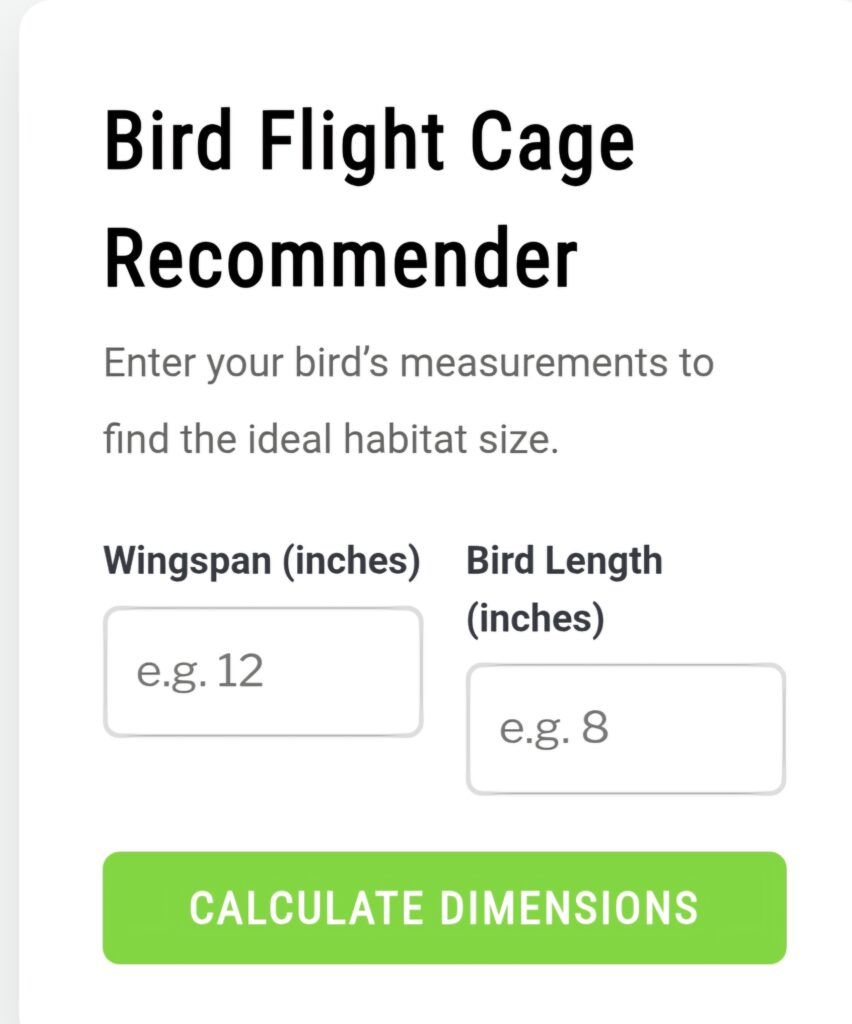
Bird Flight Cage Recommender
Enter your bird’s measurements to find the ideal habitat size.
This blog post is designed to be highly SEO-friendly, targeting keywords like “bird flight cage size,” “bird wingspan calculator,” and “avian health.”
Why Wingspan is the Secret to the Perfect Bird Cage
Finding the right cage for your feathered friend isn’t just about making sure they fit inside; it’s about ensuring they can thrive. Most first-time bird owners make the mistake of buying a cage based on the bird’s height. In reality, wingspan is the most critical metric for avian health.
In this guide, we’ll explore the science of “Flight-Ready” housing and why a few extra inches can add years to your bird’s life.
The Anatomy of a Flight Cage
Birds aren’t meant to sit; they are built for explosive movement. For a cage to be considered a true “flight cage,” it must allow for at least two to three full wing beats in a horizontal line.
- Width (Depth): Should be at least 1.5x the wingspan. This prevents feather fraying when the bird turns around or stretches.
- Length (Front): Should be 3x the wingspan. This is the “runway” where the bird gets its cardiovascular exercise.
- Height: While less critical for flight, it should be at least 3x the bird’s total length (head to tail) to accommodate perching and long tail feathers.
Image 1: The “Wingspan Rule” Visual
(Note: Use a clear infographic showing how wingspan dictates the rectangular shape of a cage, emphasizing horizontal space over vertical.)
Why Horizontal Space Beats Vertical Height
Many “tower” style cages look impressive but are actually inefficient for birds. Unless you own a climber like a parrotlet or a vertical jumper, most birds fly side-to-side.
SEO Tip: When searching for cages, always prioritize “Flight Cages” over “Decorative Cages.” Flight cages are wider than they are tall, providing the maximum “wing-beat” distance.
Top 5 Species and Their Ideal “Flight” Minimums
| Bird Species | Avg. Wingspan | Min. Cage Length | Min. Cage Width |
| Budgie (Parakeet) | 10–12″ | 30–36″ | 18″ |
| Cockatiel | 12–14″ | 36–42″ | 22″ |
| Green Cheek Conure | 10–12″ | 30–36″ | 20″ |
| African Grey | 24–28″ | 72″+ | 36″ |
| Lovebird | 9–10″ | 24–30″ | 18″ |
Image 2: A Happy Bird in a Flight Cage
(Caption: A bird with enough room to flap is a bird with a healthy heart.)
Frequently Asked Questions (FAQ)
Q: Can a cage be too big?
A: Generally, no. As long as the bar spacing is appropriate for your bird’s size (so they don’t get their head stuck), bigger is always better. However, a massive cage with poorly placed perches can be a fall risk for very young or senior birds.
Q: My bird spends all day out of the cage. Do I still need a flight cage?
A: Yes. Even if the cage is just for sleeping, your bird may need to stretch or flap during the night or early morning. A cramped cage can lead to “night frights” where the bird injures its wings against the bars.
Q: What is the best material for a flight cage?
A: Look for powder-coated steel or stainless steel. Avoid wooden cages (which can harbor bacteria and be chewed) and cheap plastic-coated wires that can flake off and be toxic if ingested.
Q: How do I measure my bird’s wingspan?
A: Wait for a moment when your bird is bathing or stretching. You can also gently hold your bird and extend one wing to measure from the center of the back to the tip, then double it. $Wingspan = 2 \times Single Wing Length$.
Final Thought: The Psychological Impact
A bird in a cage that is too small often develops “stereotypies”—repetitive, obsessive behaviors like bar-biting or feather-plucking. By choosing a cage based on the wingspan logic above, you aren’t just buying furniture; you’re providing a gym, a bedroom, and a sanctuary.
Is your cage large enough? Use our calculator above to find out!
Keywords: Bird cage requirements, flight cage dimensions, bird health, parrot wingspan, budgie housing tips.