
Top 3 Animals With Bone-Crushing Bites: Facts & FAQWordPress publishing details
SEO title: Top 3 Animals With Bone-Crushing Bites: Facts & FAQ
Meta description: Discover how jaguars, spotted hyenas, and saltwater crocodiles use powerful bites. Explore bite-force facts, wildlife photos, and answers to common questions.
Suggested slug: animals-with-bone-crushing-bites
Focus phrase: animals with bone-crushing bites
Article length: approximately 3,000 words, excluding photo credits and sources.
Copy the article HTML into a WordPress Custom HTML block. Use your post title field for the headline; remove the article’s H1 if your theme already displays it. Images load from Wikimedia online. For reliable publishing, upload the credited photos to your WordPress Media Library, replace the image URLs, and retain the credits and license links.Copy article HTML
Top 3 Animals With Bone-Crushing Bites: Nature’s Powerful Jaws
A jaguar closes its jaws around prey protected by a hard shell. A spotted hyena turns a discarded bone into food. A saltwater crocodile clamps down with a force that researchers can measure in thousands of pounds. Each moment looks like a display of brute strength, but there is much more happening behind the teeth.
Animals with bone-crushing bites combine muscular power with the right tools for their meals. Tooth shape, jaw proportions, body size, and feeding behavior all affect the result. A sharp tooth that punctures a shell performs a different job from a stout tooth that cracks a bone.
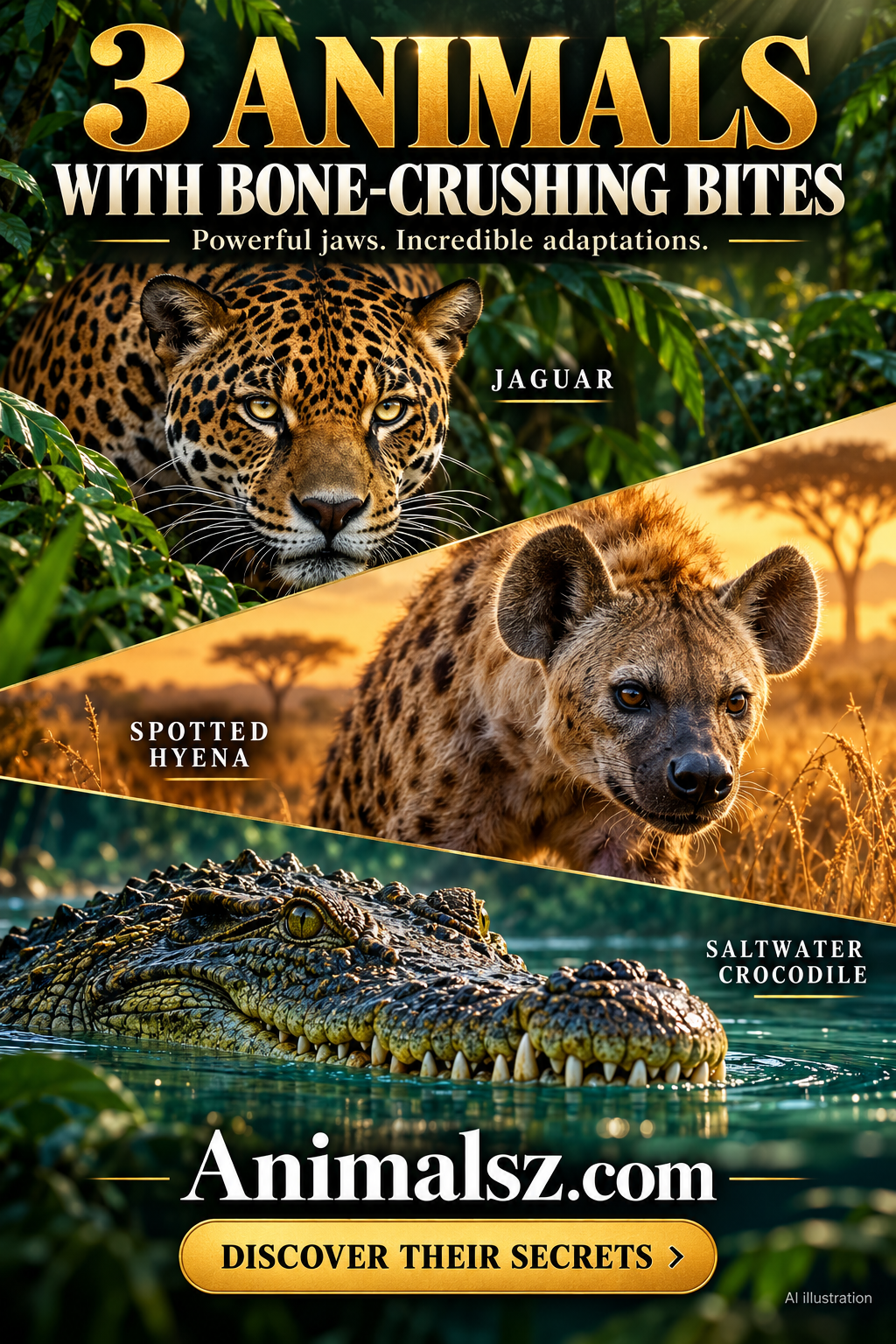
This countdown explores three remarkable examples: the jaguar, spotted hyena, and saltwater crocodile. You will discover how their bites work, why they matter, and what those dramatic bite-force numbers actually mean.
A note about the ranking: These are three standout animals selected for their fascinating feeding adaptations. The countdown is editorial, not a scientifically established ranking of the world’s three strongest bites. Comparing every animal would require consistent measurements that simply are not available for all species.
The real question is more interesting than “Who wins?” It is this: how does each animal use its jaws to solve the daily problem of finding enough food?
Quick Comparison: Three Powerful Bites, Three Different Strengths
| Countdown | Animal | What makes its bite remarkable | How to interpret the evidence |
|---|---|---|---|
| 3 | Jaguar | A powerful, penetrating bite used against hard structures such as skulls and turtle shells | Feeding ability does not provide one universal PSI value |
| 2 | Spotted hyena | Specialized teeth and jaws for processing bone | Bone-crushing specialization differs from an absolute force record |
| 1 | Saltwater crocodile | An exceptionally powerful jaw closure | A 2012 study recorded 16,414 newtons in one individual |
The crocodile measurement equals approximately 3,689 pounds-force, often rounded to 3,700. It is a measured result from one animal, not a number that applies to every crocodile. [1]
What Makes an Animal’s Bite So Powerful?
Before meeting the animals, separate three ideas that often become tangled together: force, pressure, and the ability to break something.
Bite force is the push generated by the closing jaws. Scientists commonly express it in newtons. Pounds-force is another unit. A bigger force means a stronger push, but the outcome still depends on where and how that push is applied.
Pressure describes force spread over an area. PSI means pounds per square inch. A pointed tooth concentrates a load onto a small contact area. Imagine pressing a pencil eraser against modeling clay and then pressing its sharpened tip with the same effort. The tip leaves a very different impression.
That example explains why it is incorrect to change “3,700 pounds of force” into “3,700 PSI.” You would need information about contact area to calculate pressure. Teeth also contact irregular surfaces, so the situation is more complicated than a flat object pressing against a flat board.
Breaking bone is a material problem, too. The target’s thickness, shape, condition, and support all matter. A thin section can fail differently from a thick section. Puncturing a surface, crushing it, and bending it until it breaks are not interchangeable actions.
Jaw position adds another complication. Think about a pair of pliers: where an object sits between the handles’ pivot and the tips changes the mechanical situation. In animal research, the tooth position used for a bite test matters for the same broad reason. The published crocodilian study distinguishes bites at different positions. [1]
Finally, distinguish a direct test from a model. Researchers may record force with equipment or estimate performance from anatomy. Both approaches can inform us, but an estimate should not quietly become a “measured record.” Good wildlife storytelling preserves that distinction without losing the excitement.
3. Jaguar: A Powerful Bite Built for Penetration

The jaguar, Panthera onca, makes an immediate impression with its broad face and compact, muscular build. Look past the beautiful coat and the head becomes the most interesting part of the picture: this is a predator with substantial machinery behind its bite.
San Diego Zoo describes how large jaw muscles and sharp teeth allow jaguars to pierce prey skulls and exploit hard-shelled reptiles. That makes the jaguar a compelling example of a penetrating bite. Its ability to tackle turtles and tortoises is more informative than an unsupported number copied from a social-media graphic. [2]
Can a jaguar really bite through a turtle shell?
Yes. Conservation organization Panthera also documents shell-biting behavior, including sea turtles in some regions. However, this does not mean every jaguar can casually crush every shell it encounters. Species, size, bite placement, and circumstances affect what happens. [3]
It helps to picture the challenge from the predator’s perspective. Soft tissue offers one kind of access problem; a protective shell offers another. A successful bite must apply force in a useful place. Simply opening a huge mouth is not enough. The teeth must engage the target effectively.
That is why a close view of a jaguar’s jaws tells only part of the story. The important moment is the interaction between teeth and food. A dramatic photograph can show anatomy, but it cannot prove a precise force value or explain every feeding event.
A hunter shaped by its surroundings
Jaguars occupy varied Latin American habitats, including forests, wetlands, and scrublands. Panthera’s conservation work emphasizes the importance of connected landscapes rather than isolated patches of habitat. These cats need space in which to move, find prey, and reproduce. [4]
Water is particularly relevant to their story. Jaguars are capable swimmers, and their diet can include animals associated with rivers and wetlands. Seeing one beside a river is therefore more than a picturesque scene: the setting helps explain the opportunities available to the hunter. [2]
What to notice in a jaguar photograph
Study the width of the head, the jawline, and the animal’s sturdy proportions. Then look at the coat. The rosettes often contain interior spots, a useful visual clue when distinguishing a jaguar from a leopard. [4]
The memorable fact is not that the jaguar is an unbeatable biting machine. It is that a large cat can use a forceful, well-placed bite against protective structures that appear to offer a formidable defense.
2. Spotted Hyena: The Bone-Processing Specialist

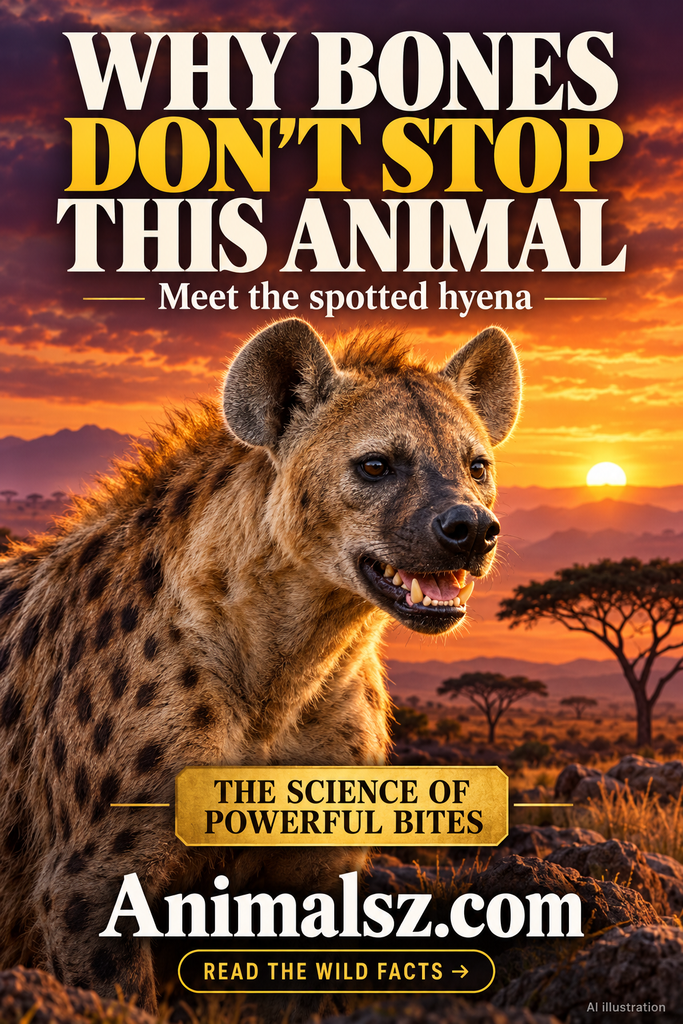
The spotted hyena, Crocuta crocuta, belongs in any discussion of animals that crush bones. While the jaguar illustrates penetration, the hyena shows how hard food can become a regular resource.
San Diego Zoo describes spotted hyenas consuming parts of prey that many other predators leave behind, including bone. Their powerful jaws help them break these materials down, while their digestive system can handle a remarkable range of animal tissues. [5]
This changes the meaning of leftovers. To one animal, a mostly stripped bone may have little remaining value. To an animal equipped to process it, the same object still represents an opportunity. Feeding success depends partly on being able to use food that competitors cannot exploit as easily.
The teeth matter as much as the muscles
Field researchers from Michigan State University’s Holekamp Lab describe hyenas positioning bones to one side of the mouth before biting down. They also explain how wear on the premolars can reveal aspects of an individual’s feeding history. [6]
That detail is worth pausing over. The familiar image of a carnivore usually emphasizes long canine teeth. Yet a hyena’s bone-processing story also involves the teeth farther back. Looking only at the fangs misses much of the equipment doing the work.
The researchers’ observations suggest another useful point for viewers: watch the placement of food, not just the opening and closing of the jaw. Repositioning a bone is meaningful behavior. An animal is handling an object with a particular shape, seeking a workable grip and applying force through its teeth.
More than the laughing scavenger stereotype
Spotted hyenas hunt as well as scavenge. Their lives also involve complex social relationships. Holekamp Lab research has explored abilities such as recognizing relationships among other group members in coalition contexts. [7]
These findings make the hyena more interesting than the familiar cartoon version. A powerful mouth is one part of an animal that also has to navigate competition, relationships, and access to food. Understanding its behavior requires watching the whole animal within its group.
Imagine two ways to describe the same feeding scene. One says, “A scary animal destroys a bone.” The other asks how the animal holds it, which teeth it uses, and what it gains from the effort. The second description gives us something to learn, while remaining just as memorable.
The spotted hyena earns its place here because bone processing is central to the story. It demonstrates that the most revealing question is sometimes “What can this animal eat?” rather than “What is its biggest number?”
1. Saltwater Crocodile: A Remarkable Measured Bite

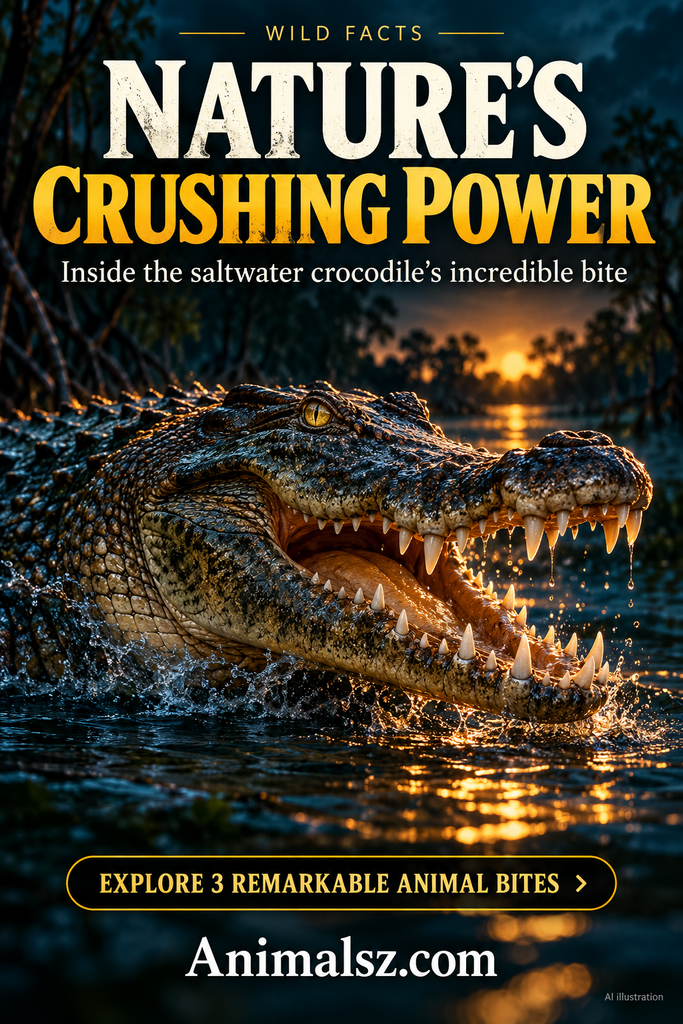
The saltwater crocodile, Crocodylus porosus, provides the clearest numerical example in this countdown. In a landmark 2012 study, researchers recorded a bite force of 16,414 newtons from one individual. That is the source of the familiar figure of roughly 3,700 pounds-force. [1]
Guinness World Records identifies the tested animal as approximately 4.59 meters long and specifies that this was a molariform bite measurement, taken at the rear tooth region. Those details matter: the measurement belongs to a particular animal and a particular testing arrangement. [8]
Why the number needs its context
Suppose someone tells you that a vehicle reached a certain speed. You would want to know which vehicle, under what conditions, and whether the result was measured or predicted. Bite-force claims deserve the same questions.
A single result cannot establish the force of every member of a species. It also should not be treated as a hard biological ceiling. An individual record tells us what happened in that test; it does not show what every possible individual could do.
The most defensible caption is therefore straightforward: “A tested saltwater crocodile produced about 3,700 pounds of bite force.” That sentence is dramatic enough without converting the units incorrectly or claiming that every saltwater crocodile delivers an identical bite.
A predator equipped for water
The Australian Museum describes a broad-snouted, heavily built reptile with eyes and nostrils positioned on top of its head. These features help explain its recognizable outline when much of the body is submerged. The museum also notes that the species occurs in freshwater as well as coastal environments. [9]
Its name can therefore mislead people who picture it living only in the sea. A saltwater crocodile may inhabit rivers, wetlands, and estuaries. The habitat surrounding a photograph is useful context, but the presence of fresh water does not rule out the species.
Does it chew like a hyena?
No. Crocodilian feeding is not the same as mammalian chewing. The Australian Museum describes food being manipulated into position for swallowing; larger items can require additional handling. [9]
This difference makes the comparison more interesting. The hyena’s story centers on processing hard food with specialized teeth. The crocodile’s story emphasizes an extraordinarily forceful grip within a different feeding system. Both involve powerful jaws, but watching them as if they were doing exactly the same job would hide the most useful details.
How to Read an Animal Bite-Force Claim
The next time a wildlife post presents a dramatic number, use five questions to decide what that number actually tells you.
- Which species is named? “Crocodile” or “big cat” is less informative than an exact species. Broad labels can conceal very different animals.
- What unit is used? Newtons and pounds-force describe force. PSI describes pressure. A chart that mixes them cannot support a simple ranking.
- Was it measured or estimated? Look for a study, testing description, or clear explanation of the model.
- Which individual and tooth position were involved? Size and testing setup provide essential context.
- What conclusion is being drawn? A force measurement does not automatically establish superior hunting skill, more dangerous behavior, or the ability to break every object.
These questions do not drain the excitement from wildlife. They replace a vague superlative with a real discovery. “This animal is unbelievably strong” soon becomes forgettable. “Researchers measured this force here, using this method” gives a reader something concrete to remember.
One useful reading habit is to follow the number back to its earliest reliable source. Does the source actually describe the same species and the same unit? Does the headline match the experiment? If an article provides no method, no reference, and no explanation, treat the figure as an unanswered question. You can still enjoy the photograph while withholding judgment about its caption. Curiosity works best when a striking claim becomes an invitation to investigate rather than a reason to stop asking questions.
Be equally careful with photographs and short clips. An open mouth shows teeth; it does not measure force. A video of something breaking demonstrates that particular event, but may omit the object’s condition or the sequence leading up to it. Strong evidence and strong visuals complement each other when their roles remain clear.
Why These Animals Deserve More Than a Fearsome Reputation
A powerful bite can attract attention, but it should be the beginning of curiosity. Once we notice the teeth, we can ask about habitat, food, behavior, and the pressures that shaped the animal’s way of life.
For jaguars, conservation organizations emphasize habitat protection and coexistence with people. Panthera works with communities and ranchers across the species’ range, linking the survival of the cat to practical decisions about landscapes and livestock. [4]
Hyena research offers a different reminder: an animal often reduced to a comic villain has a complicated social life worth studying. Crocodiles offer another: a species can look almost motionless in a photograph while possessing remarkable anatomical and behavioral adaptations.
There is no need to exaggerate these animals to make them fascinating. Their actual capabilities already invite wonder. Respectful observation, accurate captions, and well-supported explanations let their biology remain the center of attention.
Frequently Asked Questions About Bone-Crushing Bites
Which animal has the strongest bite in this countdown?
The saltwater crocodile provides the highest directly measured force discussed here: 16,414 newtons in the cited 2012 experiment. This article does not establish a complete ranking of all living animals. It compares three notable feeding adaptations and keeps the numerical claim tied to its documented test. [1]
Is 3,700 pounds of bite force the same as 3,700 PSI?
No. Pounds-force describes force, while PSI means pounds-force per square inch. Pressure depends on contact area. Replacing one unit with the other changes the meaning of the claim. Without an appropriate area measurement, you cannot convert a force figure into a pressure figure.
Can jaguars bite through turtle shells?
Yes, jaguars can penetrate turtle shells, as described by zoological and conservation sources. This ability should not be presented as a guarantee for every turtle or every encounter. The animals involved, the structure being bitten, and the placement of the bite all affect the outcome. [2],[3]
Why do spotted hyenas eat bones?
Bones can remain useful food after much of a carcass has been consumed. Spotted hyenas possess the feeding equipment to process them and can digest materials that many other predators leave behind. Their bone-eating ability expands what they can obtain from an animal meal. [5]
Are hyenas only scavengers?
No. Spotted hyenas both hunt and scavenge. Calling them only scavengers misses an important part of their feeding behavior. It is more accurate to describe them as adaptable carnivores that can acquire food in different ways and process a wide range of animal material. [5]
Do all hyenas have the same bone-crushing adaptations?
No. This article specifically discusses the spotted hyena. The hyena family contains species with different feeding habits, including the insect-eating aardwolf. A claim about one member of a family should not automatically be extended to every relative. Scientific names help keep those distinctions clear. [10]
Why does the location of a bite matter?
Teeth occupy different positions relative to the jaw joint. That affects mechanical advantage, while different tooth shapes change how force meets the target. For this reason, a force recorded at one tooth position should not be casually treated as a measurement at every point along the mouth.
Does a stronger bite make an animal a better hunter?
Not by itself. Hunting is a sequence: locating food, approaching it, making contact, and successfully feeding. A force measurement describes only one aspect of that process. Without examining behavior and circumstances, there is no sound basis for turning a bite-force chart into a universal hunting leaderboard.
Can scientists compare extinct animals with living animals?
They can make informed comparisons, but extinct animals cannot bite a measuring device. Their performance must be inferred from preserved anatomy and analytical models. When reading a comparison, keep reconstructed estimates separate from direct measurements. Both can be valuable, provided their uncertainty and methods are explained.
Can an animal’s teeth be damaged by hard food?
Powerful feeding equipment is not indestructible. Holekamp Lab researchers describe substantial wear in hyena premolars and use dental condition to investigate aspects of an animal’s life. This reminds us that teeth are working structures that experience repeated use, not permanent tools immune to wear. [6]
Do saltwater crocodiles live only in salt water?
No. Despite the common name, saltwater crocodiles also use freshwater habitats. The species is also called the estuarine crocodile. Its name describes an ability and an association with coastal environments, rather than a rule that confines it exclusively to seawater. [9]
What should I remember about these three animals?
Remember three different strengths: the jaguar’s penetrating bite, the spotted hyena’s bone-processing equipment, and the saltwater crocodile’s extraordinary measured force. Those distinctions explain more than a list of unsupported PSI figures. Each animal shows a different way that powerful jaws can help a predator feed.
Which surprised you most: a shell-piercing cat, a bone-eating hyena, or a crocodile with a measured bite of thousands of pounds-force? Share your choice and explore more wildlife stories at Animalsz.com.
Sources and Further Reading
- Erickson and colleagues, 2012: Bite-force and tooth-pressure experiments in crocodilians, PLOS ONE.
- San Diego Zoo Wildlife Alliance: Jaguar.
- Panthera: Jaguars of the Pantanal.
- Panthera: Jaguar conservation and natural history.
- San Diego Zoo Wildlife Alliance: Spotted hyena.
- Holekamp Lab: Field notes on hyena teeth and bone processing.
- Holekamp Lab: Spotted hyena cognition research.
- Guinness World Records: Strongest molariform bite force for a crocodile.
- Australian Museum: Estuarine crocodile.
- University of Michigan, Animal Diversity Web: Hyaenidae.