
Top 10 Animals That Can Survive Without Oxygen
Meta Description: Discover the top 10 animals that can survive without oxygen. Learn how these remarkable creatures thrive in oxygen-poor environments, from frozen lakes to deep-sea habitats, with fascinating facts and scientific insights.
Suggested URL Slug:top-10-animals-that-can-survive-without-oxygen
Table of Contents
- Introduction
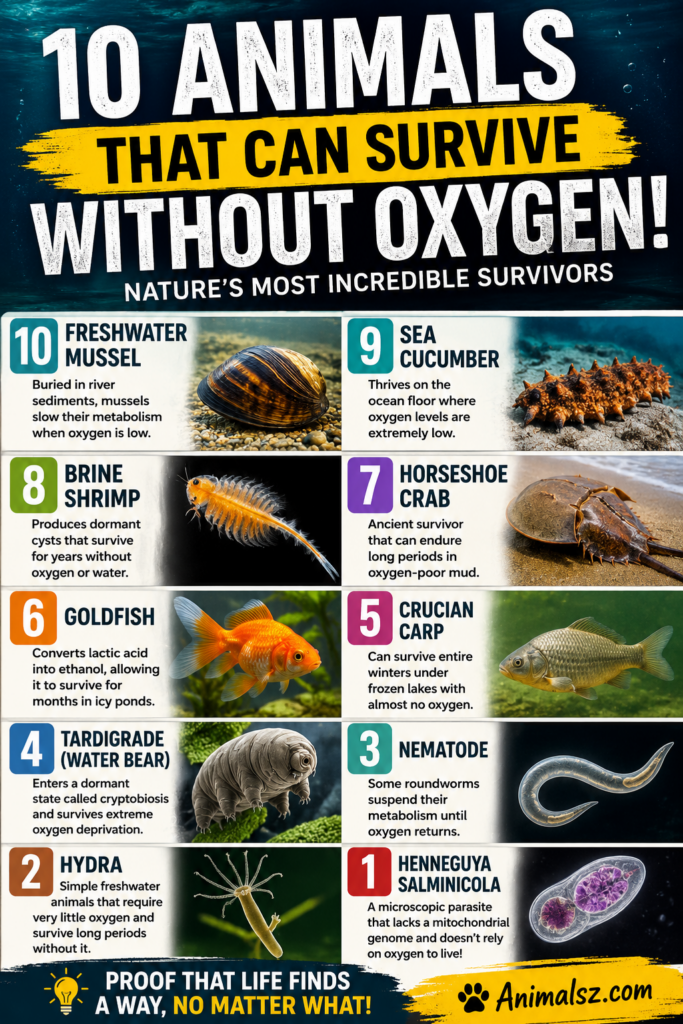
- Number 10. Freshwater Mussel
- Number 9. Sea Cucumber
- Number 8. Brine Shrimp
Introduction
Life on Earth depends heavily on oxygen. Every breath we take fuels billions of cells that keep our bodies functioning. Most animals rely on oxygen to generate energy, move, hunt, grow, and reproduce. Without it, survival seems impossible. However, nature is full of incredible surprises.
Scientists have discovered several remarkable animals that can survive for days, months, or even their entire lives with little or no oxygen. Some accomplish this by dramatically slowing their metabolism, almost pressing a biological “pause button.” Others enter a dormant state that protects their bodies until oxygen returns. One microscopic parasite has even evolved without the genetic machinery normally required for oxygen-based respiration, rewriting what scientists thought they knew about animal life.
These extraordinary adaptations help animals survive in environments that would quickly kill most living creatures. Frozen lakes, muddy riverbeds, deep-sea sediments, underground burrows, and even the muscles of other animals all contain habitats where oxygen levels can become dangerously low.
Studying these animals does more than satisfy curiosity. Researchers hope these unique survival mechanisms could someday help improve organ preservation, treat oxygen deprivation in medicine, and deepen our understanding of how life might survive on other planets.
Let’s begin our countdown of the ten most fascinating animals that have mastered life with little—or in one remarkable case, seemingly no—oxygen.
Number 10. Freshwater Mussel


Freshwater mussels are among the quietest yet most important animals living in rivers, streams, and lakes around the world. At first glance, they appear simple, spending nearly their entire lives buried beneath sand, gravel, and mud. Yet beneath this peaceful exterior lies an extraordinary survival strategy.
River bottoms often become oxygen-poor during warm weather or when large amounts of organic material begin decomposing. While many aquatic animals struggle under these conditions, freshwater mussels respond by dramatically slowing nearly every function inside their bodies.
Their heartbeat decreases, movement almost completely stops, and energy consumption drops to an absolute minimum. This allows them to survive until oxygen-rich water begins flowing again.
Freshwater mussels are also nature’s water filters. Each mussel continuously pumps water through its body, removing algae, bacteria, and tiny suspended particles. A healthy mussel population can filter thousands of gallons of water every day, improving water quality for fish, insects, and countless other aquatic species.
Unfortunately, freshwater mussels are among the world’s most endangered animals. Pollution, dam construction, habitat destruction, and invasive species have caused many populations to decline rapidly.
Protecting these remarkable creatures benefits entire freshwater ecosystems. Their ability to tolerate temporary oxygen shortages makes them one of nature’s most resilient underwater survivors.
Interesting Facts
- Some freshwater mussels live for over 100 years.
- They can filter dozens of liters of water every day.
- Over 900 species exist worldwide.
- Many species rely on fish to help disperse their larvae.
- Healthy mussel populations indicate clean water.
Number 9. Sea Cucumber


Sea cucumbers may not look impressive, but these soft-bodied marine animals are among the ocean’s greatest survival specialists. Found from shallow coral reefs to the deepest ocean trenches, they often inhabit environments where oxygen levels are extremely low.
The deep sea is a harsh place. Sunlight never reaches these depths, food is scarce, temperatures remain near freezing, and oxygen concentrations can vary dramatically. To survive, sea cucumbers have evolved an incredibly efficient lifestyle.
Instead of constantly swimming or hunting, they move slowly across the seafloor, feeding on organic material buried within the sediment. Their low-energy lifestyle naturally reduces oxygen requirements.
When oxygen becomes scarce, sea cucumbers slow their metabolism even further. They conserve energy by reducing activity until conditions improve. This remarkable flexibility allows them to survive where many larger marine animals cannot.
Sea cucumbers also serve as the ocean’s cleanup crew. By digesting sediment, they recycle nutrients that support countless marine organisms. Without them, the health of many deep-sea ecosystems would suffer dramatically.
Some species possess another astonishing defense mechanism. When threatened by predators, they can eject parts of their internal organs through their anus. After escaping danger, they regenerate the lost organs over the following weeks.
Interesting Facts
- More than 1,700 species have been identified.
- Some live over 9,000 meters beneath the ocean surface.
- They recycle nutrients essential for healthy oceans.
- Certain species regenerate expelled organs.
- They help keep the seafloor clean and healthy.
Number 8. Brine Shrimp


Brine shrimp are tiny crustaceans famous around the world for one incredible reason—their eggs can survive some of the harshest environmental conditions found anywhere on Earth.
These shrimp live in extremely salty lakes where few other animals can survive. Salt concentrations often become several times higher than ocean water, and oxygen levels can fluctuate dramatically.
When conditions become unfavorable, female brine shrimp produce dormant eggs known as cysts instead of immediately hatching young. These microscopic capsules enter a suspended state where metabolism nearly stops.
Inside this dormant shell, the developing embryo can survive years without oxygen, water, or food. Scientists have successfully hatched brine shrimp cysts after many years of storage once favorable conditions returned.
This extraordinary survival strategy allows the species to outlast droughts, freezing temperatures, intense heat, and oxygen deprivation.
Because of their resilience, brine shrimp are widely used in scientific research, aquaculture, and aquarium industries. Newly hatched shrimp provide highly nutritious food for young fish, while researchers continue studying their remarkable ability to survive extreme environmental stress.
Brine shrimp demonstrate that sometimes the greatest survival strategy is simply waiting patiently until the environment becomes suitable again.
Interesting Facts
- Dormant cysts can remain viable for years.
- They thrive in lakes much saltier than the ocean.
- Often sold as “Sea-Monkeys.”
- Widely used in biological research.
- Their eggs survive freezing, drying, and oxygen deprivation.
Number 7. Horseshoe Crab


Horseshoe crabs are among the oldest living animals on Earth, earning the nickname “living fossils.” They first appeared more than 450 million years ago, long before dinosaurs walked the planet. Despite massive changes in Earth’s climate and ecosystems, these remarkable creatures have survived multiple mass extinctions.
Although they are called crabs, horseshoe crabs are actually more closely related to spiders and scorpions. Their hard, horseshoe-shaped shell protects them while they crawl across shallow coastal waters and sandy beaches in search of worms, clams, and other small prey.
One reason for their incredible longevity is their ability to tolerate environments with very little oxygen. During low tide, horseshoe crabs often bury themselves in soft coastal mud. Beneath the surface, oxygen levels can become extremely low, especially during warm weather.
Instead of panicking, horseshoe crabs dramatically slow their metabolism. Their bodies require less oxygen, allowing them to remain buried for many hours until tides return and fresh, oxygen-rich seawater flows back over them.
Another fascinating feature is their bright blue blood. Unlike humans, whose blood carries oxygen using iron-rich hemoglobin, horseshoe crabs use copper-based hemocyanin, which turns their blood blue. Even more remarkable, their blood contains specialized cells that instantly detect harmful bacteria. Scientists use this property to test vaccines, intravenous medicines, and medical equipment for contamination, helping protect millions of patients every year.
Despite their resilience, horseshoe crab populations face growing threats from habitat loss, pollution, and overharvesting. Conservation programs around the world are working to protect these ancient survivors.
Interesting Facts
- Over 450 million years old as a species.
- More closely related to spiders than true crabs.
- Possess bright blue blood.
- Blood is used to test the safety of medical products.
- Can tolerate long periods buried in oxygen-poor mud.
Number 6. Goldfish


Most people know goldfish as colorful aquarium pets, but few realize they possess one of the most extraordinary survival abilities found in any vertebrate.
During cold northern winters, ponds and small lakes often freeze over completely. Thick ice prevents fresh oxygen from entering the water while plants stop producing oxygen through photosynthesis. As winter continues, oxygen levels gradually fall until almost none remains.
Most fish would suffocate under these conditions.
Goldfish, however, have evolved an astonishing solution. Instead of allowing harmful lactic acid to build up inside their muscles, they convert it into ethanol, or alcohol. The ethanol then diffuses harmlessly through their gills into the surrounding water.
This remarkable biochemical pathway allows goldfish to continue producing energy without oxygen for extended periods. Scientists have observed goldfish surviving several months beneath frozen ponds where oxygen levels were nearly zero.
When spring arrives and the ice melts, oxygen returns to the water. Goldfish quickly switch back to normal oxygen-based respiration as if nothing happened.
Researchers continue studying this unusual adaptation because it may help scientists better understand how organs survive oxygen deprivation and how new medical treatments could protect tissues during strokes or heart attacks.
Goldfish prove that even one of the world’s most familiar pets possesses extraordinary biological secrets.
Interesting Facts
- Produce ethanol instead of dangerous lactic acid.
- Can survive several months beneath frozen ice.
- Native to East Asia.
- Domesticated for over 1,000 years.
- Share this adaptation with crucian carp.
Number 5. Crucian Carp


If there were an Olympic champion for surviving without oxygen, the crucian carp would almost certainly win among vertebrate animals.
Native to northern Europe and Asia, this hardy freshwater fish lives in ponds and lakes that freeze completely during winter. Once thick ice covers the water, oxygen levels steadily decline as plants stop growing and decomposing organisms continue consuming oxygen.
Many lakes eventually become almost completely oxygen-free.
Instead of dying, crucian carp rely on one of nature’s most remarkable metabolic adaptations. Like goldfish, they convert lactic acid into ethanol. This prevents acid from accumulating inside their bodies while allowing their cells to continue generating small amounts of energy.
At the same time, crucian carp reduce their heart rate, swimming activity, and overall metabolism. They conserve every possible unit of energy while patiently waiting beneath the frozen surface.
Scientists have documented crucian carp surviving entire winters—sometimes lasting several months—in nearly oxygen-free water.
This extraordinary ability has made crucian carp an important model for medical research. Understanding how their brains and organs survive prolonged oxygen deprivation may one day lead to better treatments for strokes, cardiac arrest, and traumatic injuries in humans.
The crucian carp reminds us that survival isn’t always about strength or speed. Sometimes, success comes from slowing down, conserving energy, and adapting to even the harshest environments.
Interesting Facts
- One of the most oxygen-tolerant fish on Earth.
- Can survive entire winters beneath frozen lakes.
- Produces ethanol during oxygen shortages.
- Native throughout northern Europe and Asia.
- Frequently studied by medical researchers.
Number 4. Tardigrade (Water Bear)


Tardigrades, commonly known as water bears or moss piglets, are among the toughest animals ever discovered. Although they measure less than one millimeter in length, these microscopic creatures have become famous for surviving conditions that would instantly kill almost every other form of life.
Tardigrades live almost everywhere on Earth, from mountain peaks and deserts to rainforests, deep oceans, and even the icy landscapes of Antarctica. They require a thin layer of water to remain active, but when their environment dries out or oxygen disappears, they activate an incredible survival mechanism called cryptobiosis.
During cryptobiosis, a tardigrade curls into a tiny barrel-shaped form called a tun. Its metabolism slows to nearly undetectable levels—less than 0.01% of its normal activity. Water leaves its body, protective molecules stabilize its cells, and biological activity almost completely stops.
While in this dormant state, tardigrades can survive extended periods with virtually no oxygen. Once moisture and oxygen return, they absorb water, reactivate their metabolism, and continue living as though nothing happened.
Their extraordinary resilience doesn’t stop there. Tardigrades have survived freezing temperatures near absolute zero, heat above 150°C (302°F), extreme radiation, crushing pressure at the bottom of the ocean, and even direct exposure to outer space.
Scientists study tardigrades to understand how cells survive extreme stress. Their protective proteins could someday help preserve vaccines, organs for transplantation, and even human cells during long-duration space missions.
Interesting Facts
- More than 1,300 known species.
- Can survive years in a dormant state.
- Have survived exposure to outer space.
- Resistant to extreme temperatures and radiation.
- Enter cryptobiosis when oxygen or water disappears.
Number 3. Nematode (Roundworm)


Nematodes, also called roundworms, are among the most abundant animals on Earth. Scientists estimate that billions of nematodes live beneath every acre of healthy soil, while countless others inhabit freshwater, oceans, plants, and animals.
Although many species are microscopic, their survival abilities are enormous.
Certain nematodes can survive environments completely lacking oxygen by entering a state known as suspended animation. Rather than continuing normal biological activity, they almost entirely shut down their metabolism, reducing energy consumption to the lowest possible level.
Inside oxygen-free mud, wetlands, or underground environments, this strategy allows them to survive until favorable conditions return. Once oxygen becomes available again, the worms gradually restart their metabolism and resume feeding, growing, and reproducing.
Some nematodes are also famous for surviving incredibly long periods in frozen soil. Researchers have revived ancient nematodes trapped in Arctic permafrost after tens of thousands of years, demonstrating the incredible durability of these tiny animals.
Because of their simple anatomy and genetic similarities to more complex organisms, nematodes are among the most important laboratory animals in biology. The species Caenorhabditis elegans has helped scientists discover genes involved in aging, development, programmed cell death, and disease.
Despite their tiny size, nematodes continue providing enormous insights into medicine and evolution.
Interesting Facts
- Millions of species may exist worldwide.
- Found in nearly every ecosystem.
- Some survive prolonged oxygen deprivation.
- Important model organisms for biological research.
- Certain species have survived thousands of years in frozen ground.
Number 2. Hydra


Hydras are tiny freshwater animals that belong to the same group as jellyfish and sea anemones. Although they usually measure only a few millimeters long, these fascinating creatures possess remarkable survival abilities that have intrigued scientists for generations.
Hydras attach themselves to underwater plants, rocks, and other surfaces using a sticky base. Their tentacles contain specialized stinging cells used to capture tiny aquatic prey such as water fleas and insect larvae.
Unlike many larger animals, hydras require very little oxygen because their bodies are extremely simple. They have no lungs, heart, or circulatory system. Oxygen moves directly into their cells through diffusion, making their overall oxygen demand incredibly low.
When oxygen levels decrease significantly, hydras reduce their activity and metabolism, allowing them to survive conditions that would be fatal for many aquatic organisms.
Hydras are perhaps even more famous for another extraordinary ability—their remarkable regeneration. If a hydra is cut into several pieces, each piece can often regenerate into a complete new individual. Some scientists believe hydras show very little biological aging under ideal laboratory conditions, making them valuable for aging research.
Today, researchers continue studying hydras to better understand tissue regeneration, stem cells, longevity, and cellular repair mechanisms.
Although tiny and often overlooked, hydras remain one of freshwater’s most fascinating survivors.
Interesting Facts
- Can regenerate an entire body from small pieces.
- Belong to the same animal group as jellyfish.
- Require very little oxygen.
- Show little evidence of aging under ideal conditions.
- Widely used in regeneration research.
Number 1. Henneguya salminicola


Taking the number one spot is one of the most extraordinary animals ever discovered—Henneguya salminicola. This microscopic parasite completely changed scientists’ understanding of how animals survive.
Discovered living inside the muscle tissue of salmon and other fish, Henneguya salminicola belongs to a group of tiny parasites related to jellyfish and corals. For many years, scientists assumed it functioned like every other animal. However, detailed genetic research revealed something astonishing.
Unlike all previously known animals, Henneguya salminicola lacks a mitochondrial genome. Mitochondria are often called the “powerhouses” of cells because they produce energy using oxygen. Nearly every multicellular animal relies on mitochondria for aerobic respiration, making oxygen essential for survival.
Without these genes, researchers believe this parasite has evolved an entirely different way to obtain energy while living inside its fish host. Although scientists are still investigating its exact metabolism, it appears to survive without using oxygen in the conventional way.
This remarkable discovery overturned one of biology’s oldest assumptions—that every animal requires oxygen to live.
The parasite’s oxygen-free lifestyle is possible because it lives inside another organism where nutrients are constantly available. Rather than spending energy searching for food or escaping predators, it has evolved into an extremely specialized organism that depends entirely on its host.
Researchers believe studying Henneguya salminicola could help explain how life adapts to extreme environments and may even provide clues about how simple animal life could exist on planets or moons with little oxygen.
Although invisible to the naked eye, this tiny parasite represents one of the greatest discoveries in modern zoology.
Interesting Facts
- Lives inside salmon muscle tissue.
- Related to jellyfish and corals.
- Lacks a mitochondrial genome.
- Appears not to rely on oxygen-based respiration.
- Changed scientists’ understanding of animal evolution.
Final Thoughts
Nature continually reminds us that life is far more adaptable than we once imagined. From freshwater mussels buried beneath river mud to microscopic parasites living inside fish, these incredible animals have evolved remarkable strategies to survive when oxygen becomes scarce—or even absent.
Some species slow their metabolism until conditions improve. Others enter a dormant state that allows them to pause life for months or even years. Fish like the goldfish and crucian carp have developed unique biochemical pathways that prevent their bodies from being damaged during oxygen shortages. Meanwhile, tardigrades, nematodes, and hydras demonstrate how even the smallest animals can survive some of the harshest conditions on Earth.
Perhaps the most astonishing discovery is Henneguya salminicola, the only known multicellular animal that appears to have abandoned traditional oxygen-based respiration altogether. Its existence reminds us that evolution continues to surprise scientists and challenge long-held assumptions.
Studying these extraordinary animals has practical benefits as well. Their survival strategies may one day help improve organ transplantation, protect human tissues during strokes or heart attacks, develop new medicines, and even prepare future astronauts for long-duration space missions.
As researchers continue exploring Earth’s deepest oceans, underground ecosystems, and microscopic world, there is little doubt that even more incredible oxygen-defying creatures remain waiting to be discovered.
Nature’s greatest survivors prove that life always finds a way.
Frequently Asked Questions (FAQ)
1. Can any animal truly live without oxygen?
Almost all animals need oxygen at some stage of their lives. However, several species can survive long periods without oxygen by slowing their metabolism or entering dormancy. Henneguya salminicola is currently the only known multicellular animal that appears not to rely on oxygen in the traditional way.
2. Which fish can survive without oxygen?
Goldfish and crucian carp are the best-known examples. Both can survive for months beneath frozen lakes by converting lactic acid into ethanol.
3. Which animal survives the longest without oxygen?
Among vertebrates, the crucian carp is one of the longest-surviving animals in oxygen-free conditions. Among all animals, Henneguya salminicola is unique because it appears to have evolved away from conventional oxygen-based respiration.
4. How do tardigrades survive without oxygen?
Tardigrades enter a dormant state called cryptobiosis, reducing their metabolism to nearly zero until oxygen and water return.
5. Why is Henneguya salminicola so special?
It lacks a mitochondrial genome, making it the first known multicellular animal without the normal genes required for oxygen-based respiration.
6. Why do frozen lakes lose oxygen?
Ice blocks oxygen from entering the water while plants stop producing oxygen during winter. As organisms continue consuming oxygen, levels gradually decline.
7. Can humans survive without oxygen like these animals?
No. Human brain cells begin suffering irreversible damage after only a few minutes without oxygen.
8. Why do scientists study oxygen-free animals?
Researchers hope their unique survival strategies can improve medicine, organ preservation, biotechnology, and treatments for oxygen deprivation.
9. Are these animals endangered?
Some, such as many freshwater mussel species and horseshoe crabs, face threats from habitat destruction, pollution, and climate change.
10. What is the biggest lesson from these animals?
These remarkable species demonstrate that evolution can produce extraordinary solutions to environmental challenges, proving that life is incredibly resilient and adaptable.
References
- Research on Henneguya salminicola published in the journal Proceedings of the National Academy of Sciences (PNAS).
- Studies on crucian carp and goldfish anoxia tolerance from comparative physiology research.
- Scientific literature on tardigrade cryptobiosis and nematode suspended animation.
- Marine biology and freshwater ecology research on sea cucumbers, mussels, hydras, and horseshoe crabs.
Did you enjoy this countdown? Which of these incredible oxygen-surviving animals amazed you the most? Let us know in the comments below, and don’t forget to explore more fascinating wildlife articles on Animalsz.com!