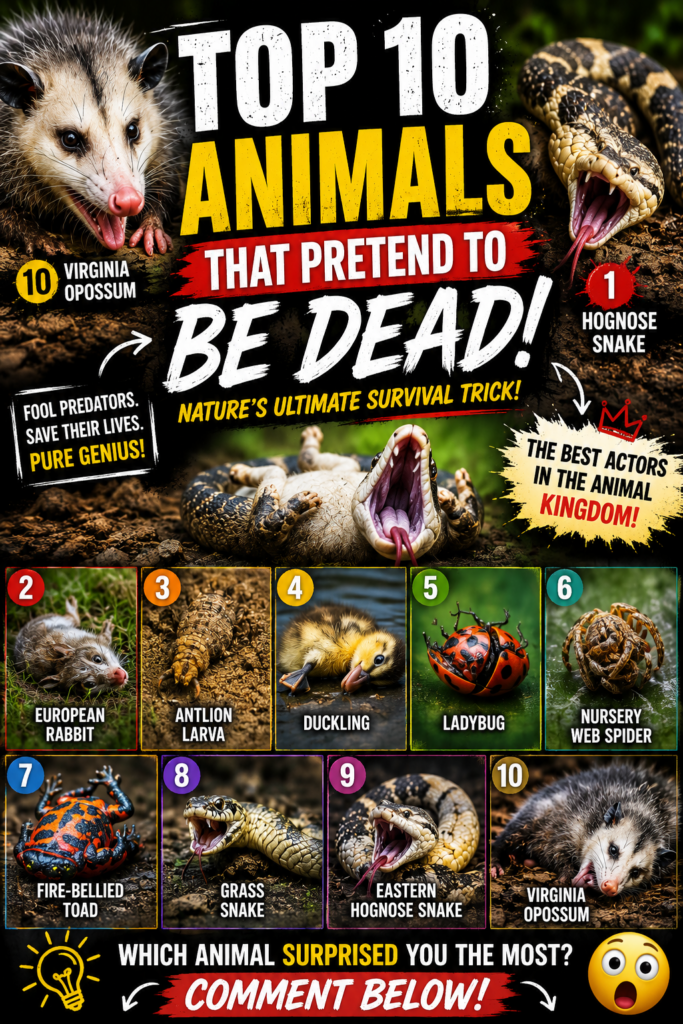
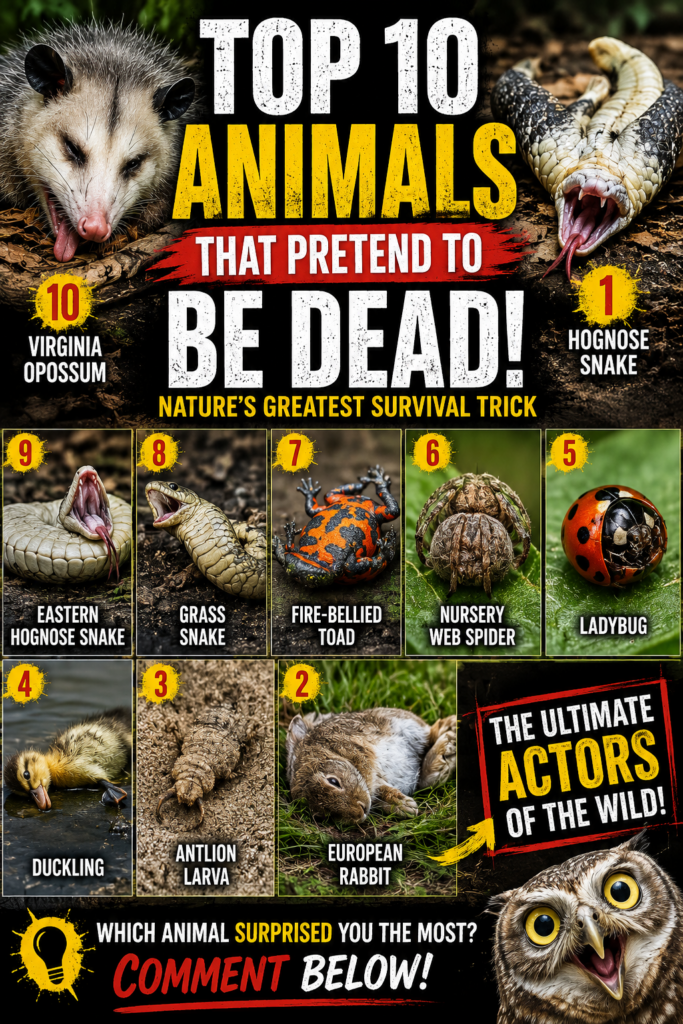
Top 10 Animals That Pretend to Be Dead: Nature’s Greatest Survival Actors
Meta Description: Discover the top 10 animals that pretend to be dead to survive. Learn how these incredible creatures use thanatosis to fool predators and increase their chances of survival.
Introduction


Have you ever imagined surviving a dangerous predator by doing absolutely nothing? While many animals rely on speed, camouflage, venom, or powerful jaws, others use one of nature’s most unusual survival strategies—pretending to be dead.
Scientists call this remarkable behavior thanatosis, also known as death feigning. During thanatosis, an animal suddenly becomes completely motionless, often lying on its side or back with its mouth open and tongue hanging out. Some species even release foul-smelling chemicals or fluids that imitate the scent of a decaying body, making predators think the animal is no longer worth eating.
This incredible defense has evolved in mammals, reptiles, amphibians, insects, spiders, fish, and birds. Many predators prefer fresh, moving prey and instinctively avoid carcasses that may carry diseases or have already begun to decompose. By convincing predators they are already dead, these clever animals often get a second chance at life.
In this countdown, we’ll explore ten amazing creatures that have perfected this extraordinary survival tactic. Some perform dramatic Oscar-worthy acts, while others rely on subtle stillness to escape danger.
Let’s begin with one of the world’s most famous “actors.”
Number 10: Virginia opossum


The Original Master of Playing Dead
The Virginia opossum is perhaps the most famous animal known for pretending to be dead. In fact, the common expression “playing possum” comes directly from this remarkable marsupial’s incredible survival strategy.
Native to North America, the Virginia opossum can be found in forests, swamps, farms, and even suburban neighborhoods. Although it isn’t particularly fast or aggressive, it has evolved one of the most effective anti-predator defenses in nature.
When confronted by predators such as coyotes, foxes, bobcats, owls, or domestic dogs, the opossum first attempts to scare them away by hissing, growling, and displaying its sharp teeth. If these warning displays fail, it suddenly collapses into a catatonic state.
Its body becomes completely limp.
Its eyes remain half open.
Its tongue hangs from its mouth.
Its breathing slows dramatically.
To make the illusion even more convincing, specialized glands release a foul-smelling greenish fluid that closely resembles the odor of a decaying animal. Many predators immediately lose interest because eating rotten meat can be dangerous.
Unlike many animals, scientists believe this behavior is mostly involuntary. Extreme fear triggers the nervous system to enter this unusual defensive state, which may last from several minutes to more than an hour.
After the predator leaves, the opossum slowly regains awareness and quietly walks away.
Habitat
- Forests
- Wetlands
- Farmlands
- Urban neighborhoods
Diet
The Virginia opossum is an omnivore that eats insects, fruits, birds’ eggs, frogs, rodents, snakes, carrion, and even ticks.
Fun Fact
A single Virginia opossum can eat thousands of ticks every year, helping reduce the spread of tick-borne diseases.
Number 9: Eastern hognose snake


Nature’s Greatest Snake Actor
If wildlife had an Academy Award for acting, the Eastern hognose snake would almost certainly take home the prize.
This harmless North American snake has developed one of the most dramatic death-feigning performances ever observed.
Before pretending to die, it puts on an intimidating show.
It spreads its neck like a cobra.
It hisses loudly.
It repeatedly strikes without actually biting.
If the predator refuses to back away, the snake suddenly changes its strategy.
It flips onto its back.
Its mouth falls open.
Its tongue hangs out.
Sometimes it even allows tiny drops of blood to appear around the mouth.
Some individuals also release foul-smelling musk to imitate the scent of decay.
One of its funniest behaviors occurs if someone turns it back upright.
Instead of crawling away, the snake immediately rolls onto its back again because, in its “performance,” dead snakes are supposed to stay upside down.
Once danger has passed, it quietly flips over and slithers away unharmed.
Habitat
- Sandy forests
- Grasslands
- Pine woodlands
- Coastal plains
Diet
The Eastern hognose snake feeds mainly on frogs and toads but occasionally eats salamanders and small reptiles.
Fun Fact
Despite its frightening performance, this snake is harmless to humans and very rarely bites.
Number 8: Grass snake


Europe’s Silent Escape Artist
The grass snake is one of Europe’s most widespread nonvenomous reptiles. Usually calm and shy, it prefers escaping into water or thick vegetation whenever danger appears.
However, when escape is impossible, the grass snake performs one of nature’s most convincing death acts.
It rolls completely onto its back.
Its mouth hangs open.
Its tongue becomes limp.
Its body remains perfectly motionless.
At the same time, glands near its tail release an extremely unpleasant-smelling liquid that resembles the odor of decomposition.
Some grass snakes even allow saliva mixed with tiny amounts of blood to drip from their mouths, making the performance even more believable.
Foxes, birds of prey, and many mammals often lose interest and search for easier prey.
As soon as the predator disappears, the snake slowly rolls upright and silently slips away.
Habitat
- Lakes
- Rivers
- Wetlands
- Meadows
- Woodland edges
Diet
Grass snakes mainly eat frogs, toads, fish, and amphibians.
Fun Fact
Grass snakes are excellent swimmers and can remain underwater for surprisingly long periods while escaping danger.
Number 7: Fire-bellied toad


The Tiny Toad with a Brilliant Bluff
The fire-bellied toad is one of the most colorful amphibians in the world. Native to parts of East Asia, this small toad lives near ponds, marshes, slow-moving streams, and wetlands. Although it measures only about 2 inches (5 cm) long, it has evolved a remarkable way to avoid becoming a predator’s next meal.
When threatened by snakes, birds, or small mammals, the fire-bellied toad first remains perfectly still. If the predator comes closer, it performs a dramatic defensive display known as the unken reflex.
The toad arches its back, flips onto its back or side, and raises its legs to expose its brilliantly colored orange-and-black belly. While holding this unusual pose, it remains completely motionless, appearing almost lifeless.
Its bright underside serves as a warning signal. The skin of the fire-bellied toad contains mild toxins that taste unpleasant to predators. Instead of taking the risk of eating a potentially poisonous meal, many predators quickly move on in search of safer prey.
The combination of vivid warning colors and complete stillness makes this one of nature’s most effective defensive displays.
Habitat
- Marshes
- Wetlands
- Forest ponds
- Slow-moving streams
Diet
The fire-bellied toad feeds on insects, worms, spiders, beetles, mosquitoes, and other small invertebrates.
Defense Mechanism
- Unken reflex
- Toxic skin secretions
- Bright warning colors
- Remaining motionless
Fun Fact
Unlike many frogs and toads that rely on camouflage, the fire-bellied toad actually wants predators to notice its brightly colored belly because it warns them to stay away.
Number 6: Nursery web spider


The Spider That Knows When Not to Move
Most spiders rely on speed or venom to escape danger, but the nursery web spider has another clever strategy. Found across Europe and parts of Asia, this fascinating spider is well known for its unique hunting skills and remarkable parental care.
When threatened by birds, wasps, or larger insects, the nursery web spider may suddenly stop moving altogether. It curls its legs tightly beneath its body and becomes completely motionless.
To a predator searching for movement, the spider appears lifeless and uninteresting. Many predators quickly lose interest and continue searching for active prey.
Once the danger has passed, the spider slowly uncurls and disappears into nearby grass or vegetation.
The nursery web spider is also famous for creating silk nurseries where female spiders carefully protect their eggs until the young hatch.
Habitat
- Meadows
- Gardens
- Grasslands
- Woodland edges
Diet
It hunts flies, mosquitoes, moths, beetles, crickets, and other small insects.
Defense Mechanism
- Death feigning
- Curling into a tight ball
- Remaining completely motionless
- Camouflage among leaves
Fun Fact
Male nursery web spiders often present females with insects wrapped in silk as “wedding gifts” before mating.
Number 5: Ladybug


Small but Surprisingly Smart
Ladybugs are among the most recognizable insects in the world. Their bright red, orange, or yellow shells covered with black spots make them easy to identify, but these colors are more than just beautiful—they serve as a warning to predators.
When attacked by birds, frogs, lizards, or spiders, a ladybug quickly folds its legs beneath its body and becomes completely motionless. At the same time, it releases tiny droplets of yellow fluid from its leg joints in a process known as reflex bleeding.
This fluid has a bitter taste and unpleasant smell, making predators think twice before taking another bite. Many predators immediately spit out the ladybug or leave it alone altogether.
By combining death-feigning with chemical defenses, ladybugs greatly improve their chances of surviving encounters with hungry predators.
In addition to protecting themselves, ladybugs play an important role in agriculture because they consume enormous numbers of aphids and other plant pests, making them one of the most beneficial insects for farmers and gardeners.
Habitat
- Gardens
- Forests
- Fields
- Farms
- Meadows
Diet
Ladybugs mainly eat aphids, mites, scale insects, pollen, and nectar.
Defense Mechanism
- Playing dead
- Reflex bleeding
- Bitter defensive chemicals
- Bright warning colors
Fun Fact
A single ladybug can eat more than 5,000 aphids during its lifetime, making it one of nature’s best natural pest controllers.
Why Death Feigning Is So Effective
Pretending to be dead works because many predators are attracted to movement. When prey suddenly becomes completely still, it may no longer trigger the predator’s hunting instincts. Some predators also avoid animals that appear dead because they could be diseased, spoiled, or unsafe to eat.
For animals like the fire-bellied toad, nursery web spider, and ladybug, combining death-feigning with bright warning colors or unpleasant chemicals creates an even stronger defense. These remarkable adaptations have evolved over millions of years and continue to help these species survive in the wild.
Number 4: Duckling


The Tiny Bird That Freezes to Survive
Ducklings may look cute and defenseless, but some species have an incredible survival instinct when faced with danger. Shortly after hatching, they must avoid predators such as foxes, hawks, snakes, turtles, and even large fish.
If escape isn’t possible, some ducklings instinctively become completely limp and motionless. This brief “playing dead” response can cause a predator to loosen its grip or become distracted.
The moment the predator hesitates, the duckling springs back to life, runs, or dives into the nearest body of water where its mother and siblings are waiting.
Although this behavior doesn’t always guarantee survival, even a few seconds of confusion can mean the difference between life and death.
Habitat
- Lakes
- Rivers
- Marshes
- Wetlands
- Ponds
Diet
Ducklings feed on aquatic insects, worms, seeds, algae, and small crustaceans.
Defense Mechanism
- Remaining motionless
- Camouflage
- Rapid escape when released
Fun Fact
Many ducklings can swim within hours of hatching and quickly learn to follow their mother wherever she goes.
Number 3: Antlion


The Patient Hunter Beneath the Sand
Antlion larvae are famous for digging cone-shaped traps in loose sand. Hidden beneath the surface, they patiently wait for ants and other small insects to slip into their pits.
But these tiny predators also become prey.
When larger insects, birds, or reptiles disturb them, antlion larvae often remain perfectly still, blending almost invisibly into the sand.
Their rough, sand-colored bodies provide excellent camouflage, while their complete lack of movement makes them extremely difficult to detect.
Only after danger has passed do they continue hunting.
This combination of camouflage and death-feigning makes antlion larvae surprisingly successful survivors.
Habitat
- Sandy soils
- Dry forests
- Desert edges
- Beaches
Diet
Ants, termites, beetles, and other small insects.
Defense Mechanism
- Remaining motionless
- Excellent camouflage
- Burrowing beneath sand
Fun Fact
An antlion larva may wait several days before catching its next meal.
Number 2: European rabbit


The Silent Survivor
European rabbits usually depend on speed and powerful hind legs to escape danger. However, under intense stress they may suddenly freeze, remaining perfectly motionless.
This temporary immobility can confuse predators, especially if the rabbit is well hidden among tall grass or bushes.
Once the predator moves away or becomes distracted, the rabbit explodes into action, sprinting toward the safety of its underground burrow.
Rabbits are among the fastest small mammals, capable of reaching speeds of up to 35 miles (56 kilometers) per hour during short bursts.
Habitat
- Grasslands
- Meadows
- Farmlands
- Forest edges
Diet
Grasses, herbs, leaves, bark, and wildflowers.
Defense Mechanism
- Freezing
- Camouflage
- High-speed escape
- Burrow protection
Fun Fact
A rabbit’s eyes provide nearly 360-degree vision, helping it detect predators from almost every direction.
Number 1: Hognose snake


Nature’s Greatest Actor
No animal performs the art of pretending to be dead better than the hognose snake.
This harmless snake has perfected one of the most dramatic survival displays in the entire animal kingdom.
When first threatened, it tries to scare predators away by flattening its neck, hissing loudly, and making fake strikes.
If these warnings fail, the real performance begins.
The snake suddenly flips onto its back.
Its mouth falls wide open.
Its tongue hangs loosely from its mouth.
Its body becomes completely limp.
Some individuals release foul-smelling musk, while others may even allow tiny drops of blood to appear around the mouth, making the performance look even more realistic.
Perhaps the funniest part comes if someone gently turns the snake upright.
Instead of escaping, it immediately rolls back onto its back because “dead snakes” shouldn’t lie right-side up.
Scientists consider the hognose snake one of the finest examples of thanatosis ever documented.
Its remarkable acting skills fool countless predators every year, allowing this harmless reptile to survive where many others would not.
Habitat
- Sandy forests
- Prairies
- Grasslands
- Pine woodlands
Diet
Frogs, toads, salamanders, lizards, and occasionally small mammals.
Defense Mechanism
- Loud hissing
- Neck flattening
- Playing dead (thanatosis)
- Releasing foul-smelling musk
Fun Fact
The hognose snake is so committed to its performance that it often refuses to “come back to life” until it is absolutely sure the predator has left.
Conclusion
Nature has developed countless ways for animals to survive, but pretending to be dead is one of the most fascinating. From the famous Virginia opossum to the dramatic hognose snake, these incredible creatures prove that survival isn’t always about strength or speed. Sometimes, the smartest defense is convincing a predator that the meal is already gone.
Whether it’s a snake rolling onto its back, a ladybug becoming perfectly still, or a tiny duckling going limp, each of these animals demonstrates the extraordinary power of evolution and adaptation.
The next time you hear the phrase “playing dead,” remember that it’s more than just an expression—it’s one of the most effective survival strategies found in the natural world.
SEO Meta Description
Discover the top 10 animals that pretend to be dead to escape predators. Learn how thanatosis helps these incredible creatures survive in the wild.
Length: 156 characters
SEO URL Slug
top-10-animals-that-pretend-to-be-dead
Focus Keyword
Animals That Pretend to Be Dead
Related SEO Keywords
- Animals that play dead
- Thanatosis
- Death feigning animals
- Animal survival strategies
- Wildlife survival
- Amazing animal defenses
- Smart animals
- Animal behavior
- Predator avoidance
- Wildlife facts
- Nature facts
- Animal adaptations
- Defensive behavior in animals
- Animals that fake death
- Weird animal facts
- Opossum playing dead
- Hognose snake
- Grass snake defense
- Fire-bellied toad
- Ladybug defense mechanism
Frequently Asked Questions (FAQs)
1. What is thanatosis?
Thanatosis, also known as death feigning, is a defensive behavior where an animal pretends to be dead to discourage predators from attacking.
2. Why do animals pretend to be dead?
Many predators prefer live prey. By appearing dead, animals can convince predators that they are diseased, spoiled, or no longer worth eating.
3. Which animal is most famous for playing dead?
The Virginia opossum is the world’s best-known animal for pretending to be dead.
4. Is playing dead voluntary?
In some species, yes. In others, such as the Virginia opossum, it is largely an involuntary response triggered by extreme fear.
5. What does the word “thanatosis” mean?
The word comes from the Greek word “Thanatos,” meaning death, and refers to an animal behaving as though it has died.
6. Which snake is famous for pretending to be dead?
The Eastern hognose snake is one of the best examples of death-feigning in reptiles.
7. Can insects pretend to be dead?
Yes. Many insects, including Ladybugs, ants, beetles, and weevils, use thanatosis to escape predators.
8. Do birds pretend to be dead?
Some young birds, including certain ducklings, may temporarily become motionless when captured by predators.
9. Is pretending to be dead common?
Scientists have documented thanatosis in hundreds of species, including mammals, reptiles, amphibians, birds, fish, spiders, and insects.
10. Does pretending to be dead always work?
No. While it can be highly effective against predators that prefer live prey, it does not guarantee survival.
11. Why do predators ignore dead animals?
Many predators avoid carcasses because they may carry diseases, parasites, or toxins.
12. Which mammals use thanatosis?
The Virginia opossum is the best-known mammal, although some rabbits and other small mammals may also freeze or feign death in certain situations.
13. What other defenses do these animals use?
Besides pretending to be dead, they may hiss, release foul-smelling chemicals, display warning colors, or rely on camouflage.
14. Can pet snakes pretend to be dead?
Yes. Pet hognose snakes sometimes display death-feigning behavior when frightened.
15. What is the purpose of death feigning?
Its primary purpose is survival. By convincing a predator that they are already dead, animals improve their chances of escaping.
16. Which tiny animal on this list plays dead?
The Ladybug uses death-feigning along with releasing a bitter defensive fluid.
17. Which amphibian pretends to be dead?
The Fire-bellied toad uses the unken reflex, remaining motionless while displaying its brightly colored belly.
18. Why does the hognose snake roll back over?
If turned upright, many hognose snakes roll onto their backs again to maintain the illusion that they are dead.
19. Are these animals dangerous to humans?
Most are harmless and rely on defensive behaviors rather than attacking people.
20. Which animal is the best actor?
Many wildlife experts consider the Hognose snake the greatest “actor” because of its elaborate death-feigning display.
Conclusion
Nature has evolved countless ways for animals to survive, and pretending to be dead is one of the most extraordinary. Whether it’s the famous Virginia opossum collapsing into a lifelike trance or the hognose snake performing an award-worthy act, these species show that intelligence and adaptation can be just as powerful as speed or strength.
Studying these remarkable behaviors helps scientists better understand evolution, predator-prey relationships, and the incredible diversity of life on Earth. The next time you see an animal lying perfectly still, it might not be dead at all—it could simply be putting on one of nature’s greatest performances.
Image Alt Text
- Virginia opossum playing dead on a forest floor.
- Eastern hognose snake upside down pretending to be dead.
- Grass snake lying motionless as a defense.
- Fire-bellied toad displaying the unken reflex.
- Nursery web spider curled up on a leaf.
- Ladybug on a green leaf using defensive behavior.
- Duckling resting beside a wetland.
- Antlion larva hidden beneath loose sand.
- European rabbit frozen in a grassy meadow.
- Hognose snake performing its dramatic death-feigning display.
Internal Linking Suggestions
Link this article to related wildlife topics such as:
- Animals That Survived Extinction
- Top 10 Tiny Animals That Are Extremely Dangerous
- Top 10 Creepiest Cave Creatures
- Top 10 Animals That Look Like Aliens
- Top 10 Most Venomous Creatures
- Top 10 Animals That Live the Longest
- Top 10 Largest Birds Ever Discovered