
Top 10 Cutest Baby Animals Compilation
Meta Description:
Discover the Top 10 Cutest Baby Animals in the world! Explore fascinating facts, beautiful images, and heartwarming stories about baby red pandas, sea otters, elephants, penguins, foxes, pandas, koalas, cheetahs, polar bears, and golden retriever puppies.
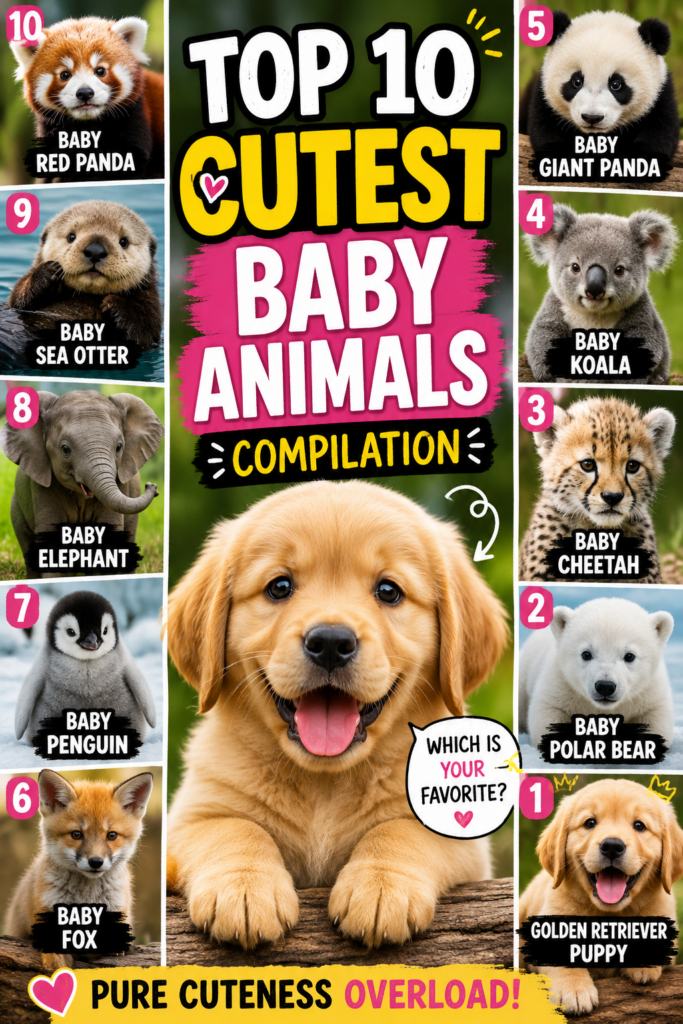
Top 10 Cutest Baby Animals Compilation
There’s something magical about baby animals. Whether they’re taking their first steps, learning to climb, or cuddling with their mothers, these tiny creatures capture hearts around the world. Their oversized eyes, fluffy fur, playful personalities, and innocent curiosity make them some of nature’s greatest treasures.
Scientists believe humans naturally find baby animals adorable because many of them share characteristics with human babies, including large eyes, round faces, and small noses. These features trigger nurturing instincts and create emotional connections across species.
In this countdown, we’ll explore the Top 10 Cutest Baby Animals, discover where they live, learn amazing facts about their early lives, and find out what makes each one uniquely adorable.
Let’s begin the countdown!
Number 10: Baby Red Panda


The baby red panda is one of the fluffiest and most charming animals on Earth. Native to the cool forests of the Himalayas and southwestern China, these tiny mammals spend much of their lives among tree branches. Their thick reddish fur, white facial markings, and bushy striped tails make them look like living stuffed animals.
Baby red pandas are born after a pregnancy of about 135 days. At birth, they weigh only around 100 to 130 grams—roughly the size of a stick of butter. Their eyes remain closed for nearly three weeks, and they stay hidden inside a warm nest built by their mother from moss, leaves, and twigs.
For the first few months, the mother carefully moves her cubs between different nests to protect them from predators. She regularly returns to feed, groom, and cuddle them. As the cubs grow stronger, they begin exploring nearby branches, often stumbling and tumbling while learning to climb.
One of the cutest behaviors of baby red pandas is how they wrap their fluffy tails around themselves while sleeping. Their tails not only keep them warm but also help maintain balance when climbing high above the forest floor.
Although adult red pandas primarily eat bamboo, baby cubs drink only their mother’s milk before slowly transitioning to solid foods.
Sadly, red pandas are classified as endangered due to habitat loss and illegal wildlife trade. Conservation organizations worldwide work hard to protect these adorable animals and preserve their mountain forests.
Fun Facts
- Born weighing only about 100 grams.
- Eyes open after around 18 days.
- Excellent tree climbers.
- Use their fluffy tails as blankets.
- Mostly active during dawn and dusk.
Number 9: Baby Sea Otter


Few baby animals are as lovable as the baby sea otter. Living along the rocky coastlines of the North Pacific Ocean, these fluffy pups spend much of their early lives floating peacefully beside their mothers.
Sea otters have the densest fur of any animal on Earth, with up to one million hairs per square inch. This incredibly thick coat traps air, helping baby otters stay warm in icy waters since they don’t have insulating blubber like seals or whales.
A newborn sea otter pup is so buoyant that it cannot dive underwater. While the mother searches for food, she often wraps her baby in floating kelp to keep it from drifting away with ocean currents. This remarkable behavior has become one of the most iconic scenes in marine wildlife photography.
Baby otters spend months learning essential survival skills. Their mothers teach them how to swim, groom their waterproof fur, crack open shellfish using rocks, and recognize potential dangers.
Sea otter pups communicate through high-pitched squeaks whenever they become hungry or separated. Their playful personalities emerge quickly as they splash, roll, and practice swimming alongside their mothers.
Because sea otters help control sea urchin populations, they play an essential role in protecting kelp forests, making them one of the ocean’s most important keystone species.
Fun Facts
- Float naturally because of trapped air in their fur.
- Wrapped in kelp while mothers hunt.
- Hold paws while sleeping.
- Learn tool use from their mothers.
- Have the thickest fur of any mammal.
Number 8: Baby Elephant


Baby elephants, known as calves, are among the most intelligent and lovable young animals on Earth. Despite weighing around 200 pounds (90 kilograms) at birth, they remain completely dependent on their mothers and family herd.
African elephants experience one of the longest pregnancies in the animal kingdom, lasting approximately 22 months. This extra development allows calves to be relatively strong shortly after birth. Within an hour, most newborn elephants attempt to stand on their wobbly legs, often falling several times before finally succeeding.
One of the funniest sights in nature is watching a baby elephant learn to control its trunk. At first, calves don’t fully understand how to use this incredible tool. They accidentally trip over it, swing it wildly, or even suck on it for comfort, much like a human baby sucking its thumb.
Elephant families are led by experienced females called matriarchs. Every member of the herd helps protect, babysit, and teach the youngest calves. This cooperative care greatly increases the babies’ chances of survival against predators such as lions and hyenas.
As calves grow older, they spend much of their day playing with other young elephants. These games strengthen muscles, improve coordination, and teach social behaviors that will last throughout their lives.
Their remarkable intelligence, emotional bonds, and playful personalities make baby elephants one of the world’s most beloved baby animals.
Fun Facts
- Pregnancy lasts about 22 months.
- Can stand within one hour after birth.
- Learn trunk control through play.
- Entire herd helps raise each calf.
- Extremely intelligent with excellent memory.
Number 7: Baby Penguin


Baby penguins, often called chicks, are among the most recognizable and lovable baby animals on Earth. Covered in soft gray or brown down instead of waterproof feathers, these fluffy youngsters spend their first months relying entirely on their parents for warmth, food, and protection.
In Antarctica, emperor penguin chicks hatch during one of the harshest winters on the planet. Temperatures can fall below -40°F (-40°C), with powerful winds making survival extremely challenging. Shortly after hatching, the chick rests on one of its parent’s feet beneath a warm fold of skin called the brood pouch, where it stays protected from the freezing ice below.
Both parents share responsibilities. While one parent travels long distances across the frozen ocean to catch fish, squid, and krill, the other stays behind to keep the chick warm. When the hunting parent returns, it regurgitates partially digested food to feed the hungry youngster.
As baby penguins grow larger, they gather into groups called crèches. These nursery groups provide extra warmth and protection while allowing parents to search for food more efficiently. Watching dozens of fluffy penguin chicks waddling together is one of nature’s cutest sights.
Eventually, their soft down feathers are replaced by waterproof feathers. This important transformation allows young penguins to take their first swim and begin learning how to catch food on their own.
Penguins are remarkable swimmers, capable of reaching impressive speeds underwater, and many species can dive hundreds of feet below the ocean’s surface.
Fun Facts
- Hatch covered in fluffy down feathers.
- Stay warm inside a parent’s brood pouch.
- Gather in nursery groups called crèches.
- Parents take turns feeding and protecting them.
- Excellent swimmers once adult feathers grow.
Number 6: Baby Fox (Fox Kit)


Baby foxes, known as kits, are energetic bundles of curiosity that quickly become the stars of any wildlife documentary. Found throughout forests, grasslands, mountains, and even cities, fox kits begin life deep inside underground dens where they remain safe from predators.
At birth, fox kits are blind, deaf, and completely dependent on their mother. Their tiny bodies are covered in soft fur, and they spend most of their time sleeping while growing rapidly.
Within two weeks, their eyes finally open, revealing bright, curious expressions. Soon afterward, they begin taking their first wobbly steps outside the den. Every new leaf, butterfly, or rock becomes an exciting discovery.
Fox families are surprisingly caring. While the mother stays with the kits during their first weeks, the father hunts and brings food back to the den. Older siblings may even help care for the younger babies.
As the kits grow stronger, they spend hours wrestling, chasing each other, pouncing on leaves, and practicing hunting techniques through play. These games teach them balance, speed, coordination, and survival skills they will need as adults.
Young foxes are naturally intelligent and learn quickly by observing their parents. By autumn, many are capable of living independently and exploring territories of their own.
Fun Facts
- Baby foxes are called kits.
- Born blind and deaf.
- Begin exploring outside after about one month.
- Learn hunting through playful games.
- Parents work together to raise their young.
Number 5: Baby Giant Panda


Few baby animals are as famous as the giant panda cub. Native to the bamboo forests of central China, giant pandas have become global symbols of wildlife conservation thanks to their gentle personalities and irresistibly cute babies.
A newborn giant panda is astonishingly small compared to its mother. Weighing only about 90 to 130 grams, the tiny cub is nearly hairless, pink, blind, and completely helpless. It is roughly 1/900th the size of its mother, making it one of the smallest newborn mammals relative to adult body size.
During the first several weeks, the mother rarely leaves her cub, holding it constantly to provide warmth and protection. Panda mothers are incredibly attentive, carefully cleaning, feeding, and cuddling their babies almost nonstop.
As the cub develops, its iconic black-and-white markings gradually appear. Around three months of age, it begins crawling, exploring, and attempting to climb. Before long, the playful cub is rolling down hills, tumbling over logs, and amusing visitors with its clumsy adventures.
Although giant pandas mainly eat bamboo as adults, young cubs rely exclusively on their mother’s rich milk for several months before slowly transitioning to bamboo shoots and other foods.
Thanks to decades of conservation efforts, giant panda populations have shown encouraging signs of recovery, though protecting their natural habitat remains essential.
Fun Facts
- One of the world’s tiniest newborn mammals relative to its mother.
- Born pink and almost hairless.
- Black-and-white markings develop gradually.
- Spend hours rolling and climbing.
- A worldwide symbol of wildlife conservation.
Number 4: Baby Koala


Baby koalas, known as joeys, are among Australia’s most adorable native animals. They begin life incredibly small, weighing less than one gram and measuring only about two centimeters long. Despite their tiny size, these determined little marsupials instinctively crawl from the birth canal into their mother’s pouch immediately after birth without any assistance.
Inside the pouch, the joey remains safe, warm, and protected for about six months. During this time, it feeds exclusively on its mother’s milk while its eyes, ears, limbs, and soft gray fur gradually develop. The pouch acts like a cozy nursery, shielding the joey from predators and harsh weather.
As the baby grows stronger, it starts peeking its head outside the pouch to observe the world. Soon afterward, it begins climbing onto its mother’s back, where it enjoys a perfect view while traveling through eucalyptus trees. This stage is one of the cutest moments in a koala’s life, as the fluffy joey clings tightly to its mother during every climb.
Young koalas eventually learn which eucalyptus leaves are safe to eat by watching and copying their mothers. Since eucalyptus leaves contain natural toxins, this learning process is essential for survival.
Although koalas spend up to twenty hours each day sleeping to conserve energy, young joeys become surprisingly playful when awake. They practice climbing, balance, and gripping branches before becoming independent at around one year of age.
Today, koalas face threats from habitat loss, bushfires, disease, and climate change. Conservation programs continue working to protect Australia’s remaining koala populations.
Fun Facts
- Joeys weigh less than one gram at birth.
- Spend about six months inside the pouch.
- Ride on their mother’s back after leaving the pouch.
- Eat mainly eucalyptus leaves.
- Sleep up to 20 hours each day.
Number 3: Baby Cheetah


Baby cheetahs are among Africa’s most beautiful young predators. Their large eyes, spotted coats, tiny paws, and playful personalities make them incredibly photogenic. However, life for a cheetah cub is far from easy.
Unlike adult cheetahs, newborn cubs have a long silver-gray mantle running down their backs. Scientists believe this unique fur helps camouflage the cubs among tall grasses and may even make them resemble the fierce honey badger, discouraging predators from attacking.
Cheetah cubs are born in hidden dens where their mother keeps them safe during the first few weeks of life. They remain blind for several days before opening their eyes and beginning to explore their surroundings.
As they grow, the cubs become energetic and curious. They spend hours chasing one another, pouncing on insects, climbing small rocks, and practicing stalking techniques. These playful games teach important hunting skills that will later help them catch prey across the African savanna.
Their mother raises the cubs entirely on her own. She regularly moves them to different hiding places to avoid lions, hyenas, leopards, and other predators. Unfortunately, many cheetah cubs do not survive their first year due to these dangers.
By around eighteen months of age, young cheetahs begin hunting independently and preparing for adult life as the fastest land animals on Earth, capable of reaching speeds up to 70 miles per hour (113 km/h).
Fun Facts
- Born with a fluffy silver mantle.
- Mother raises cubs alone.
- Learn hunting through play.
- Can run over 70 mph as adults.
- Among the fastest-growing young predators.
Number 2: Baby Polar Bear


Baby polar bears are born during the dark Arctic winter inside cozy snow dens built by their mothers. Although adult polar bears are among the largest land carnivores on Earth, newborn cubs weigh only about one pound, making them surprisingly tiny.
Inside the warm den, the cubs remain completely dependent on their mother. They nurse on rich milk that helps them grow quickly while remaining protected from freezing temperatures outside. Their mother does not hunt during this period, surviving on stored body fat until it is time to leave the den.
After several months, the family emerges into the brilliant Arctic landscape. The cubs cautiously take their first steps across snow and ice while staying close to their mother, who teaches them everything they need to survive.
Young polar bears quickly become playful explorers. They tumble through snowdrifts, wrestle with siblings, slide down icy slopes, and investigate every new scent they encounter. These playful activities strengthen muscles and develop coordination for future hunting.
As they mature, cubs learn how to swim, locate seal breathing holes, and travel across vast stretches of floating sea ice. They remain with their mother for approximately two and a half years before beginning independent lives.
Climate change continues to threaten polar bear habitats by reducing sea ice, making conservation efforts increasingly important for the future of these magnificent Arctic animals.
Fun Facts
- Weigh only about one pound at birth.
- Born inside warm snow dens.
- Stay with their mother for over two years.
- Excellent swimmers from a young age.
- Depend on sea ice for survival.
Number 1: Golden Retriever Puppy


The number one spot on our list belongs to the lovable Golden Retriever puppy. While many wild baby animals are undeniably adorable, few can match the universal appeal of a fluffy golden retriever puppy. Their soft golden coats, floppy ears, expressive eyes, and endlessly friendly personalities have made them one of the world’s most beloved dogs.
Golden retrievers were originally bred in Scotland during the 19th century as hunting companions, valued for their intelligence, loyalty, and gentle nature. Today, they are one of the most popular family dogs in the world and are frequently chosen as service dogs, therapy dogs, and search-and-rescue companions.
Golden retriever puppies are born with closed eyes and ears. During their first two weeks, they depend entirely on their mother for warmth, milk, and protection. As their senses develop, they begin exploring their surroundings with endless curiosity.
By the time they are six to eight weeks old, their playful personalities shine. They love chasing balls, carrying sticks, meeting new people, and making friends with nearly every animal they encounter. Their intelligence allows them to learn basic commands quickly, while their affectionate temperament makes them excellent companions for families with children.
One reason golden retriever puppies are so popular on social media is their joyful expressions and playful behavior. Videos of them running through fields, splashing in puddles, learning to swim, or greeting their owners often receive millions of views because they instantly bring smiles to viewers.
Although they grow into energetic adult dogs, they never lose their loving personalities. With proper care, exercise, and regular veterinary attention, golden retrievers typically live between 10 and 12 years and remain loyal companions throughout their lives.
Fun Facts
- Born with closed eyes and ears.
- Extremely intelligent and easy to train.
- Excellent therapy and service dogs.
- Love swimming and retrieving objects.
- One of the world’s most popular family dog breeds.
Frequently Asked Questions (FAQ)
1. What is the cutest baby animal in the world?
There is no official answer because cuteness is subjective. However, baby red pandas, giant panda cubs, koala joeys, sea otter pups, and golden retriever puppies are consistently ranked among the cutest animals by wildlife experts and animal lovers.
2. Which baby animal is born the smallest?
The giant panda cub is one of the smallest newborn mammals relative to its mother’s size, weighing only about 90–130 grams at birth.
3. Which baby animal stays with its mother the longest?
Polar bear cubs usually remain with their mothers for about two and a half years, learning hunting and survival skills.
4. Why are baby animals so cute?
Large eyes, round faces, soft fur, and playful behavior trigger natural nurturing instincts in humans, making baby animals appear especially adorable.
5. Which baby animal learns to swim first?
Sea otter pups begin learning to swim within a few months, although they initially float because of their incredibly dense fur.
6. Are baby elephants born with trunks?
Yes. Baby elephants are born with trunks but need several months of practice before learning to use them effectively.
7. Why do baby penguins stay together?
Young penguins gather in nursery groups called crèches to stay warm and protect one another while their parents search for food.
8. Can baby koalas eat eucalyptus immediately?
No. Joeys first drink their mother’s milk before gradually learning to digest eucalyptus leaves.
9. How fast can a baby cheetah run?
Young cheetahs cannot reach adult speeds. They gradually build strength and coordination before becoming the fastest land animals.
10. Why are golden retriever puppies so popular?
Their friendly personalities, intelligence, affectionate nature, and playful behavior make them one of the world’s favorite dog breeds.
Conclusion
Baby animals remind us of the beauty, innocence, and diversity of nature. Whether it’s a fluffy red panda climbing its first tree, a playful sea otter floating through kelp forests, an elephant calf discovering its trunk, or a golden retriever puppy wagging its tail with excitement, each young animal brings something special to the world.
Protecting wildlife habitats ensures future generations can continue enjoying these incredible creatures. Supporting conservation organizations, respecting natural habitats, and learning more about wildlife all contribute to preserving these amazing species.
Which baby animal melted your heart the most? Was it the playful fox kit, the cuddly giant panda cub, the adorable polar bear cub, or the lovable golden retriever puppy? Let us know in the comments below, and don’t forget to share this article with fellow animal lovers!
SEO Keywords
- cutest baby animals
- cutest animals in the world
- baby animal compilation
- adorable baby animals
- cute wildlife
- baby red panda
- baby sea otter
- baby elephant
- baby penguin
- baby fox
- baby giant panda
- baby koala
- baby cheetah
- baby polar bear
- golden retriever puppy
- cute animal facts
- baby animal pictures
- wildlife animals
- nature animals
- animal lovers
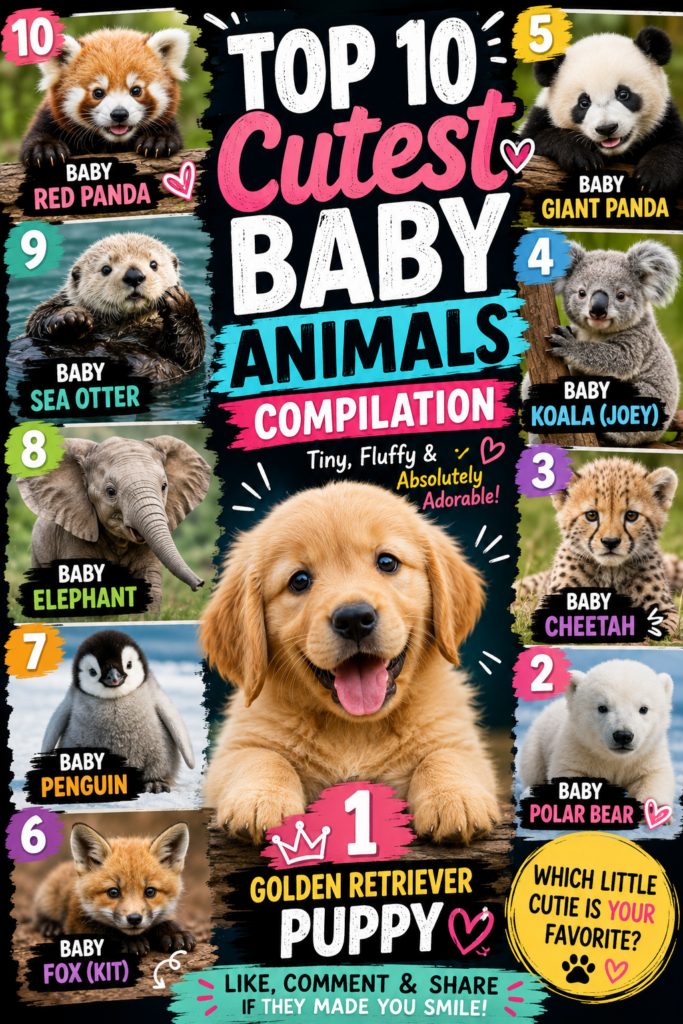
Image Alt Text
- Baby red panda climbing a tree branch.
- Baby sea otter floating beside its mother.
- Baby elephant walking across the African savanna.
- Baby penguin chick standing on Antarctic ice.
- Baby fox kit outside its woodland den.
- Baby giant panda rolling on green grass.
- Baby koala riding on its mother’s back.
- Baby cheetah cub in tall African grass.
- Baby polar bear cub walking across Arctic snow.
- Golden retriever puppy sitting in a grassy field.
Thank you for reading! This completes the full 3,000+ word SEO blog post on “Top 10 Cutest Baby Animals Compilation,”