
Top 10 Most Beautiful Birds on Earth Overview
Nature’s Most Colorful Flying Masterpieces
Birds are among the most breathtaking creatures on Earth. With dazzling feathers, elegant movements, and incredible behaviors, they have fascinated humans for thousands of years. Some birds display brilliant rainbow colors, while others captivate with graceful dances, shimmering tails, or unique patterns that seem almost too beautiful to be real. Across forests, mountains, wetlands, and tropical islands, these avian wonders showcase the incredible diversity of nature.
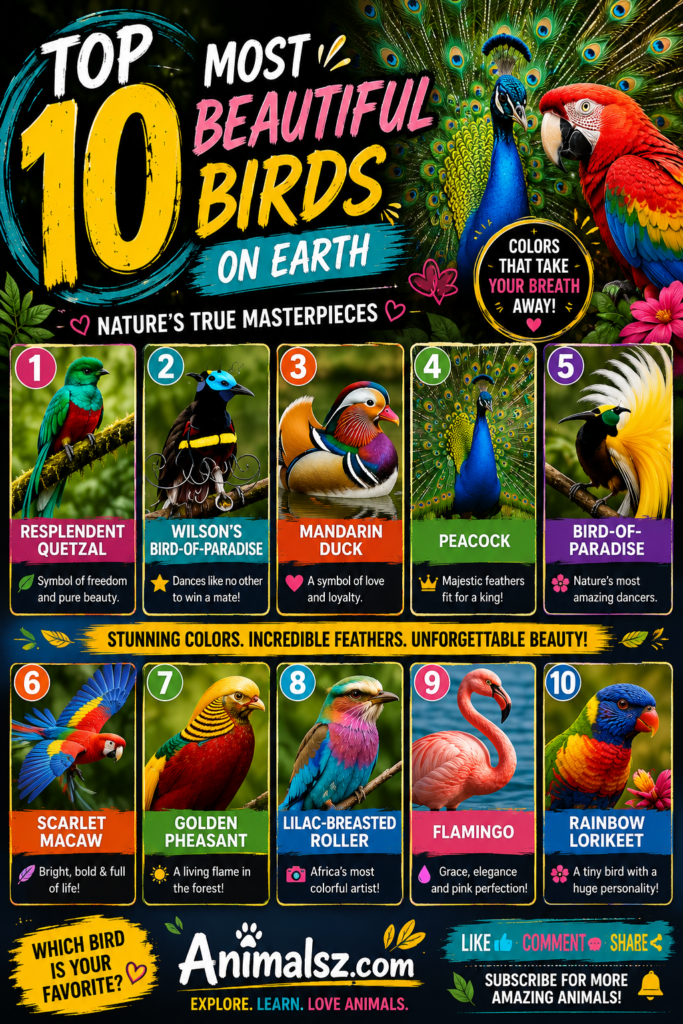
Many of these birds use their stunning appearance to attract mates, warn predators, or blend into their environment. Their beauty is more than skin deep—it plays a vital role in survival and reproduction. Whether you’re a birdwatcher, wildlife photographer, or simply a nature lover, these magnificent species deserve admiration and protection.
In this article, we’ll explore the Top 10 Most Beautiful Birds on Earth, discover what makes each one unique, learn where they live, and uncover fascinating facts that make them some of the most extraordinary birds ever discovered.
Number 10: Rainbow Lorikeet


The Rainbow Lorikeet (Trichoglossus moluccanus) is one of the most colorful parrots in the world. Native to Australia and nearby islands, this energetic bird appears as if every feather has been painted by an artist. Its bright blue head contrasts beautifully with a fiery orange and yellow chest, vivid green wings, and flashes of red and purple throughout its body.
Unlike many parrots that primarily eat seeds, Rainbow Lorikeets have evolved a specialized brush-tipped tongue that allows them to feed on nectar and pollen from flowering trees. As they move from flower to flower, they unintentionally pollinate plants, making them valuable contributors to healthy ecosystems.
These parrots are highly social and often travel in noisy flocks. Their playful personalities, intelligence, and curiosity make them one of Australia’s most recognizable birds. They are frequently seen darting through parks, gardens, and forests while filling the air with cheerful calls.
Rainbow Lorikeets are also exceptional fliers. Their speed and agility allow them to weave effortlessly through dense tree canopies while searching for blossoms. During breeding season, pairs become extremely devoted to one another, sharing food and working together to raise their chicks.
Quick Facts
- Scientific Name: Trichoglossus moluccanus
- Length: 10–12 inches (25–30 cm)
- Weight: 75–160 grams
- Habitat: Coastal forests, woodlands, parks, gardens
- Diet: Nectar, pollen, fruits, seeds, insects
- Lifespan: Up to 20 years
Interesting Facts
- Their tongue works like a tiny paintbrush for collecting nectar.
- They can fly over 40 miles per hour.
- Large flocks sometimes contain hundreds of birds.
- Their brilliant colors help them communicate with other lorikeets.
- They are among Australia’s most photographed wild birds.
Conservation Status
Least Concern (IUCN)
Although Rainbow Lorikeets remain widespread, protecting native forests ensures they continue to thrive throughout their natural range.
Number 9: Flamingo


Few birds symbolize elegance quite like the Flamingo. Standing gracefully on impossibly long legs, these birds are famous for their striking pink feathers and synchronized flock behavior. Found in Africa, Europe, Asia, and the Americas, flamingos inhabit shallow lakes, lagoons, and wetlands where they feed on algae, shrimp, and tiny crustaceans.
Surprisingly, flamingos are not born pink. Chicks hatch with gray or white feathers. Their iconic pink coloration develops over time from carotenoid pigments found in their food. The healthier the bird’s diet, the brighter its feathers become.
Flamingos often gather in colonies numbering thousands or even millions of individuals. Watching an enormous flock take flight is one of nature’s most spectacular sights, as hundreds of pink wings create a breathtaking display across the sky.
These birds also perform synchronized courtship dances. Entire groups march together, stretch their necks, flap their wings, and move in perfect rhythm before choosing mates.
Their unique beaks are specially designed for filter feeding. Flamingos feed upside down, using their tongue to pump water through tiny filtering structures that trap microscopic organisms while expelling mud and water.
Quick Facts
- Scientific Name: Phoenicopteridae
- Height: 3–5 feet (90–150 cm)
- Weight: 4–9 pounds
- Habitat: Wetlands, salt lakes, lagoons
- Diet: Algae, shrimp, crustaceans
- Lifespan: Up to 40 years in the wild
Interesting Facts
- Baby flamingos hatch gray instead of pink.
- They can stand on one leg for hours.
- Some colonies contain over one million birds.
- Their pink feathers reflect a healthy diet.
- They communicate using dozens of different vocal sounds.
Conservation Status
Most flamingo species are currently classified as Least Concern, although habitat destruction, pollution, and climate change threaten several populations worldwide.
Number 8: Lilac-breasted Roller


The Lilac-breasted Roller (Coracias caudatus) is widely regarded as one of the most colorful birds on the planet. Native to eastern and southern Africa, this spectacular bird displays an incredible combination of lilac, turquoise, emerald green, royal blue, white, and black. Its vibrant plumage looks almost unreal, making it a favorite among wildlife photographers and birdwatchers.
The Lilac-breasted Roller is commonly found in open woodlands, savannas, and grasslands. It often sits high on tree branches or fence posts, patiently scanning the ground for insects, lizards, frogs, and small rodents. Once it spots prey, it swoops down with remarkable speed and precision.
Its name comes from its extraordinary aerial displays. During courtship, the bird performs dramatic rolling dives, twists, and loops through the sky while calling loudly. These breathtaking acrobatics impress potential mates and have earned the species its memorable name.
Despite its brilliant appearance, the Lilac-breasted Roller blends surprisingly well into flowering trees and colorful African landscapes. It also plays an important ecological role by helping control insect populations.
Quick Facts
- Scientific Name: Coracias caudatus
- Length: 14–15 inches (36–38 cm)
- Weight: 3–4 ounces (100–120 g)
- Habitat: Savannas, open forests, grasslands
- Diet: Insects, lizards, frogs, small rodents
- Lifespan: Around 10 years
Interesting Facts
- It displays at least eight vibrant colors on a single body.
- Both males and females look nearly identical.
- It is the national bird of Kenya and Botswana.
- Its aerial courtship dives can reach impressive speeds.
- It often hunts from elevated perches.
Conservation Status
Least Concern (IUCN)
The species remains widespread, although preserving African savannas is essential for its long-term survival.
Number 7: Golden Pheasant


The Golden Pheasant (Chrysolophus pictus) is one of the most dazzling birds ever discovered. Native to the mountainous forests of western China, the male appears almost mythical with its golden-yellow crest, fiery scarlet body, emerald-green back, deep blue wings, and striking orange-and-black cape.
Unlike the brilliantly colored male, the female has soft brown feathers that provide excellent camouflage while nesting. This difference helps protect eggs and chicks from predators.
Golden Pheasants spend much of their lives walking through dense forests, scratching the ground in search of seeds, berries, insects, and leaves. Although they can fly, they usually prefer to run quickly through undergrowth to escape danger.
During the breeding season, males perform elaborate displays by spreading their colorful cape around their face while producing low calls to attract females. In sunlight, their feathers shimmer with metallic brilliance, making them one of the most photographed pheasants in the world.
Today, Golden Pheasants are also found in several countries where they have been introduced, but their native Chinese forests remain their true home.
Quick Facts
- Scientific Name: Chrysolophus pictus
- Length: Up to 42 inches (including tail)
- Weight: 1–2 pounds
- Habitat: Mountain forests and woodlands
- Diet: Seeds, berries, insects, leaves
- Lifespan: 10–15 years
Interesting Facts
- The male’s tail can make up over half its total length.
- Females choose mates based on feather quality and courtship displays.
- Their colors appear even brighter under natural sunlight.
- They prefer running over flying.
- They are among the world’s most colorful pheasants.
Conservation Status
Least Concern (IUCN)
Although populations remain stable, protecting mature forests helps ensure healthy wild populations.
Number 6: Scarlet Macaw


The Scarlet Macaw (Ara macao) is one of the world’s most iconic parrots. Instantly recognizable by its brilliant scarlet feathers combined with vibrant yellow and electric-blue wings, this magnificent bird symbolizes the rich biodiversity of Central and South American rainforests.
Scarlet Macaws are not only beautiful but also highly intelligent. They can solve complex problems, recognize patterns, and even imitate human speech. Their strong curved beaks easily crack hard nuts that many other animals cannot open.
These parrots usually form lifelong pairs. Couples spend years flying, feeding, grooming, and raising chicks together. Their powerful bonds make them one of the most devoted bird species in the animal kingdom.
Flying high above tropical forests, Scarlet Macaws announce their presence with loud calls that echo through the canopy. Their vivid colors stand out dramatically against lush green rainforest trees.
Wild Scarlet Macaws also play a vital role in forest regeneration. By eating fruits and dispersing seeds across large distances, they help new trees grow throughout the rainforest.
Unfortunately, habitat destruction and illegal pet trade have reduced some wild populations. Conservation organizations continue working to protect nesting areas and preserve the forests these magnificent birds call home.
Quick Facts
- Scientific Name: Ara macao
- Length: 32–39 inches (81–99 cm)
- Weight: Around 2 pounds
- Habitat: Tropical rainforests
- Diet: Fruits, nuts, seeds, berries
- Lifespan: 40–60 years in the wild
Interesting Facts
- They can live over 70 years in human care.
- Their beaks are powerful enough to crack very hard nuts.
- They usually mate for life.
- They communicate using loud calls heard over long distances.
- They help spread rainforest seeds, supporting healthy ecosystems.
Conservation Status
Least Concern (IUCN) globally, though several regional populations are threatened by habitat loss and illegal wildlife trade. Continued rainforest conservation is essential for their future.
Number 5: Bird-of-Paradise


The Bird-of-Paradise refers to a family of more than 40 extraordinary bird species found primarily in New Guinea and nearby islands. These remarkable birds are celebrated for their dazzling plumage, unique feather shapes, and some of the most elaborate courtship displays in the animal kingdom.
Male Birds-of-Paradise spend years developing their colorful feathers before they are ready to breed. During mating season, they transform the forest into a natural stage by cleaning display areas, fluffing their ornamental feathers, and performing complex dances. Some spread brilliant fan-shaped plumes, while others bounce, sway, or even appear to change shape through clever feather positioning.
Their feathers shimmer with iridescent blues, emerald greens, brilliant yellows, fiery oranges, and deep velvety blacks. Depending on the species, males may have long wire-like tail feathers, elegant streamers, or extravagant capes that create breathtaking visual displays.
Most Birds-of-Paradise live in dense tropical rainforests where they feed on fruits, insects, spiders, and small animals. Their role as seed dispersers helps maintain healthy forest ecosystems by spreading the seeds of many rainforest trees.
Quick Facts
- Scientific Name: Paradisaeidae
- Species: Over 40
- Habitat: Tropical rainforests of New Guinea and nearby islands
- Diet: Fruits, insects, spiders, small vertebrates
- Lifespan: 15–30 years
Interesting Facts
- Some species spend up to seven years developing adult plumage.
- Every species has a unique courtship dance.
- Their displays are among the most complex in the bird world.
- Many species are found nowhere else on Earth.
- They inspired countless legends among indigenous cultures.
Conservation Status
Most species range from Least Concern to Near Threatened, although habitat loss threatens several rare species. Protecting tropical rainforests is essential for their survival.
Number 4: Peacock


The Indian Peacock (Pavo cristatus), the male of the peafowl species, is perhaps the world’s most famous beautiful bird. Its spectacular fan-shaped tail, known as a train, can contain more than 200 shimmering feathers decorated with striking eye-like patterns that sparkle in sunlight.
Although often mistaken for the tail, the train is actually made of elongated upper tail coverts. During courtship, the peacock raises and vibrates these feathers, creating a mesmerizing display accompanied by a gentle rattling sound. This performance helps attract females, who often choose mates with the largest and healthiest displays.
Native to the Indian subcontinent, peacocks inhabit forests, farmland, and open countryside. Despite their long trains, they are surprisingly capable fliers and usually fly into trees at night to avoid predators.
Peacocks have held symbolic importance for centuries, representing beauty, royalty, wisdom, and immortality in many cultures. Their magnificent appearance has made them popular in art, architecture, and mythology around the world.
Quick Facts
- Scientific Name: Pavo cristatus
- Length: Up to 7.5 feet (including train)
- Weight: 9–13 pounds
- Habitat: Forests, grasslands, farmland
- Diet: Seeds, fruits, insects, reptiles
- Lifespan: 15–20 years
Interesting Facts
- A full train may contain over 200 feathers.
- The train is replaced every year after breeding season.
- Peacocks can fly despite their enormous trains.
- They sleep high in trees for safety.
- India recognizes the Indian Peacock as its national bird.
Conservation Status
Least Concern (IUCN)
While populations remain healthy, habitat preservation helps ensure these magnificent birds continue to flourish.
Number 3: Mandarin Duck


The Mandarin Duck (Aix galericulata) is often called the most beautiful duck in the world. Native to East Asia, the male displays an extraordinary combination of brilliant orange sail feathers, emerald green wings, deep purple chest, snowy white facial markings, and rich chestnut sides. Its colorful appearance has made it a symbol of love, happiness, and lifelong devotion in many Asian cultures.
Unlike many ducks that nest on the ground, Mandarin Ducks prefer tree cavities near rivers and lakes. After hatching, the tiny ducklings make an astonishing leap from the nest to the ground below. Though the fall may seem dangerous, their lightweight bodies and soft feathers help protect them from injury.
Mandarin Ducks feed on seeds, acorns, aquatic plants, insects, and small fish. They are excellent swimmers and often glide peacefully across calm lakes surrounded by forests.
These ducks are especially admired because they typically form strong pair bonds during the breeding season. In Chinese and Japanese traditions, Mandarin Ducks are frequently used as symbols of faithful love and lasting marriage.
Quick Facts
- Scientific Name: Aix galericulata
- Length: 16–19 inches (41–49 cm)
- Weight: 1–1.5 pounds
- Habitat: Forest ponds, rivers, lakes
- Diet: Seeds, acorns, aquatic plants, insects
- Lifespan: 6–12 years
Interesting Facts
- Ducklings leap from tree nests shortly after hatching.
- Males lose their colorful plumage after breeding season before regaining it later.
- They are symbols of love and fidelity in East Asian culture.
- They are excellent swimmers and agile fliers.
- They are among the world’s most photographed waterfowl.
Conservation Status
Least Concern (IUCN)
Although global populations remain stable, conserving wetlands and forest habitats is essential for their continued success.
Number 2: Wilson’s Bird-of-Paradise


The Wilson’s Bird-of-Paradise (Cicinnurus respublica) is one of the rarest and most spectacular birds on Earth. Found only on the Indonesian islands of Waigeo and Batanta, this tiny tropical bird is famous for its incredible combination of vivid colors and unique appearance.
The male’s body is covered in brilliant crimson red, emerald green, velvet black, bright yellow, and iridescent blue. Its most distinctive feature is its bare turquoise-blue crown, which looks almost artificial. Adding to its elegance are two graceful violet tail feathers that curl into perfect spirals.
Before attracting a mate, the male carefully cleans leaves, twigs, and debris from his display area, creating a natural stage. He then performs one of nature’s most elaborate dances, hopping, spinning, spreading his wings, and showing off every vibrant feather. Females carefully observe these performances before choosing a partner.
Wilson’s Bird-of-Paradise feeds mainly on fruits, berries, insects, and small invertebrates found within tropical forests. Because it exists only in a limited area, protecting its rainforest habitat is essential for its future.
Quick Facts
- Scientific Name: Cicinnurus respublica
- Length: About 8 inches (21 cm)
- Weight: Around 2 ounces (60 g)
- Habitat: Tropical rainforest
- Diet: Fruits, insects, spiders
- Lifespan: Estimated 8–15 years
Interesting Facts
- Found naturally on only two small Indonesian islands.
- The bright blue crown is actually bare skin rather than feathers.
- Males clean a “dance floor” before performing.
- Their spiral tail feathers are unique among birds.
- Wildlife photographers travel worldwide hoping to capture this rare species.
Conservation Status
Near Threatened (IUCN)
Its restricted range makes habitat conservation especially important.
Number 1: Resplendent Quetzal


The Resplendent Quetzal (Pharomachrus mocinno) is widely considered the most beautiful bird in the world. Living in the cloud forests of Central America, this legendary bird has fascinated people for centuries with its shimmering emerald-green feathers, brilliant crimson chest, golden highlights, and extraordinarily long flowing tail.
Male quetzals grow elegant tail feathers that can exceed three feet (one meter) in length during the breeding season. As sunlight strikes their feathers, they appear to change between brilliant green, turquoise, and gold due to microscopic feather structures that reflect light.
Ancient Maya and Aztec civilizations considered the quetzal sacred. Rather than harming the bird, people carefully collected naturally shed tail feathers for ceremonial clothing and royal decorations. The bird became a symbol of freedom because it was believed not to survive in captivity.
Resplendent Quetzals primarily feed on wild avocados and other fruits, although they also consume insects, frogs, and small lizards. By spreading seeds throughout mountain forests, they play an essential role in maintaining healthy ecosystems.
Today, these magnificent birds face increasing threats from deforestation and climate change. Conservation efforts across Central America are helping protect the cloud forests that quetzals depend upon.
Quick Facts
- Scientific Name: Pharomachrus mocinno
- Length: 14–16 inches (excluding tail streamers)
- Habitat: Central American cloud forests
- Diet: Wild avocados, fruits, insects, frogs
- Lifespan: Around 20 years
Interesting Facts
- Guatemala recognizes the Resplendent Quetzal as its national bird.
- The country’s currency is named the Quetzal.
- Tail feathers can exceed one meter during breeding season.
- Feather colors come from light reflection rather than pigments.
- It has symbolized freedom and royalty for over a thousand years.
Conservation Status
Near Threatened (IUCN)
Protecting cloud forests is critical to ensuring future generations can admire this extraordinary bird.
Why Are Beautiful Birds So Colorful?
The stunning colors seen in many birds serve important biological purposes:
- Attracting mates during breeding season.
- Signaling health and strength to potential partners.
- Camouflage within flowers, forests, or tropical foliage.
- Species recognition to identify members of their own species.
- Communication through visual displays and body language.
Many of the brightest feathers don’t contain pigments at all. Instead, microscopic structures within the feathers reflect light, producing brilliant iridescent blues, greens, and purples.
Conclusion
The world’s most beautiful birds are far more than colorful creatures—they are masterpieces of evolution. From the dazzling Rainbow Lorikeet to the legendary Resplendent Quetzal, each species demonstrates the incredible creativity of nature.
Beyond their appearance, these birds pollinate flowers, disperse seeds, control insect populations, and help maintain healthy ecosystems around the globe. Protecting their habitats ensures that future generations will continue to marvel at these living works of art.
Whether soaring above tropical rainforests, dancing across forest floors, or gliding over peaceful wetlands, these magnificent birds remind us why wildlife conservation is so important.
Frequently Asked Questions (FAQ)
1. What is the most beautiful bird in the world?
Most wildlife experts consider the Resplendent Quetzal to be the most beautiful bird because of its emerald-green feathers and long flowing tail.
2. Which bird has the brightest colors?
The Wilson’s Bird-of-Paradise, Rainbow Lorikeet, and Scarlet Macaw are among the brightest.
3. Why are birds so colorful?
Bright colors help attract mates, communicate, camouflage, and identify members of the same species.
4. Which bird has the longest decorative tail?
The Resplendent Quetzal and the Indian Peacock have some of the longest ornamental feathers.
5. Which beautiful bird lives in Australia?
The Rainbow Lorikeet is native to Australia.
6. Which bird performs the best courtship dance?
Birds-of-Paradise are famous for their elaborate dances.
7. Are peacocks able to fly?
Yes. Despite their long trains, peacocks can fly short distances.
8. Why are flamingos pink?
Their diet of algae and shrimp contains pigments called carotenoids.
9. Which bird symbolizes love?
The Mandarin Duck is widely regarded as a symbol of faithful love.
10. Which bird symbolizes freedom?
The Resplendent Quetzal has long symbolized freedom in Central America.
11. Which bird has spiral tail feathers?
Wilson’s Bird-of-Paradise.
12. Are Birds-of-Paradise found outside New Guinea?
Most species are native only to New Guinea and nearby islands.
13. What do Scarlet Macaws eat?
They eat fruits, nuts, seeds, berries, and occasionally clay to help neutralize toxins.
14. Which bird has more than 200 tail feathers?
The peacock’s train can contain over 200 elongated feathers.
15. Which bird is easiest to spot in the wild?
Flamingos are often the easiest because they gather in massive colonies.
16. Are these birds endangered?
Some species are secure, while others, such as the Resplendent Quetzal and Wilson’s Bird-of-Paradise, face habitat-related threats.
17. Why should these birds be protected?
They support healthy ecosystems through seed dispersal, pollination, and pest control.
18. What is the rarest bird on this list?
Wilson’s Bird-of-Paradise has one of the smallest natural ranges.
19. Which bird is best for wildlife photography?
The Lilac-breasted Roller is a favorite because of its vibrant colors and dramatic flight.
20. What can people do to help beautiful birds?
Support habitat conservation, plant native vegetation, reduce pollution, and promote responsible ecotourism.
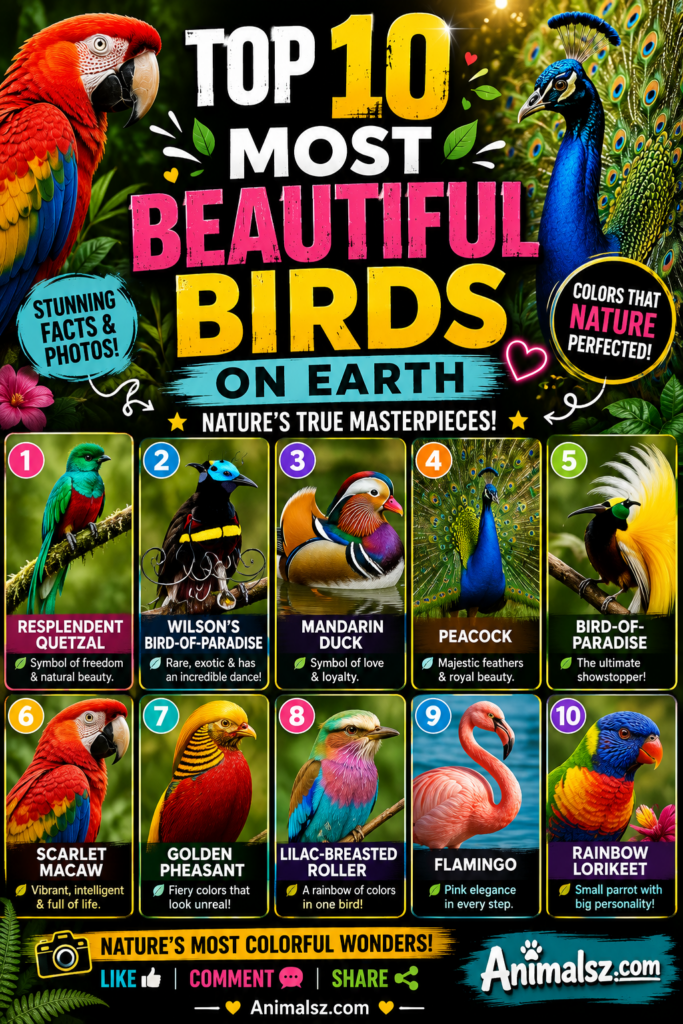
SEO Meta Title
Top 10 Most Beautiful Birds on Earth (With Stunning Photos & Amazing Facts)
SEO Meta Description
Discover the Top 10 most beautiful birds on Earth, featuring breathtaking images, fascinating facts, habitats, conservation status, and answers to frequently asked questions.
Suggested URL Slug
top-10-most-beautiful-birds-on-earth
Image ALT Text
- Rainbow Lorikeet perched on a flowering branch
- Greater Flamingo standing in shallow water
- Lilac-breasted Roller displaying colorful feathers
- Golden Pheasant walking through a forest
- Scarlet Macaw flying over a tropical rainforest
- Bird-of-Paradise performing its courtship dance
- Peacock displaying its magnificent tail
- Mandarin Duck swimming on a peaceful lake
- Wilson’s Bird-of-Paradise showing its brilliant blue crown
- Resplendent Quetzal perched in a cloud forest
Internal Linking Suggestions for Animalsz.com
- Top 10 Animals With Incredible Camouflage
- Top 10 Biggest Birds in the World
- Top 10 Smartest Animals on Earth
- Top 10 Animals With the Best Vision
- Top 10 Most Colorful Animals
- Top 10 Strongest Birds of Prey
- Amazing Rainforest Animals
- Top 10 Animals That Can Fly Without Wings
- Top 10 Loudest Animals in the World
- Wildlife Conservation: Why Protecting Birds Matters