
Top 10 Animals That Can Fly Without Wings
Keywords: animals that can fly without wings, gliding animals, flying snake, flying squirrel, flying fish, colugo, Draco lizard, ballooning spider, wingless flying animals
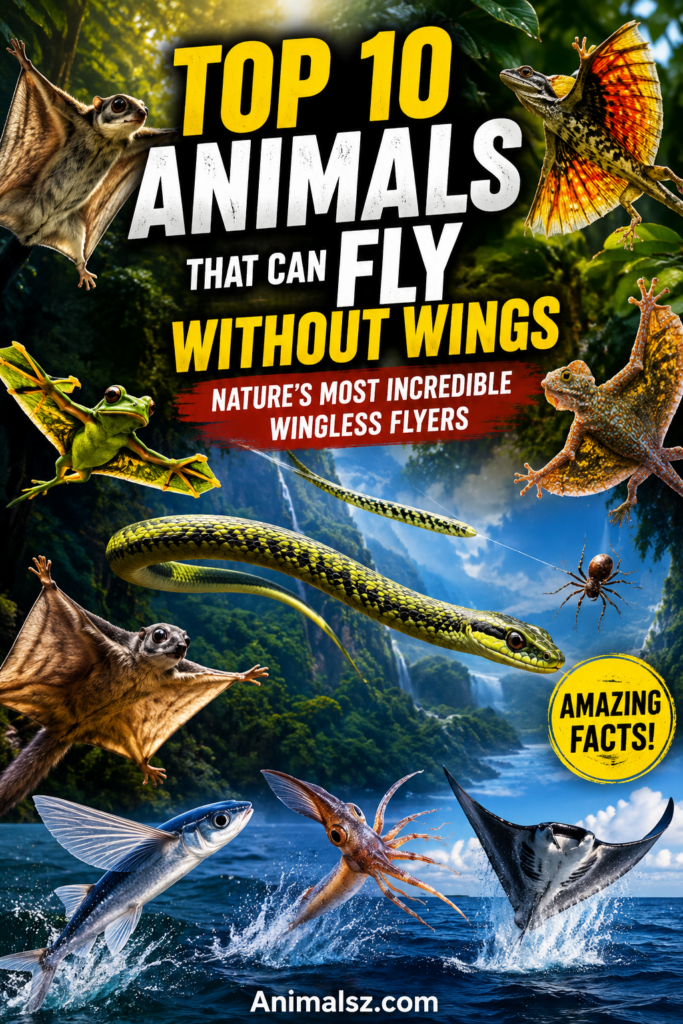
Table of Contents
- Introduction
- Number 10. Flying Squid
- Number 9. Gliding Gecko
- Number 8. Gliding Tree Frog
Introduction
Nature has developed countless ways for animals to move through the air. While birds, bats, and insects rely on wings to generate lift, some fascinating creatures have evolved completely different methods to travel above the ground or water. These remarkable animals glide, parachute, sail, or even launch themselves into the air using specialized body structures instead of wings.
Gliding is an energy-efficient way to escape predators, search for food, travel between trees, and survive in challenging environments. Some species flatten their bodies to create lift, others spread skin membranes like living parachutes, while a few rely on silk or powerful underwater propulsion to become airborne.
In this article, we’ll explore ten incredible animals that can “fly” without wings. You’ll discover how each species accomplishes this amazing feat, where they live, what they eat, and why their unique adaptations have fascinated scientists for decades.
Number 10. Flying Squid


Scientific Name
Todarodes pacificus (Japanese Flying Squid)
Habitat
The flying squid inhabits the Pacific Ocean, especially around Japan, China, Korea, and nearby coastal waters. It prefers open ocean environments where it hunts in schools.
Size
- Length: 8–20 inches (20–50 cm)
- Weight: Up to 3 pounds (1.4 kg)
Diet
Flying squid are active predators that feed on:
- Small fish
- Shrimp
- Crabs
- Other squid
Their powerful tentacles are lined with suction cups that help capture prey quickly.
How Does It Fly Without Wings?
Although it has no wings, the flying squid launches itself from the ocean using powerful jet propulsion. By forcefully expelling water through a muscular siphon, it shoots out of the sea at impressive speeds.
Once airborne, the squid spreads its fins and extends its tentacles to stabilize its body. This aerodynamic posture allows it to glide above the water instead of immediately falling back into the ocean.
Researchers have recorded flying squid gliding for more than 100 feet (30 meters) while reaching speeds approaching 25 mph (40 km/h).
Amazing Adaptations
Its streamlined body minimizes air resistance, while its flexible fins help maintain balance. Flying squid often leap in groups, creating spectacular displays over the ocean surface.
Scientists believe this ability evolved primarily to escape fast-swimming predators such as tuna, dolphins, and larger fish.
Interesting Facts
- Flying squid cannot flap like birds.
- Their jet propulsion is among the fastest escape mechanisms in marine animals.
- Some species can remain airborne for several seconds.
- They often travel in large schools numbering thousands.
Conservation Status
Currently listed as Least Concern, although overfishing and changing ocean temperatures may affect future populations.
Why It Matters
The flying squid demonstrates that evolution can produce remarkable aerial abilities without wings. By combining speed, hydrodynamics, and body control, it has become one of the ocean’s most extraordinary gliders.
Number 9. Gliding Gecko


Scientific Name
Gekko kuhli (Kuhl’s Flying Gecko)
Habitat
This remarkable gecko lives in the tropical rainforests of:
- Thailand
- Malaysia
- Indonesia
- Singapore
It spends most of its life on tree trunks where its camouflage makes it nearly invisible.
Size
- Length: 6–8 inches (15–20 cm)
Diet
The gliding gecko feeds mainly on:
- Crickets
- Moths
- Beetles
- Spiders
- Other small insects
How Does It Fly Without Wings?
Unlike birds, the gliding gecko doesn’t generate lift by flapping. Instead, it leaps from one tree and spreads loose folds of skin along its sides, legs, tail, and feet.
These skin flaps dramatically increase surface area, slowing its descent and allowing controlled glides toward another tree.
Its flattened tail acts like a rudder, helping it steer through dense forest canopies with remarkable accuracy.
Camouflage Expert
One of its greatest defenses is camouflage. Its bark-like coloration blends perfectly with tree trunks, making it difficult for predators to spot.
Even while gliding, the gecko remains surprisingly stable and can land precisely on vertical surfaces.
Interesting Facts
- It can cling upside down thanks to millions of microscopic toe hairs.
- It hunts almost entirely at night.
- It often glides to escape snakes and birds.
- Its camouflage is among the best in the reptile world.
Conservation Status
Generally considered Least Concern, although rainforest destruction threatens local populations.
Why It Matters
The gliding gecko shows how relatively small body modifications can dramatically improve survival. Rather than evolving wings, it transformed loose skin into an effective parachute.
Number 8. Gliding Tree Frog


Scientific Name
Rhacophorus nigropalmatus (Wallace’s Flying Frog)
Habitat
Native to the rainforests of:
- Malaysia
- Borneo
- Indonesia
- Southern Thailand
It spends nearly its entire life high in the forest canopy.
Size
- Length: 3–4 inches (8–10 cm)
Diet
The gliding tree frog primarily eats:
- Ants
- Beetles
- Flies
- Crickets
- Small spiders
How Does It Fly Without Wings?
Instead of wings, Wallace’s flying frog relies on enormous webbed feet.
When it leaps from tall trees, it spreads all four legs wide apart. The large webbing acts like tiny parachutes that create air resistance and slow its fall.
The frog adjusts the angle of its legs during flight, allowing it to steer toward nearby branches.
Some individuals have been observed gliding distances of over 50 feet (15 meters).
Built for the Rainforest
Living high above the forest floor means avoiding many predators. Gliding allows these frogs to travel between trees without climbing all the way down, saving both time and energy.
Their bright green coloration also provides excellent camouflage among leaves.
Interesting Facts
- Wallace’s Flying Frog was named after explorer Alfred Russel Wallace.
- Its toe pads allow it to grip smooth leaves.
- It lays eggs in foam nests above ponds.
- Tadpoles fall directly into the water after hatching.
Conservation Status
Currently listed as Least Concern, though habitat loss remains a growing concern due to deforestation.
Why It Matters
The gliding tree frog demonstrates how even amphibians can evolve sophisticated aerial abilities. Its giant webbed feet function as natural parachutes, making it one of the rainforest’s most remarkable aerial animals.
Number 7. Ballooning Spider


Scientific Name
Several spider species are capable of ballooning, but one of the most well-known belongs to the family Linyphiidae, commonly called sheet weavers or money spiders.
Habitat
Ballooning spiders can be found on every continent except Antarctica. They thrive in:
- Grasslands
- Forests
- Gardens
- Farms
- Coastal regions
- Mountain slopes
Many species live close to the ground but travel through the air to reach new habitats.
Size
- Length: 0.04–0.4 inches (1–10 mm)
- Weight: Less than a gram
Although tiny, these spiders accomplish one of the greatest aerial journeys in the animal kingdom.
Diet
Ballooning spiders feed on:
- Aphids
- Mosquitoes
- Gnats
- Small flies
- Tiny beetles
- Other small insects
They help farmers by naturally controlling pest populations.
How Does It Fly Without Wings?
Unlike birds or insects, ballooning spiders never flap their legs. Instead, they climb to the highest point they can find, raise their abdomen, and release several extremely thin silk strands.
The silk catches wind currents and even Earth’s electric field. As lift increases, the spider becomes airborne and drifts through the sky.
Scientists have discovered ballooning spiders thousands of feet above the ground and even hundreds of miles offshore.
Amazing Adaptations
Spider silk is incredibly light yet remarkably strong. Multiple silk threads create enough drag to lift the spider into the air despite its tiny size.
Researchers also believe atmospheric electrical charges help pull the silk upward, making ballooning possible even on days with very little wind.
Interesting Facts
- Ballooning usually occurs during warm, calm weather.
- Young spiders balloon more often than adults.
- Some spiders travel over 100 miles (160 km).
- Charles Darwin observed ballooning spiders while aboard the HMS Beagle far out at sea.
Conservation Status
Most ballooning spider species are abundant and are currently Least Concern.
Why It Matters
Ballooning spiders prove that flight doesn’t require wings or muscles. Nature has transformed simple silk into one of the world’s most effective methods of aerial travel, allowing spiders to colonize new environments across vast distances.
Number 6. Flying Fish


Scientific Name
Family Exocoetidae
There are more than 60 species of flying fish found around the world.
Habitat
Flying fish inhabit warm tropical and subtropical oceans, including:
- Atlantic Ocean
- Pacific Ocean
- Indian Ocean
- Caribbean Sea
- Mediterranean regions
They usually swim near the ocean’s surface.
Size
- Length: 7–20 inches (18–50 cm)
- Weight: Up to 2 pounds (900 g)
Diet
Flying fish primarily eat:
- Plankton
- Small crustaceans
- Fish larvae
- Tiny marine organisms
How Does It Fly Without Wings?
Flying fish begin by swimming underwater at speeds exceeding 35 mph (56 km/h). Just before reaching the surface, they rapidly beat their tails to gain extra acceleration.
As they burst into the air, they spread their enlarged pectoral fins, which function like glider wings. These fins don’t flap; instead, they generate lift as the fish glides above the water.
Some species can stay airborne for nearly 45 seconds, covering distances of more than 650 feet (200 meters).
Occasionally, they touch the water with their tails to gain another burst of speed before gliding again.
Amazing Adaptations
Their streamlined body reduces drag underwater, while their oversized fins maximize lift in the air.
Large eyes help them avoid predators both below and above the water.
Interesting Facts
- Flying fish cannot truly fly like birds.
- Dolphins, tuna, and marlin are their biggest predators.
- Some species have four enlarged fins, giving them an airplane-like appearance.
- Sailors have admired flying fish for centuries.
Conservation Status
Most flying fish species remain Least Concern, though climate change and overfishing may affect regional populations.
Why It Matters
Flying fish represent one of evolution’s greatest escape strategies. By combining incredible swimming speed with efficient gliding, they dramatically improve their chances of escaping hungry predators.
Number 5. Mobula Ray (Flying Ray)


Scientific Name
Genus Mobula
Several species belong to this group, including the giant devil ray and the spinetail mobula.
Habitat
Mobula rays inhabit warm oceans worldwide, especially in:
- Pacific Ocean
- Atlantic Ocean
- Indian Ocean
- Gulf of Mexico
- Sea of Cortez
They often swim in large schools close to the surface.
Size
Depending on the species:
- Wingspan: Up to 17 feet (5.2 meters)
- Weight: Up to 3,000 pounds (1,360 kg)
Diet
Mobula rays are filter feeders that consume:
- Plankton
- Tiny shrimp
- Krill
- Small fish larvae
They continuously swim with their mouths open to capture food.
How Does It Fly Without Wings?
Mobula rays generate tremendous speed underwater before launching themselves completely out of the ocean.
Once airborne, their broad pectoral fins act like gliding surfaces, allowing them to soar gracefully before splashing back into the sea.
Although they cannot sustain powered flight, some individuals leap over 6 feet (2 meters) above the water.
Why Do They Leap?
Scientists believe mobula rays leap for several reasons:
- Removing parasites
- Escaping predators
- Communicating with other rays
- Courtship displays
The loud splash when they land may also help signal nearby rays.
Amazing Adaptations
Their enormous fins provide excellent lift in water and stability in the air.
Their lightweight cartilage skeleton makes them more agile than many other large marine animals.
Interesting Facts
- Mobula rays are close relatives of manta rays.
- They sometimes perform synchronized jumps in groups.
- They can travel thousands of miles during migration.
- Watching hundreds of rays leap together is one of the ocean’s most spectacular wildlife events.
Conservation Status
Several Mobula species are listed as Endangered or Vulnerable because of overfishing, accidental capture in fishing nets, and slow reproduction.
Why It Matters
Mobula rays remind us that the ocean still holds astonishing surprises. Their breathtaking leaps showcase the incredible athletic abilities of one of the sea’s most graceful giants while highlighting the importance of protecting these magnificent animals for future generations.
Number 4. Colugo (Flying Lemur)


Scientific Name
The two living colugo species are:
- Sunda Colugo (Galeopterus variegatus)
- Philippine Colugo (Cynocephalus volans)
Despite the nickname “flying lemur,” colugos are not true lemurs and cannot perform powered flight. Instead, they are the world’s most accomplished gliding mammals.
Habitat
Colugos inhabit the dense tropical rainforests of:
- Malaysia
- Indonesia
- Thailand
- Singapore
- The Philippines
They spend nearly their entire lives in the forest canopy and rarely descend to the ground.
Size
- Body length: 13–17 inches (34–43 cm)
- Weight: 2–4 pounds (1–2 kg)
Diet
Colugos are herbivores that feed on:
- Young leaves
- Flower buds
- Fruits
- Sap
- Soft shoots
Their specialized stomach helps digest tough plant material.
How Does It Fly Without Wings?
The colugo possesses the largest gliding membrane, called a patagium, of any mammal. This membrane stretches from its neck to its fingertips, between its legs, and all the way to the tip of its tail.
When it leaps, the membrane opens like a living parachute, creating an enormous surface area that generates lift and allows the animal to glide with remarkable stability.
Researchers have documented colugos gliding more than 500 feet (150 meters) in a single leap while losing very little height.
Amazing Adaptations
Large forward-facing eyes provide excellent night vision, allowing colugos to navigate safely through dark forests.
Their sharp claws help them cling securely to tree trunks before launching into another glide.
Mother colugos can even glide while carrying their babies, wrapping the gliding membrane around the young like a protective pouch.
Interesting Facts
- Colugos are almost entirely nocturnal.
- They spend most daylight hours clinging motionless to tree trunks.
- Their gliding membrane is one of the largest relative to body size in the animal kingdom.
- Scientists consider them among the closest living relatives of primates.
Conservation Status
Most populations are listed as Least Concern, although habitat destruction and deforestation continue to reduce suitable rainforest habitat.
Why It Matters
The colugo represents one of evolution’s finest examples of efficient gliding. Rather than developing wings, it evolved an enormous membrane that allows long-distance travel through rainforest canopies while conserving energy.
Number 3. Flying Squirrel


Scientific Name
Flying squirrels belong to the tribe Pteromyini, which includes over 50 species found across North America, Europe, and Asia.
Some well-known species include:
- Northern Flying Squirrel (Glaucomys sabrinus)
- Southern Flying Squirrel (Glaucomys volans)
- Siberian Flying Squirrel (Pteromys volans)
Habitat
Flying squirrels live in:
- Deciduous forests
- Conifer forests
- Mixed woodlands
- Mountain forests
They nest inside tree cavities and abandoned woodpecker holes.
Size
- Body length: 8–15 inches (20–38 cm)
- Weight: 2–8 ounces (60–230 g)
Diet
Flying squirrels eat:
- Nuts
- Seeds
- Acorns
- Fruits
- Mushrooms
- Bird eggs
- Insects
- Tree buds
Their varied diet changes with the seasons.
How Does It Fly Without Wings?
Flying squirrels possess a furry membrane called the patagium, stretching between their front and back legs.
When jumping from a tree, they spread all four limbs, opening the membrane into a wide gliding surface.
Their flattened tail functions like both a rudder and a brake, allowing precise steering and gentle landings.
Some species glide 300 feet (90 meters) or more in a single leap.
Amazing Adaptations
Flying squirrels rotate their wrists nearly 180 degrees, giving them exceptional maneuverability during flight.
Their large eyes collect maximum light, making them excellent nighttime gliders.
Some species even glow pink under ultraviolet light, a discovery that surprised scientists in recent years.
Interesting Facts
- Flying squirrels do not flap like bats.
- They can make turns of almost 90 degrees while gliding.
- They communicate using high-pitched vocalizations humans cannot hear.
- Many species are active only after sunset.
Conservation Status
Most flying squirrel species are listed as Least Concern, although several localized populations face threats from habitat loss.
Why It Matters
Flying squirrels demonstrate how gliding can become an incredibly effective survival strategy. Their silent nighttime flights allow them to escape predators, locate food, and move efficiently through forest ecosystems.
Number 2. Draco (Flying Dragon Lizard)


Scientific Name
Genus Draco
Scientists have identified more than 40 species of Draco lizards throughout Southeast Asia.
Habitat
Flying dragons inhabit tropical forests in:
- Indonesia
- Malaysia
- Thailand
- Philippines
- India
- Vietnam
They spend almost their entire lives in trees.
Size
- Length: 7–10 inches (18–25 cm)
- Weight: Less than 7 ounces (200 g)
Diet
These fascinating reptiles feed primarily on:
- Ants
- Termites
- Beetles
- Tiny spiders
- Small insects
Ants often make up the majority of their diet.
How Does It Fly Without Wings?
Unlike any other lizard, Draco species possess elongated ribs that can extend outward from their bodies.
Attached to these ribs is a colorful membrane that unfolds into a pair of wing-like surfaces.
After leaping from a tree, the lizard spreads its ribs, creating lift that allows it to glide smoothly through the forest.
Its long tail acts as a stabilizer, helping steer toward another tree.
Most glides range from 30 to 200 feet (10–60 meters) depending on height and wind conditions.
Amazing Adaptations
The colorful gliding membranes also play an important role in courtship and territorial displays.
Different Draco species display unique colors and patterns, allowing individuals to recognize members of their own species.
Interesting Facts
- Draco lizards rarely descend to the forest floor.
- They can quickly fold their “wings” against their bodies after landing.
- Some species glide several times every day.
- They are among the most agile gliding reptiles on Earth.
Conservation Status
Most species are currently listed as Least Concern, though rainforest destruction remains the greatest long-term threat.
Why It Matters
The Draco flying lizard is one of evolution’s most remarkable engineering achievements. By transforming ordinary ribs into a sophisticated gliding system, it has mastered life high above the rainforest floor.
Number 1. Flying Snake


Scientific Name
Several species in the genus Chrysopelea are capable of gliding, including:
- Paradise Flying Snake (Chrysopelea paradisi)
- Golden Tree Snake (Chrysopelea ornata)
- Twin-Barred Tree Snake (Chrysopelea pelias)
- Sri Lankan Flying Snake (Chrysopelea taprobanica)
Despite the name, these snakes do not truly fly. Instead, they perform one of the most advanced forms of gliding found in any reptile.
Habitat
Flying snakes are native to the tropical forests of:
- India
- Sri Lanka
- Thailand
- Malaysia
- Singapore
- Indonesia
- The Philippines
They spend most of their lives in trees, where they hunt and rest high above the forest floor.
Size
- Length: 2–4 feet (0.6–1.2 meters)
- Weight: Generally less than 1 pound (450 g)
Diet
Flying snakes are carnivores and feed on:
- Lizards
- Tree frogs
- Small birds
- Bats
- Rodents
- Small reptiles
They rely on excellent eyesight and quick reflexes to capture prey.
How Does It Fly Without Wings?
The flying snake begins by climbing to a high branch. Before launching, it hangs from the edge in a distinctive “J” shape.
As it leaps, the snake dramatically flattens its body by spreading its ribs outward. This transforms its normally round body into a wide, concave shape that generates lift.
While gliding, the snake continuously undulates in the air, creating additional stability and helping it steer around branches.
Researchers have recorded flying snakes gliding more than 300 feet (90 meters) with remarkable precision.
Amazing Adaptations
Unlike gliding mammals that depend on skin membranes, flying snakes rely entirely on body shape and movement.
Scientists continue to study their unique aerodynamics because understanding their flight could inspire future drone and aircraft designs.
Interesting Facts
- Flying snakes are mildly venomous, but they pose little danger to humans.
- They can accurately target narrow tree branches while landing.
- Their gliding technique is unique among all snakes.
- They are considered some of the most agile tree-dwelling reptiles in Asia.
Conservation Status
Most flying snake species are currently classified as Least Concern, although deforestation continues to reduce their natural habitat.
Why It Matters
The flying snake is one of evolution’s greatest engineering marvels. Without wings, fins, or gliding membranes, it has mastered aerial movement simply by reshaping its body. It proves that nature can solve the challenge of flight in extraordinary ways.
Frequently Asked Questions (FAQ)
Can animals really fly without wings?
Most of these animals do not perform powered flight. Instead, they glide, parachute, or soar by using specialized body structures that create lift and reduce their rate of descent.
Which animal glides the farthest without wings?
The colugo is considered one of the longest-distance gliders among mammals, capable of traveling more than 500 feet (150 meters) in a single glide. Flying fish can also cover over 650 feet (200 meters) above the ocean.
Are flying snakes dangerous?
Flying snakes are only mildly venomous and are generally shy. They rarely interact with humans and prefer escaping into the trees.
Do flying squirrels actually fly?
No. Flying squirrels glide using a membrane called the patagium. They cannot flap their limbs to achieve powered flight like bats.
Why do flying fish leave the water?
Flying fish leap into the air primarily to escape predators such as tuna, dolphins, and marlin. Gliding allows them to quickly put distance between themselves and danger.
How do ballooning spiders stay in the air?
They release extremely fine silk threads that catch wind currents and atmospheric electric fields, allowing them to drift long distances through the sky.
Which gliding animal is the most accurate?
The flying snake is considered one of the most maneuverable gliders, capable of steering around obstacles and landing with surprising precision.
Are gliding animals found all over the world?
Yes. Gliding animals inhabit tropical rainforests, temperate forests, oceans, grasslands, and even gardens. Different species have independently evolved gliding abilities on multiple continents.
Why did these animals evolve gliding?
Gliding helps animals:
- Escape predators
- Travel between trees
- Find food more efficiently
- Conserve energy
- Explore new habitats
- Reduce the risk of descending to dangerous ground level
Conclusion
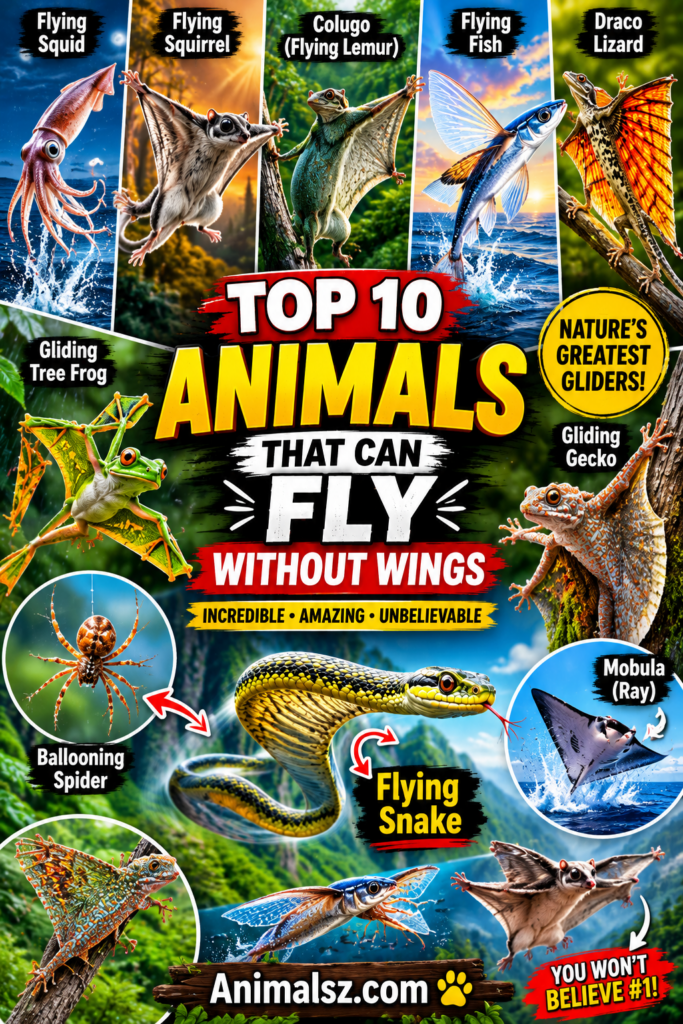
Animals don’t always need wings to conquer the skies. Through millions of years of evolution, nature has produced remarkable creatures capable of gliding across forests, soaring above oceans, and floating through the atmosphere using entirely different adaptations.
From the Flying Squid launching itself out of the sea to the Ballooning Spider riding invisible air currents, each species demonstrates a unique solution to aerial movement. The Flying Fish escapes predators with breathtaking speed, while the Colugo glides effortlessly through rainforest canopies using one of the largest membranes found in mammals. The Draco Flying Lizard transforms its ribs into wing-like structures, and the Flying Snake amazes scientists by reshaping its entire body into an aerodynamic airfoil.
These extraordinary animals remind us that evolution often finds unexpected solutions. Their ability to glide without wings showcases the incredible diversity of life on Earth and highlights the importance of protecting forests, oceans, and ecosystems where these species continue to thrive.
Whether you’re fascinated by reptiles, mammals, marine life, or tiny spiders floating across the sky, these wingless flyers prove that nature is far more inventive than we often imagine.
Suggested Internal Links
- Top 10 Animals With Incredible Camouflage
- Top 10 Animals That Live the Longest
- Top 10 Animals That Pretend to Be Dead
- Top 10 Strongest Predators in Africa
- Top 10 Tiny Animals That Are Extremely Dangerous
- Top 10 Animals With Human-Like Behaviors
- Top 10 Animals That Hunt in Packs
- Top 10 Animals That Look Like Aliens
Image SEO Alt Text
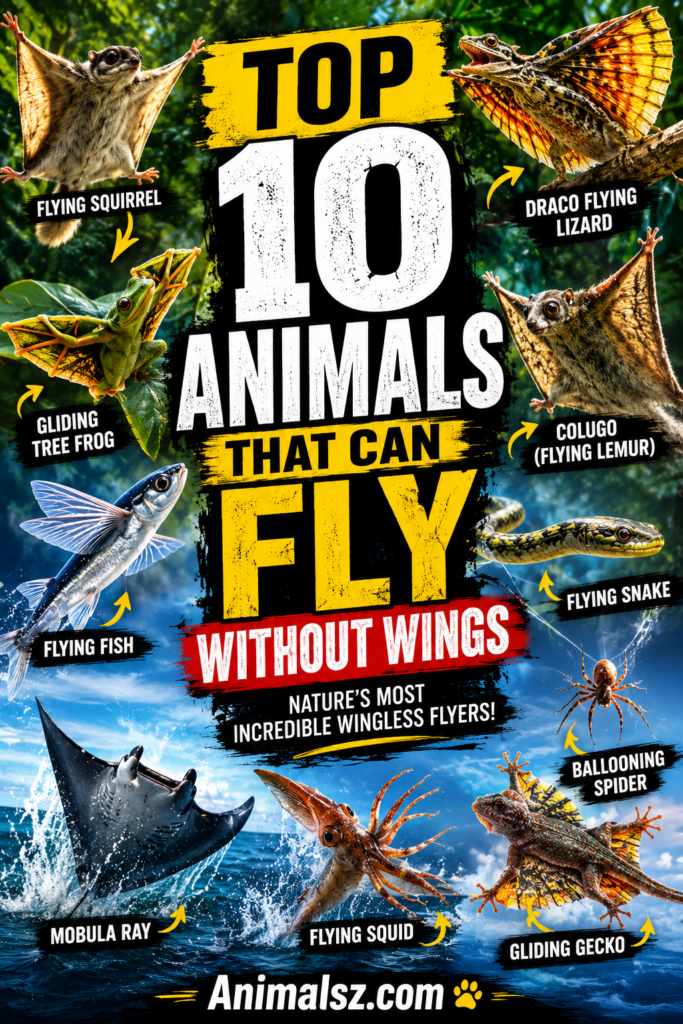
- Flying Squid gliding above the Pacific Ocean after launching from the water.
- Gliding Gecko spreading skin flaps while moving between rainforest trees.
- Wallace’s Flying Frog gliding through a tropical rainforest canopy.
- Ballooning Spider releasing silk threads to float through the air.
- Flying Fish soaring above ocean waves with enlarged fins extended.
- Mobula Ray leaping high above the ocean surface.
- Colugo gliding between tall rainforest trees at night.
- Flying Squirrel gliding silently through a forest canopy.
- Draco Flying Lizard extending colorful gliding membranes between trees.
- Paradise Flying Snake gliding through a tropical forest without wings.
Final Thoughts
The next time you think of flight, don’t just picture birds. Some of the world’s most astonishing aerial acrobats have no wings at all. Their incredible adaptations continue to inspire scientists, engineers, and wildlife enthusiasts alike, proving that the natural world is full of extraordinary surprises waiting to be discovered.