
Top 10 Strongest Predators in Africa
Meta Title: Top 10 Strongest Predators in Africa | Animalsz
Meta Description: Discover the top 10 strongest predators in Africa, from the mighty African lion to the deadly black mamba. Learn fascinating facts, hunting techniques, habitats, and why these apex predators dominate the wild.
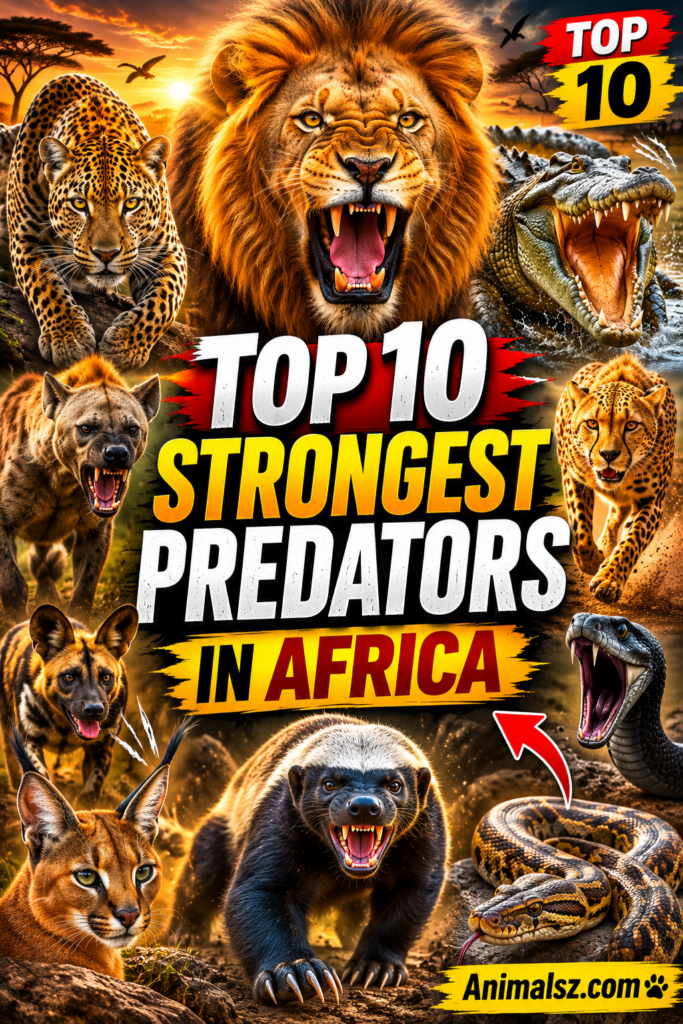
Africa is home to some of the most powerful predators on Earth. Across vast savannas, dense forests, winding rivers, and scorching deserts, these remarkable hunters have evolved incredible strength, speed, intelligence, and survival skills. Some rely on teamwork, while others depend on stealth, brute force, or deadly venom. Together, they maintain the balance of Africa’s ecosystems by controlling prey populations and ensuring only the strongest animals survive.
In this countdown, we’ll explore the Top 10 Strongest Predators in Africa, beginning with number 10.
Number 10: Caracal


The Caracal (Caracal caracal) may not be the largest predator in Africa, but it is one of the continent’s most athletic and efficient hunters. Instantly recognizable by its long black ear tufts and muscular build, the caracal is often called the “desert lynx,” although it is not a true lynx.
Found across sub-Saharan Africa, the Middle East, and parts of Asia, the caracal thrives in grasslands, woodlands, scrublands, and semi-desert environments. Unlike many large predators, it is highly adaptable and can survive in areas where food and water are limited.
What makes the caracal truly remarkable is its explosive jumping ability. It can leap over 10 feet (3 meters) into the air from a standing position, allowing it to catch multiple birds in a single jump. Few predators possess such incredible agility. Its powerful hind legs generate astonishing force, while razor-sharp claws ensure a secure grip on prey.
Although relatively small, weighing between 18 and 40 pounds (8–18 kilograms), the caracal regularly hunts animals close to its own size. Its diet includes guinea fowl, francolins, rabbits, hares, rodents, monkeys, reptiles, and young antelope. Every hunt relies on patience, camouflage, and lightning-fast acceleration rather than endurance.
Unlike lions or African wild dogs, caracals hunt alone. They stalk silently through tall grass before launching an explosive attack at precisely the right moment. Their excellent hearing allows them to locate prey hidden beneath vegetation, even in complete darkness.
Caracals are also highly territorial. They mark their territories with scent glands and defend hunting grounds from rivals. Their nocturnal lifestyle helps them avoid larger predators while maximizing hunting opportunities.
Despite being overshadowed by Africa’s famous big cats, the caracal’s combination of strength, speed, agility, and precision earns it a well-deserved place among Africa’s strongest predators.
Number 9: Honey Badger


Few animals have earned a reputation as fearless as the Honey Badger (Mellivora capensis). Although it weighs only 20 to 35 pounds (9–16 kilograms), this incredibly tough predator is famous for confronting animals many times larger than itself.
Native to most of sub-Saharan Africa, honey badgers inhabit grasslands, forests, deserts, and mountainous regions. Their adaptability allows them to survive almost anywhere food can be found.
The honey badger possesses thick, loose skin that protects it from bites and allows it to twist around even when another predator grabs it. This remarkable defense helps it survive encounters with venomous snakes, crocodiles, wild dogs, and even lions.
Its diet is one of the most varied among African predators. Honey badgers eat rodents, birds, insects, reptiles, tortoises, scorpions, eggs, fruit, and, of course, honey. Their powerful claws effortlessly tear apart termite mounds, dig burrows, and expose hidden prey beneath the ground.
Perhaps their most impressive ability is hunting venomous snakes such as cobras and puff adders. Thick skin offers some protection against bites, while their aggressive attacks quickly overpower dangerous reptiles.
Honey badgers are exceptionally intelligent. They have been observed using tools, solving problems, escaping enclosures, and remembering successful hunting techniques. Their determination has made them one of Africa’s most respected predators despite their modest size.
Although they generally hunt alone, honey badgers are capable of defending themselves against predators that most animals would flee from immediately.
Their courage, resilience, intelligence, and incredible physical toughness make the honey badger one of the fiercest hunters in the African wilderness.
Number 8: Black Mamba


The Black Mamba (Dendroaspis polylepis) is widely regarded as Africa’s most feared snake. While it relies on venom rather than brute strength, its speed, precision, and deadly efficiency make it one of the continent’s most formidable predators.
Despite its name, the black mamba is actually gray or olive-colored. The name comes from the jet-black interior of its mouth, which it displays when threatened.
Growing up to 14 feet (4.3 meters) long, it is among the world’s longest venomous snakes. Even more impressive is its speed. The black mamba can travel up to 12 miles (20 kilometers) per hour, making it one of the fastest snakes on Earth.
Unlike ambush predators, black mambas actively search for prey during daylight hours. Their diet includes birds, rodents, squirrels, bats, and other small mammals. Once prey is located, the snake strikes with incredible speed, injecting powerful neurotoxic venom before retreating safely. Within minutes, the venom begins shutting down the victim’s nervous system.
Black mambas possess excellent eyesight and remarkable awareness of their surroundings. Rather than wasting energy, they carefully choose the perfect opportunity to attack.
Although feared by humans, black mambas naturally avoid confrontation whenever possible. Most bites occur only when the snake feels cornered or threatened.
Their combination of speed, precision, intelligence, and one of the most potent venoms in the animal kingdom secures the black mamba’s position among Africa’s strongest predators.
Number 7: African Rock Python


The African Rock Python (Python sebae) is the largest snake in Africa and one of the continent’s most powerful predators. Although it is non-venomous, it relies on incredible muscle strength and patience to overpower prey. Growing up to 20 feet (6 meters) long and weighing more than 200 pounds (90 kilograms), this giant constrictor can successfully hunt animals much larger than most people would imagine.
African rock pythons are found throughout sub-Saharan Africa in grasslands, forests, wetlands, rocky hillsides, and river valleys. They are excellent swimmers and often stay close to water, where many animals gather to drink. Their natural camouflage blends perfectly with dry grass, fallen leaves, and rocky terrain, making them almost invisible until they strike.
Unlike fast-moving predators that chase their prey, the African rock python is an ambush hunter. It can remain perfectly motionless for hours while waiting for the right opportunity. Once an antelope, monkey, warthog, bird, or other animal comes within range, the python launches a lightning-fast attack. It grabs the prey with dozens of backward-curved teeth before wrapping its muscular body around the victim.
Contrary to popular belief, pythons do not crush bones. Instead, each time the prey exhales, the snake tightens its coils, preventing the animal from breathing until it eventually suffocates. Once the prey is dead, the python slowly swallows it whole using highly flexible jaws connected by stretchy ligaments.
African rock pythons can consume prey weighing more than half their own body weight. After an enormous meal, they may not need to eat again for several weeks or even months.
Female African rock pythons also display remarkable parental care. Unlike most reptiles, mothers remain coiled around their eggs, protecting them from predators until they hatch. This behavior increases the survival rate of their young and demonstrates an uncommon level of dedication among snakes.
With overwhelming strength, exceptional patience, and remarkable hunting efficiency, the African rock python deserves its place among Africa’s strongest predators.
Number 6: Cheetah


The Cheetah (Acinonyx jubatus) is the fastest land animal on Earth, capable of reaching speeds of up to 70 miles per hour (112 kilometers per hour). Built for speed rather than brute force, this incredible cat represents one of nature’s greatest engineering achievements.
Cheetahs inhabit open grasslands and savannas across eastern and southern Africa, where wide spaces allow them to use their extraordinary speed. Their lightweight body, flexible spine, oversized lungs, enlarged heart, and long muscular legs all work together to produce explosive acceleration.
Unlike lions or leopards, cheetahs hunt mainly during daylight hours. Their exceptional eyesight enables them to spot prey from hundreds of yards away while avoiding competition with larger nocturnal predators.
A typical hunt begins with a slow, careful stalk. The cheetah quietly approaches within approximately 200 feet (60 meters) before launching an explosive sprint. During the chase, its tail acts like a rudder, allowing rapid changes in direction as prey zigzags across the grasslands.
Most hunts last less than one minute because sprinting at maximum speed requires tremendous energy. Once the cheetah catches its prey, usually gazelles, impalas, young wildebeest, or hares, it uses a powerful bite to the throat to quickly suffocate the animal.
Although cheetahs are not the strongest cats in Africa, their incredible acceleration, agility, and precision make them among the continent’s most successful hunters. Their hunting success rate is often significantly higher than that of many larger predators.
Unfortunately, cheetahs face growing threats from habitat loss, declining prey populations, and conflict with humans. Conservation programs across Africa continue working to protect this iconic species for future generations.
The cheetah proves that speed, accuracy, and perfect timing can be just as powerful as raw strength.
Number 5: African Wild Dog


The African Wild Dog (Lycaon pictus), also known as the painted dog, is one of Africa’s most efficient and intelligent predators. While each individual weighs only 40 to 80 pounds (18–36 kilograms), their incredible teamwork allows them to bring down prey many times larger than themselves.
African wild dogs roam the grasslands, woodlands, and open savannas of eastern and southern Africa. Their colorful coats feature unique black, brown, white, and gold patterns, making every individual instantly recognizable. No two wild dogs have exactly the same markings.
Unlike solitary predators, African wild dogs depend entirely on cooperation. Every hunt is carefully coordinated using body language, vocalizations, and remarkable communication skills. Before setting off, pack members greet one another enthusiastically, strengthening social bonds that are essential for successful hunting.
Once prey is spotted, the entire pack works together with extraordinary discipline. Rather than relying on sudden bursts of speed, wild dogs use endurance. They chase antelope, impalas, gazelles, and other herbivores over long distances until the exhausted prey can no longer escape.
African wild dogs possess one of the highest hunting success rates of any large predator, often exceeding 80 percent. This remarkable efficiency comes from teamwork, strategy, and constant communication rather than overwhelming physical strength.
Their social structure is equally fascinating. Injured, elderly, and young pack members are often fed first after a successful hunt. Adults willingly regurgitate food for pups and weaker individuals, ensuring the survival of the entire family group.
Despite their incredible abilities, African wild dogs remain one of Africa’s most endangered carnivores. Habitat fragmentation, disease, and human conflict have significantly reduced their populations across the continent.
Their intelligence, endurance, cooperation, and exceptional hunting success make African wild dogs among the strongest and most effective predators in Africa.
Number 4: Leopard


The Leopard (Panthera pardus) is one of Africa’s most adaptable and powerful predators. Unlike lions that depend on prides or African wild dogs that hunt in packs, the leopard relies entirely on stealth, patience, and incredible strength. It is an apex predator capable of surviving in environments ranging from dense rainforests and rugged mountains to open savannas and semi-deserts.
Adult leopards typically weigh between 66 and 200 pounds (30–90 kilograms), but their muscular bodies allow them to perform astonishing feats of strength. One of their most famous abilities is dragging prey that weighs more than their own body weight high into the branches of a tree. This protects their meal from lions, hyenas, and other scavengers.
Leopards are primarily nocturnal hunters. Their spotted coat provides exceptional camouflage, allowing them to blend seamlessly into tall grass, rocky landscapes, or forest shadows. They often stalk within just a few feet of their target before launching an explosive ambush.
Their diet is incredibly diverse. Leopards hunt impalas, gazelles, monkeys, warthogs, baboons, birds, reptiles, rodents, fish, and even young crocodiles. Their adaptability allows them to survive in areas where other large predators struggle.
Strong jaws, razor-sharp claws, and remarkable climbing skills make the leopard one of Africa’s most versatile hunters. Unlike cheetahs that depend on speed, leopards combine stealth, power, agility, and intelligence into one deadly package.
Leopards are also highly territorial. They mark their territories with scent markings, scratches on trees, and vocal calls to warn rivals. Despite living alone most of the time, they are extremely successful hunters and can survive for many years by avoiding unnecessary conflict.
Because of their unmatched combination of strength, stealth, and adaptability, leopards remain among the most respected predators in the African wilderness.
Number 3: Spotted Hyena


The Spotted Hyena (Crocuta crocuta) is one of Africa’s strongest and most misunderstood predators. Popular culture often portrays hyenas as scavengers that steal food from lions, but scientific research has shown that they are actually highly skilled hunters responsible for catching much of their own prey.
Adult spotted hyenas weigh between 100 and 200 pounds (45–90 kilograms) and possess one of the strongest bite forces of any land mammal, reaching approximately 1,100 PSI. Their jaws are powerful enough to crush thick bones that most predators cannot break, allowing them to consume nearly every part of an animal, including bones, hooves, and horns.
Spotted hyenas live in large social groups called clans, which may contain more than 80 individuals. These clans operate under a complex social hierarchy led by dominant females, who are generally larger and more powerful than males.
When hunting, hyenas rely on teamwork, endurance, and communication. They often pursue zebras, wildebeest, antelope, buffalo calves, and other large herbivores over long distances until exhaustion weakens the prey. Their coordinated attacks make them exceptionally effective hunters.
Hyenas are also highly intelligent. Researchers have observed them solving complex problems, recognizing individual clan members, remembering territories, and adapting their hunting strategies to changing conditions. Their intelligence rivals that of some primates.
Although they frequently compete with lions over food, hyenas are capable of defending their kills and sometimes forcing lions to retreat when they greatly outnumber them.
Their incredible bite strength, endurance, intelligence, and social cooperation firmly establish the spotted hyena as one of Africa’s most formidable predators.
Number 2: Nile Crocodile


The Nile Crocodile (Crocodylus niloticus) is one of the oldest and most powerful predators still living today. Virtually unchanged for millions of years, this massive reptile dominates Africa’s rivers, lakes, wetlands, and swamps with unmatched patience and raw strength.
Large males commonly reach 16 to 20 feet (5–6 meters) in length and can weigh more than 1,600 pounds (725 kilograms). Even more impressive is their bite force, which exceeds 5,000 PSI, the strongest measured bite of any living animal.
Unlike predators that actively chase prey across open ground, Nile crocodiles rely on stealth. They float almost completely submerged, exposing only their eyes and nostrils while remaining nearly invisible. Animals approaching the water to drink often never realize the danger lurking beneath the surface.
When the perfect opportunity arrives, the crocodile explodes from the water with incredible speed. Its powerful jaws clamp shut instantly, while its muscular body drags the prey into deeper water. Larger victims are often killed using the famous “death roll,” where the crocodile spins violently to tear flesh and overwhelm struggling animals.
Nile crocodiles feed on fish, birds, reptiles, antelope, zebras, wildebeest, buffalo, and occasionally even lions that venture too close to the water’s edge. Juveniles begin with insects and small fish before gradually moving on to larger prey as they grow.
These ancient predators also demonstrate surprising parental care. Female crocodiles guard their nests aggressively and gently carry newly hatched babies to the water in their mouths, protecting them during the most vulnerable stage of life.
With unmatched bite force, extraordinary patience, explosive power, and remarkable evolutionary success, the Nile crocodile stands among the strongest predators Africa has ever produced.
Number 1: African Lion


The African Lion (Panthera leo) stands at the top of Africa’s food chain and is widely recognized as the continent’s most iconic predator. Known as the King of the Savanna, the lion combines immense physical strength, intelligence, teamwork, and courage to dominate some of the harshest environments on Earth.
Adult male lions typically weigh between 330 and 550 pounds (150–250 kilograms), while females generally weigh 265 to 400 pounds (120–180 kilograms). Their muscular bodies, sharp claws, and powerful jaws allow them to overpower prey much larger than themselves. A lion’s bite force is around 650 PSI, but it is their coordinated hunting strategy that truly makes them exceptional predators.
Unlike most big cats, lions live in highly social groups called prides. A pride may include several related females, their cubs, and one or more dominant males. This unique social structure allows lions to cooperate when hunting, defending territory, and raising young.
Lionesses perform most of the hunting. Working together, they quietly stalk prey before surrounding it from multiple directions. Their teamwork enables them to hunt some of Africa’s largest herbivores, including buffalo, zebras, wildebeest, giraffes, and occasionally young elephants and hippopotamuses. Once within striking distance, they launch a powerful ambush that leaves prey with little chance of escape.
Male lions primarily defend the pride’s territory against rival males and other predators. A male’s thunderous roar can travel up to 5 miles (8 kilometers) across the African savanna, warning competitors to stay away. Their presence helps protect cubs and ensures the pride maintains access to valuable hunting grounds.
Despite their reputation as fearless hunters, lions also face challenges. They often compete with hyenas, leopards, crocodiles, and even other lion prides for food and territory. Survival requires constant vigilance, strength, and cooperation.
African lions play a vital ecological role by controlling populations of large herbivores and maintaining the balance of the ecosystem. Without apex predators like lions, entire food chains can become unstable.
For their unmatched combination of power, intelligence, teamwork, leadership, and hunting ability, the African lion earns the number one position among the strongest predators in Africa.
Final Thoughts
Africa’s predators have evolved over millions of years into some of the most efficient hunters on the planet. Each species possesses unique adaptations that help it survive and thrive in its environment.
From the explosive speed of the cheetah to the crushing bite of the Nile crocodile, the bone-breaking jaws of the spotted hyena, the stealth of the leopard, and the cooperative hunting of African wild dogs, every predator plays an essential role in maintaining healthy ecosystems.
At the top stands the African lion—a symbol of strength, courage, and leadership that continues to inspire people around the world. Protecting these magnificent animals and their habitats is essential to preserving Africa’s extraordinary biodiversity for future generations.
Whether you dream of going on an African safari or simply enjoy learning about wildlife, these incredible predators remind us of nature’s beauty, power, and delicate balance.
Frequently Asked Questions (FAQ)
1. What is the strongest predator in Africa?
The African lion is generally considered the strongest predator in Africa because of its combination of physical power, teamwork, hunting ability, and dominance over the savanna.
2. Which African predator has the strongest bite?
The Nile crocodile has the strongest bite of any living animal, measuring over 5,000 PSI.
3. What is the fastest predator in Africa?
The cheetah is the fastest predator in Africa and the fastest land animal in the world, capable of reaching speeds of up to 70 mph (112 km/h).
4. Which predator has the highest hunting success rate?
The African wild dog has one of the highest hunting success rates of any large predator, often exceeding 80% because of its outstanding teamwork.
5. Are spotted hyenas only scavengers?
No. Although they scavenge when opportunities arise, spotted hyenas are highly effective hunters that catch much of their own prey.
6. Can a leopard carry prey into trees?
Yes. Leopards are famous for dragging prey heavier than themselves high into trees to protect it from other predators.
7. What animals do African lions hunt?
Lions commonly hunt zebras, wildebeest, buffalo, impalas, giraffes, warthogs, and occasionally young elephants and hippopotamuses.
8. Why are African wild dogs endangered?
Habitat loss, disease, road accidents, and conflicts with humans have significantly reduced wild dog populations across Africa.
9. Are black mambas aggressive?
Black mambas usually avoid humans and prefer to escape. They become dangerous mainly when cornered or threatened.
10. What makes the African rock python so powerful?
Its massive muscular body allows it to kill prey through constriction before swallowing it whole.
11. Which predator is the best climber?
The leopard is Africa’s best climbing predator and frequently stores its prey in trees.
12. Why are honey badgers considered fearless?
Their thick skin, powerful claws, intelligence, and willingness to confront dangerous animals have earned them a reputation for exceptional fearlessness.
13. Which African predator is the most intelligent?
The spotted hyena and African wild dog are among Africa’s most intelligent predators due to their advanced social behavior and problem-solving abilities.
14. Do crocodiles hunt on land?
Yes. Although they spend most of their lives in water, Nile crocodiles often ambush animals at the water’s edge and can move surprisingly quickly over short distances on land.
15. Why are apex predators important?
Apex predators regulate prey populations, reduce disease among wildlife, and help maintain healthy, balanced ecosystems.
16. Which African predator would you rank as number one?
Many experts place the African lion first because of its unmatched combination of strength, teamwork, and dominance, while others argue the Nile crocodile deserves the top spot due to its extraordinary bite force and ambush hunting abilities.
Thank you for reading!
Which African predator impresses you the most—the mighty lion, the unstoppable Nile crocodile, the lightning-fast cheetah, or another incredible hunter? Share your answer in the comments below!