
Top 10 Animals With Human-Like Behaviors
Have you ever watched an animal and thought, “That looks surprisingly human”? Scientists have spent decades studying animal behavior, and the discoveries are astonishing. Many animals display emotions, intelligence, teamwork, empathy, communication, and even culture that closely resemble our own. Some comfort grieving family members, others teach their young valuable survival skills, and a few even use tools to solve complex problems.
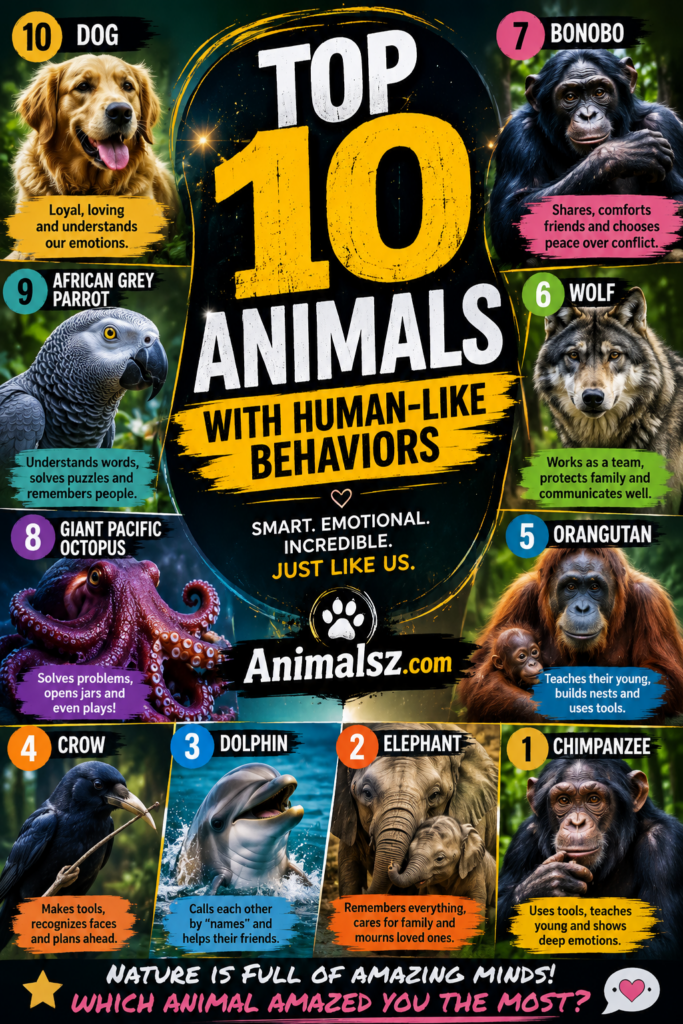
While humans remain unique in many ways, these incredible creatures remind us that intelligence and emotion are not exclusive to our species. From forests and oceans to the African savanna, these animals continue to surprise researchers with behaviors once believed to exist only in humans.
Let’s begin our countdown of the Top 10 Animals With Human-Like Behaviors.
Number 10. Dog


Dogs have earned the title of “man’s best friend” for thousands of years, and for good reason. Their ability to understand human emotions, communicate with people, and form lifelong relationships is unlike almost any other domesticated animal. Researchers have found that dogs can recognize facial expressions, distinguish happy from sad voices, and even respond differently depending on their owner’s emotional state.
One of the most remarkable human-like traits in dogs is empathy. Many dogs instinctively comfort people who are crying or upset. They may gently place a paw on someone’s leg, lick their face, or simply stay close to provide emotional support. This behavior is one reason therapy and service dogs are so successful in hospitals, nursing homes, and schools.
Dogs also understand human gestures remarkably well. Point to a toy across the room, and many dogs will immediately know where to look. This ability is rare in the animal kingdom and shows how closely dogs have evolved alongside humans over thousands of years.
Another fascinating behavior is their capacity for learning language. Studies suggest that some highly trained dogs can recognize hundreds of spoken words, distinguish between different objects, and even learn new vocabulary through repeated exposure. Border Collies, Golden Retrievers, and German Shepherds are especially known for their impressive learning abilities.
Dogs also display loyalty that rivals human friendships. They celebrate reunions with excitement, miss family members when they leave, and often put themselves in danger to protect the people they love. Stories of dogs rescuing children, alerting families to fires, or staying beside injured owners continue to make headlines around the world.
Their social lives mirror our own as well. Dogs form friendships with other dogs, cooperate during play, establish social hierarchies, and communicate through body language, facial expressions, and vocalizations. Every wagging tail, playful bow, and gentle nudge reflects a sophisticated system of communication developed over thousands of years.
These remarkable qualities make dogs one of the clearest examples of animals displaying behaviors that closely resemble those of humans.
Number 9. African Grey Parrot


African Grey Parrots are widely regarded as some of the most intelligent birds on Earth. While many parrots can imitate sounds, African Greys go far beyond simple mimicry. They often understand the meaning of the words they use and can apply them appropriately in different situations.
One of the most famous examples was an African Grey named Alex, whose extraordinary abilities changed scientists’ understanding of bird intelligence. Alex could identify colors, shapes, numbers, and materials while answering questions correctly. His achievements demonstrated that birds possess far more advanced cognitive abilities than previously believed.
These parrots also exhibit strong emotional intelligence. They develop deep bonds with family members and often recognize individual voices and faces. If separated from a favorite person, they may call out repeatedly until reunited. Some even appear jealous when another pet receives attention.
African Grey Parrots are excellent problem solvers. They manipulate objects, open locks, solve puzzles, and quickly learn routines through observation. In captivity, they often invent games to entertain themselves, showing creativity similar to that seen in young children.
Communication plays a central role in their lives. Wild African Greys constantly exchange calls with flock members to maintain social connections while flying through dense forests. Their ability to remember dozens or even hundreds of different sounds allows them to communicate effectively over long distances.
Like humans, these birds learn through observation and practice. Young parrots watch older birds closely before mastering important survival skills such as finding food, recognizing predators, and navigating complex forest environments.
Their intelligence, emotional awareness, and advanced communication skills make African Grey Parrots one of nature’s closest examples of human-like thinking.
Number 8. Giant Pacific Octopus


The Giant Pacific Octopus may look like an alien from another world, but beneath its soft body lies one of the most intelligent minds in the ocean. Unlike mammals and birds, octopuses evolved their remarkable intelligence independently, making their abilities even more extraordinary.
Octopuses are famous for solving complex puzzles. In laboratories, they have learned to open screw-top jars, unlock containers, navigate intricate mazes, and escape from aquariums through surprisingly small openings. Many researchers have watched them memorize solutions and repeat successful strategies without hesitation.
Curiosity is one of their most human-like characteristics. Rather than avoiding unfamiliar objects, octopuses frequently investigate them using their sensitive arms. They explore every surface, manipulate tools, and carefully examine anything new that enters their environment.
Another impressive behavior is play. Scientists have observed octopuses repeatedly pushing floating objects through currents, catching them again, and repeating the activity for no obvious survival benefit. Play is generally associated with highly intelligent animals and indicates advanced cognitive development.
Each octopus appears to have its own personality. Some individuals are bold and curious, while others are shy or cautious. Aquarium keepers often report that certain octopuses recognize familiar caretakers and respond differently to strangers, suggesting individual memory and social awareness.
Although they usually live alone, octopuses demonstrate remarkable adaptability. They gather shells, rocks, and coconut halves to construct shelters that protect them from predators. This ability to manipulate objects and alter their surroundings resembles the human tendency to build homes using available resources.
Perhaps most astonishing is their problem-solving flexibility. Instead of relying solely on instinct, octopuses often experiment with different approaches until they discover a successful solution. This trial-and-error learning resembles the way humans tackle unfamiliar challenges.
The Giant Pacific Octopus reminds us that intelligence has evolved in many different forms, proving that a large brain isn’t the only path to remarkable cognitive abilities.
Number 7. Bonobo


Bonobos are among humanity’s closest living relatives, sharing nearly 99% of their DNA with humans. Native to the rainforests of the Democratic Republic of the Congo, these highly intelligent apes are famous for their peaceful societies, emotional intelligence, and remarkable ability to cooperate. While chimpanzees often rely on aggression to settle disputes, bonobos usually resolve conflicts through affection, grooming, sharing, and social bonding.
One of the most human-like behaviors displayed by bonobos is empathy. Researchers have observed bonobos comforting distressed companions by hugging, touching, or gently grooming them after frightening or stressful experiences. Similar to humans comforting a friend, these actions reduce stress and strengthen social relationships within the group.
Bonobos are also incredibly generous. Experiments have shown that they willingly share food with individuals they have never met before, even when there is no immediate reward for doing so. This type of voluntary generosity was once believed to be a uniquely human trait.
Communication is another area where bonobos excel. They use a rich combination of facial expressions, body language, vocalizations, and gestures to express emotions and intentions. Young bonobos spend years learning these communication skills by observing older members of their community, much like human children learn from parents and teachers.
Family plays a central role in bonobo society. Mothers care for their young for several years, teaching them how to find food, build relationships, and navigate complex social interactions. Juveniles spend much of their childhood playing together, developing social skills that prepare them for adulthood.
Bonobos also demonstrate fairness and cooperation. During food-gathering activities, group members often work together instead of competing aggressively. They recognize the value of teamwork and maintain long-lasting friendships that can last for decades.
Scientists continue studying bonobos because their peaceful communities provide important insights into the evolution of empathy, cooperation, and human social behavior. Their lives remind us that kindness and collaboration can be powerful survival strategies in the natural world.
Number 6. Wolf


Wolves are often portrayed as fierce predators, but behind their powerful reputation lies one of the strongest family structures in the animal kingdom. A wolf pack functions much like a close-knit human family, with parents raising their young, older siblings helping care for pups, and every member contributing to the group’s survival.
Cooperation is the foundation of wolf society. During hunts, wolves carefully coordinate their movements to surround prey, communicate silently through body language, and adapt their strategy as conditions change. This level of teamwork requires trust, planning, and experience, qualities that closely resemble human group cooperation.
Communication among wolves is remarkably sophisticated. They howl to gather scattered pack members, warn neighboring packs about territory boundaries, and maintain contact over long distances. At close range, they use ear positions, tail movements, facial expressions, and posture to express emotions and intentions without making a sound.
Parental care is another striking human-like behavior. Wolf parents remain deeply devoted to their pups, protecting them from danger and bringing food back to the den. Older brothers and sisters often babysit, play with, and defend younger pups while the adults hunt. This cooperative family structure greatly improves the pups’ chances of survival.
Wolves also display grief and loyalty. Researchers have documented wolves remaining near deceased pack members, showing reduced activity after losing a companion, and searching for missing family members over extended periods. These emotional responses suggest strong social bonds similar to those seen in humans.
Learning plays a vital role in wolf life. Young wolves observe experienced adults to master hunting techniques, recognize dangerous situations, and understand pack communication. Skills are passed from one generation to the next through observation and practice rather than instinct alone.
Far from being solitary killers, wolves thrive because of trust, communication, loyalty, and family cooperation. Their complex social lives make them one of nature’s finest examples of human-like behavior.
Number 5. Orangutan


Orangutans are among the most intelligent primates on Earth and spend much of their lives high in the rainforests of Borneo and Sumatra. Although they are generally more solitary than chimpanzees or bonobos, they display remarkable behaviors that closely resemble human learning, parenting, and problem-solving.
One of the most fascinating human-like traits of orangutans is their ability to learn by observation. Young orangutans spend up to eight years with their mothers, one of the longest childhoods in the animal kingdom. During this time, they carefully watch every movement their mothers make, learning where to find food, which plants are safe to eat, how to avoid danger, and how to build comfortable sleeping nests.
Every evening, an orangutan constructs a fresh nest from branches and leaves high in the trees. These carefully woven structures provide safety, comfort, and protection from weather. The skill is learned through practice and experience, much like humans learn to build shelters or homes.
Orangutans are also skilled tool users. In different regions, they use sticks to extract insects or honey, leaves as umbrellas during rainstorms, and large leaves as gloves when handling thorny plants. Some populations even develop unique tool-use traditions that are passed from one generation to another, creating what scientists describe as animal culture.
Their intelligence shines through problem-solving. Orangutans can remember solutions to puzzles, manipulate complex objects, and adapt their strategies when faced with new challenges. In research settings, they have demonstrated excellent memory and planning abilities.
Emotionally, orangutans form deep bonds between mothers and offspring. Mothers patiently teach, protect, and nurture their young for years, sacrificing much of their own time and energy to ensure their offspring develop the skills needed to survive independently.
Researchers have also observed orangutans showing curiosity, patience, creativity, and even humor during play. These qualities, combined with their exceptional learning abilities and cultural traditions, make orangutans one of the strongest examples of human-like behavior in the animal kingdom.
Number 4. Crow


Crows are among the smartest birds on Earth, and their intelligence often rivals that of great apes. Members of the crow family, known as corvids, have repeatedly amazed scientists with their ability to solve problems, use tools, remember faces, and even plan for the future. Their remarkable cognitive abilities have earned them a reputation as the “geniuses” of the bird world.
One of the most impressive human-like behaviors displayed by crows is tool use. The New Caledonian crow, in particular, is famous for crafting hooks from twigs and shaping leaves into specialized tools to extract insects hidden inside tree bark. Instead of relying on instinct alone, these birds modify tools to fit specific tasks, demonstrating creativity and planning.
Crows also possess extraordinary memories. Researchers have shown that they can recognize individual human faces for years after a single encounter. If a person threatens or captures a crow, it may warn other crows, and even future generations appear to recognize the same individual. This ability to share information within a community resembles the way humans pass knowledge from one generation to another.
Problem-solving is another area where crows excel. In laboratory experiments, they have solved multi-step puzzles that require completing several actions in sequence before receiving a reward. They understand cause and effect, adapt their strategies when circumstances change, and often discover solutions without trial-and-error.
Social relationships are equally important. Crows cooperate to defend their territory, warn one another about predators, and sometimes gather in large groups to investigate unfamiliar objects. Young birds learn by watching experienced adults, creating local traditions that differ between crow populations.
Scientists have also observed crows storing food for future use. They hide food in secret locations and even move it later if they believe another crow has been watching. This suggests they can anticipate future needs and understand that others may steal from them, a level of thinking once believed to exist only in humans and a few primates.
Whether making tools, recognizing faces, teaching young, or planning ahead, crows continually demonstrate that remarkable intelligence is not limited to mammals.
Number 3. Dolphin


Dolphins have fascinated people for centuries because of their playful personalities, incredible intelligence, and strong social bonds. Living in highly organized pods, these marine mammals display many behaviors that closely resemble human cooperation, communication, and learning.
Perhaps their most remarkable human-like behavior is communication. Every bottlenose dolphin develops a unique signature whistle that functions much like a personal name. Other dolphins use these whistles to identify and call specific individuals, making dolphins one of the few known animals to use individual vocal labels.
Teamwork is another defining characteristic of dolphin society. During hunts, pods work together to herd schools of fish into tight groups, making them easier to catch. Each dolphin plays a specific role, demonstrating coordination, planning, and cooperation similar to that of organized human teams.
Dolphins also invest heavily in teaching their young. Mothers spend several years raising calves, showing them how to hunt, avoid predators, and navigate their environment. In some coastal regions, mothers teach calves to use marine sponges as protective tools over their snouts while searching for food on the seafloor. This learned behavior is passed from generation to generation, creating cultural traditions unique to certain dolphin populations.
Empathy is another trait dolphins share with humans. They have been observed supporting injured pod members by lifting them to the water’s surface so they can breathe. There are also numerous documented cases of dolphins protecting swimmers from sharks or assisting stranded individuals back toward shore, although such behavior varies by situation.
Play remains an essential part of dolphin life. They surf ocean waves, chase one another, toss seaweed through the water, and create bubble rings purely for entertainment. Scientists believe play strengthens social bonds while helping young dolphins develop important physical and cognitive skills.
Their advanced communication, cooperation, culture, empathy, and playful nature make dolphins one of the closest parallels to human society found anywhere in the animal kingdom.
Number 2. Elephant


Elephants are widely regarded as some of the most emotionally intelligent animals on Earth. Their deep family bonds, extraordinary memories, and compassionate behavior have impressed scientists for decades. Living in close-knit herds led by experienced matriarchs, elephants rely on cooperation, communication, and shared knowledge to survive.
One of the most touching human-like behaviors displayed by elephants is mourning. Researchers have repeatedly observed elephants returning to the bones or tusks of deceased herd members, gently touching them with their trunks and standing silently nearby. Some elephants revisit these locations years later, suggesting long-term memory and emotional attachment.
Family is the center of elephant life. Mothers, grandmothers, aunts, and older sisters work together to raise calves in a cooperative system often described as “allomothering.” If a calf falls, becomes trapped, or is threatened by predators, several adults immediately rush to protect and assist it. This collective childcare resembles the support systems found in many human communities.
Elephants also display remarkable empathy. Herd members comfort distressed companions by touching them with their trunks, making soft vocalizations, and remaining close during difficult situations. Injured or elderly elephants often receive assistance from healthier members while traveling long distances in search of food and water.
Their memory is legendary. Experienced matriarchs remember migration routes, water sources, and safe feeding grounds across vast landscapes, even after many years of drought. This knowledge is shared with younger generations, allowing the herd to survive changing environmental conditions.
Communication among elephants is equally sophisticated. They use powerful low-frequency rumbles, many below the range of human hearing, to communicate across several kilometers. Combined with body language and touch, these signals help coordinate movement, strengthen social bonds, and warn of potential danger.
Elephants have also been observed playing, celebrating reunions, and showing curiosity toward unfamiliar objects. These behaviors, combined with their empathy, long-term memory, cooperative parenting, and emotional depth, make elephants one of the most human-like animals on the planet.
Number 1. Chimpanzee


Chimpanzees are our closest living relatives, sharing approximately 98–99% of their DNA with humans. Found in the forests and savannas of Central and West Africa, these remarkable primates display an astonishing range of behaviors that closely resemble our own. From making tools to expressing emotions and teaching their children, chimpanzees demonstrate just how closely connected humans are to the rest of the animal kingdom.
One of the most famous examples of chimpanzee intelligence is their use of tools. Wild chimpanzees carefully select sticks, strip away leaves, and insert the tools into termite mounds to catch insects. They also use rocks as hammers to crack open nuts and large leaves as drinking sponges to soak up water. These are not instinctive actions alone—they are learned skills passed from one generation to the next.
Chimpanzees also have complex social lives. They live in communities where friendships, alliances, and cooperation play important roles. Group members groom one another to strengthen social bonds, reduce stress, and build trust. Grooming serves much the same purpose as human hugs, handshakes, or friendly conversations.
Perhaps the most touching human-like behavior is their emotional intelligence. Chimpanzees comfort frightened companions, care for injured individuals, and mourn the loss of close family members. Mothers remain deeply devoted to their infants, carrying them everywhere and patiently teaching them survival skills for several years.
Young chimpanzees spend much of their childhood observing adults. They learn which foods are safe to eat, how to build sleeping nests, how to communicate effectively, and how to use tools. This process of learning through observation closely mirrors the way human children develop skills from parents and teachers.
Scientists have also documented chimpanzees planning ahead, solving multi-step problems, recognizing themselves in mirrors, remembering solutions for years, and even using simple gestures to communicate specific requests. Their facial expressions clearly convey happiness, fear, anger, surprise, and affection, making their emotions surprisingly familiar to us.
These extraordinary abilities have transformed our understanding of intelligence and social behavior. Chimpanzees remind us that many of the qualities we once believed made humans unique—cooperation, learning, empathy, culture, and problem-solving—also exist in our closest relatives.
Their remarkable intelligence earns them the number one spot on this list of Animals With Human-Like Behaviors.
Conclusion
The natural world is filled with astonishing examples of intelligence, compassion, and cooperation. Dogs comfort their owners, parrots understand words, octopuses solve puzzles, bonobos resolve conflicts peacefully, wolves care for their families, orangutans teach their young, crows plan ahead, dolphins call each other by individual “names,” elephants mourn their loved ones, and chimpanzees use tools while passing knowledge from one generation to the next.
These behaviors demonstrate that humans are not alone in experiencing emotions, forming deep relationships, or solving complex problems. Every new scientific discovery continues to reveal just how sophisticated animal minds truly are. Protecting these incredible species and their habitats ensures that future generations can continue learning from them and appreciating the rich diversity of life on Earth.
Whether living in forests, oceans, deserts, or grasslands, these animals remind us that empathy, cooperation, communication, and intelligence are shared across the animal kingdom. Their stories inspire us to respect nature and recognize the remarkable connections between humans and wildlife.
Frequently Asked Questions (FAQ)
1. Which animal behaves most like a human?
Chimpanzees are generally considered the most human-like animals because they share nearly 99% of our DNA. They use tools, solve problems, form friendships, express emotions, teach their young, and live in complex social groups.
2. Can animals feel emotions like humans?
Yes. Scientific research shows that many animals experience emotions such as joy, fear, sadness, grief, affection, and empathy. Elephants, dolphins, dogs, wolves, and great apes are particularly well known for their emotional behavior.
3. Which animals use tools?
Chimpanzees, orangutans, crows, dolphins, and octopuses are among the best-known tool users. They use sticks, rocks, leaves, sponges, shells, and other objects to obtain food or solve problems.
4. Do animals teach their young?
Absolutely. Many species actively teach their offspring important survival skills. Orangutans, chimpanzees, elephants, dolphins, wolves, and some birds spend years helping their young learn how to find food, avoid predators, and interact with others.
5. Which animal has the best memory?
Elephants are famous for their exceptional long-term memory. They can remember migration routes, water sources, family members, and dangerous locations for many years.
6. Can animals recognize themselves?
Yes. Chimpanzees, bonobos, orangutans, dolphins, elephants, and magpies have all passed versions of the mirror self-recognition test, suggesting a level of self-awareness.
7. Which bird is the smartest?
Many scientists consider crows, ravens, and African grey parrots to be among the smartest birds because of their advanced problem-solving abilities, memory, communication skills, and capacity for learning.
8. Why do elephants touch the bones of dead elephants?
Researchers believe this behavior reflects mourning, curiosity, memory, and strong social bonds. Elephants often gently investigate the remains of herd members with their trunks.
9. Why are dolphins considered highly intelligent?
Dolphins communicate using signature whistles, cooperate during hunts, teach their young, solve problems, recognize themselves in mirrors, and display empathy toward other dolphins and, in some cases, humans.
10. Why is it important to protect intelligent animals?
Protecting intelligent species helps preserve biodiversity, supports healthy ecosystems, and ensures that future generations can continue studying and appreciating these remarkable creatures.
Final Thoughts
The more scientists study wildlife, the more they discover that intelligence, compassion, communication, and culture are not uniquely human. These extraordinary animals continue to reshape our understanding of life on Earth and remind us that every species has something valuable to teach us.
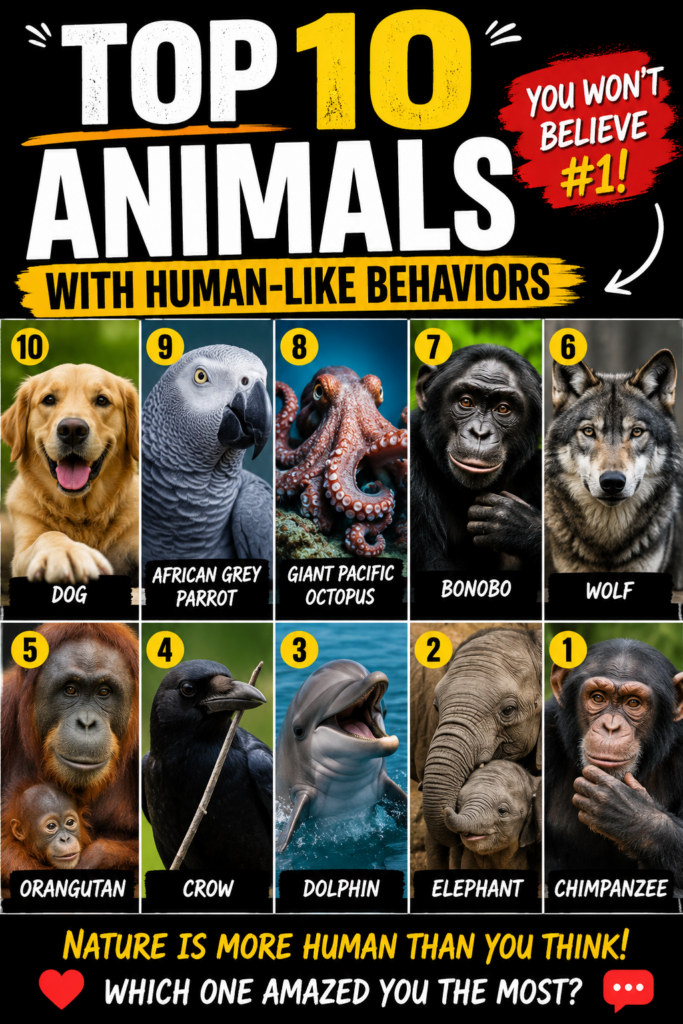
Which animal on this list surprised you the most, and which one do you think behaves the most like humans? Share your thoughts in the comments below!