
Top 10 Animals That Can Survive Without Water
Introduction
Deserts are among the harshest environments on Earth. With scorching daytime temperatures, freezing nights, and little to no rainfall, surviving in these landscapes is an incredible challenge. Yet, some animals have evolved extraordinary adaptations that allow them to live for weeks, months, or even their entire lives without drinking water.
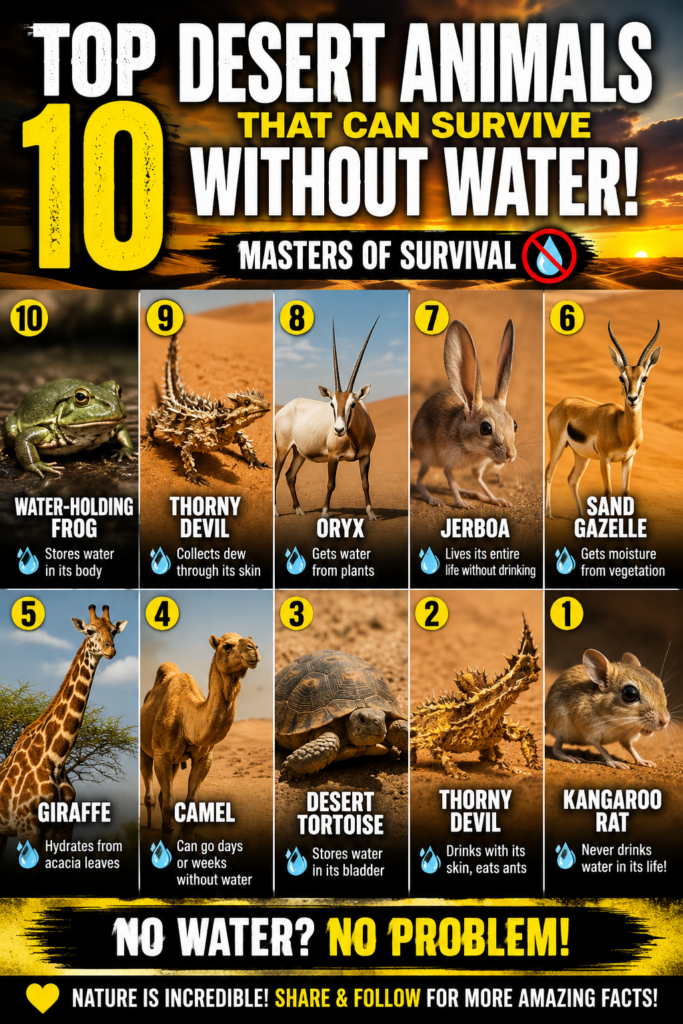
Instead of relying on rivers or lakes, these remarkable creatures obtain moisture from their food, store water inside their bodies, or minimize water loss through specialized biological features. From tiny rodents that never need a drink to reptiles that collect dew through their skin, nature has developed countless survival strategies.
In this countdown, we’ll explore the Top 10 Animals That Can Survive Without Water, beginning with one of Australia’s most fascinating amphibians.
Number 10. Water-Holding Frog


The Water-Holding Frog (Cyclorana platycephala) is one of Australia’s most remarkable desert survivors. While frogs are usually associated with ponds and wetlands, this species has evolved to thrive in some of the driest regions of the Australian Outback.
Before the dry season begins, the frog drinks and absorbs enormous amounts of water through its skin. Its body acts like a living water tank, storing moisture in tissues beneath the skin and inside its bladder. Once fully hydrated, it buries itself deep underground using its powerful hind legs.
Inside its underground chamber, the frog enters a state called aestivation, a type of dormancy similar to hibernation but designed for surviving hot, dry conditions. During this period, its metabolism slows dramatically, allowing it to survive for months—and in some cases over a year—without eating or drinking.
To reduce water loss even further, the frog produces a protective cocoon made from layers of shed skin. This natural barrier helps trap moisture inside its body while shielding it from the surrounding dry soil.
When heavy rains finally arrive, the cocoon softens, and the frog quickly emerges from the ground. It immediately begins feeding on insects and breeding in temporary pools that form after storms. Because these pools disappear quickly, the frog’s entire life cycle is incredibly fast and efficient.
The Water-Holding Frog has even played an important role in the survival of Indigenous Australians. During extreme droughts, people have traditionally located these frogs underground and carefully accessed the stored water they contain, providing a valuable emergency source of hydration.
This extraordinary amphibian demonstrates that even animals commonly associated with water can evolve incredible strategies to survive prolonged drought.
Quick Facts
- Scientific Name: Cyclorana platycephala
- Habitat: Australian deserts and arid grasslands
- Diet: Insects, spiders, worms, and other small invertebrates
- Maximum Survival Without Drinking: Several months to over a year during aestivation
- Special Adaptation: Stores water inside its body and forms a protective cocoon underground
Did You Know?
The Water-Holding Frog can remain buried underground until rainfall returns, sometimes staying hidden for more than a year before emerging to continue its life cycle.
Number 9. Spadefoot Toad


The Spadefoot Toad is one of nature’s greatest desert survival experts. Despite being an amphibian—a group of animals that usually depend on water—this remarkable toad spends most of its life far from ponds and streams. Instead, it survives in dry deserts, grasslands, and sandy plains across North America by avoiding the harsh environment rather than fighting it.
Its name comes from the hard, shovel-like “spade” on each hind foot. These specialized structures allow the toad to dig backward into loose soil within minutes. Once underground, it escapes the scorching desert heat and remains in cool, moist soil where water loss is greatly reduced.
During long droughts, the Spadefoot Toad enters a deep dormant state known as aestivation. Its heart rate and metabolism slow dramatically, allowing it to survive for many months without drinking water or eating food. Some species have remained underground for nearly a year while waiting for the next heavy rainfall.
When powerful desert storms finally arrive, the transformation is almost instant. The toads emerge from their burrows at night and race to temporary rain pools. Because these pools may disappear within days, they breed quickly. Females lay hundreds or even thousands of eggs, and the tadpoles grow at an astonishing speed—sometimes completing metamorphosis in as little as two weeks before the water evaporates.
Unlike many amphibians, Spadefoot Toads obtain much of the moisture they need from insects, worms, beetles, and other small invertebrates they consume. Their mostly nocturnal lifestyle also helps conserve water by avoiding the intense daytime sun.
Their excellent camouflage, burrowing behavior, and ability to survive extended droughts make them one of the most resilient amphibians on Earth. Although rarely seen, these fascinating animals are perfectly adapted to some of the harshest environments in North America.
Quick Facts
- Scientific Name: Scaphiopus spp. and Spea spp.
- Habitat: Deserts, prairies, scrublands, and sandy grasslands of North America
- Diet: Insects, spiders, beetles, ants, termites, worms, and other small invertebrates
- Maximum Survival Without Drinking: Many months while underground during aestivation
- Special Adaptation: Powerful burrowing feet, extremely slow metabolism, and rapid breeding after rainfall
Did You Know?
Some Spadefoot Toad tadpoles can transform into young toads in less than two weeks, making them among the fastest-developing amphibians in the world. This incredible speed allows them to complete their life cycle before temporary desert pools dry up.
Number 8. Oryx


The Oryx is one of the most iconic desert animals in the world. With its long, straight horns and striking black-and-white facial markings, this powerful antelope thrives in some of the hottest and driest environments on Earth. Found in the deserts of Africa and the Arabian Peninsula, the oryx has evolved extraordinary adaptations that allow it to survive for weeks without drinking water.
Instead of relying on waterholes, the oryx gets most of its hydration from the plants it eats. Desert grasses, shrubs, roots, bulbs, and succulent plants contain enough moisture to meet much of its daily water needs. After rare desert rains, the oryx quickly feeds on fresh vegetation, storing valuable nutrients and moisture for the dry months ahead.
One of its greatest survival tools is its ability to regulate body temperature. During the hottest part of the day, the oryx allows its body temperature to rise slightly, reducing the need to sweat. By sweating less, it conserves precious water that would otherwise be lost through evaporation. A specialized network of blood vessels near the brain also helps cool the blood, protecting vital organs from extreme heat.
The oryx is most active during the cooler hours of the morning, evening, and night. During the day, it rests in the shade or faces into the wind to reduce heat exposure. Its broad hooves make walking across loose desert sand much easier, allowing it to travel long distances in search of food.
Although strong enough to defend itself with its sharp horns, the oryx mainly relies on its speed, alertness, and group behavior to avoid predators such as lions, hyenas, and wild dogs. Living in small herds also increases the chances of finding food and detecting danger.
Once hunted to near extinction in parts of its range, conservation programs have helped restore populations of species like the Arabian oryx. Today, it stands as one of the world’s greatest conservation success stories and a symbol of survival in the desert.
Quick Facts
- Scientific Name: Oryx spp.
- Habitat: Deserts, semi-deserts, and arid grasslands of Africa and the Arabian Peninsula
- Diet: Grasses, shrubs, roots, bulbs, herbs, and succulent plants
- Maximum Survival Without Drinking: Several weeks, depending on available vegetation
- Special Adaptation: Obtains water from plants, conserves moisture by reducing sweating, and tolerates high body temperatures
Did You Know?
The Arabian oryx was once extinct in the wild. Thanks to international breeding and reintroduction efforts, it became the first large mammal to move from “Extinct in the Wild” to a lower conservation risk category—a remarkable wildlife conservation achievement.
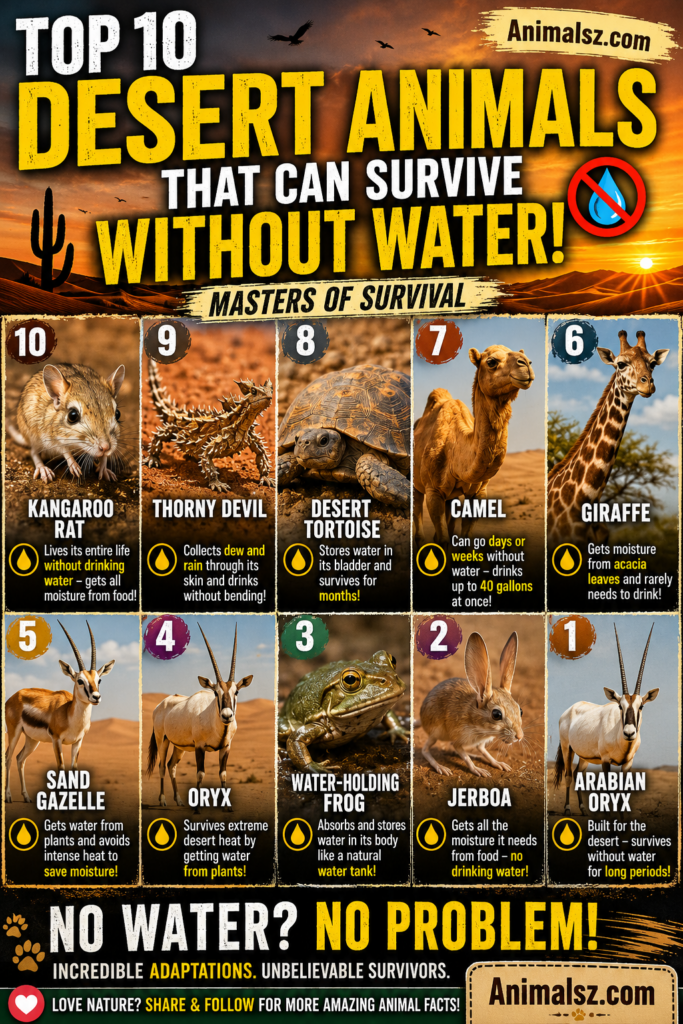
Number 6. Sand Gazelle


The Sand Gazelle (Gazella marica) is one of the most graceful animals to roam the deserts of the Arabian Peninsula. Living in landscapes where temperatures can soar above 120°F (49°C) and rainfall is extremely scarce, this elegant antelope has evolved remarkable adaptations that allow it to survive for long periods without drinking water.
Unlike many mammals, the Sand Gazelle does not depend on rivers or watering holes for its daily survival. Instead, it obtains most of the moisture it needs from the leaves, grasses, herbs, and desert shrubs it eats. After rare rainstorms, these plants absorb precious water, providing the gazelle with enough hydration to thrive even when standing water is unavailable.
To conserve water, the Sand Gazelle avoids the hottest part of the day. It is most active during the early morning, late afternoon, and nighttime when temperatures are cooler. During the intense midday heat, it rests in the shade of bushes or small dunes, reducing both body temperature and water loss.
Its light-colored coat reflects much of the sun’s heat, while its efficient kidneys produce highly concentrated urine, helping the animal retain nearly every drop of moisture. These physiological adaptations make the Sand Gazelle one of the best-equipped mammals for surviving prolonged drought.
The Sand Gazelle is also an incredibly agile runner. It can sprint at speeds of up to 50 miles per hour (80 km/h), allowing it to escape predators such as wolves, foxes, and large birds of prey. Its slender legs and broad hooves make it well suited for running across loose desert sand.
Although once abundant across the Middle East, habitat loss, hunting, and human development have caused populations to decline. Today, conservation programs and protected reserves are helping ensure that this beautiful antelope continues to survive in its natural desert home.
The Sand Gazelle is a perfect example of how nature has equipped wildlife to flourish in one of the harshest environments on Earth.
Quick Facts
- Scientific Name: Gazella marica
- Habitat: Sandy deserts, gravel plains, and arid grasslands of the Arabian Peninsula
- Diet: Desert grasses, herbs, leaves, shrubs, flowers, and young shoots
- Maximum Survival Without Drinking: Several weeks, depending on the moisture available in vegetation
- Special Adaptation: Obtains water from plants, conserves moisture with efficient kidneys, and avoids extreme daytime heat
Did You Know?
A Sand Gazelle can detect approaching danger from hundreds of feet away and instantly accelerate into fast, graceful leaps across the desert, making it one of the most agile antelopes in the world.
Number 5. Giraffe


The Giraffe (Giraffa spp.) is the tallest land animal on Earth, reaching heights of up to 18 feet (5.5 meters). While giraffes are often seen roaming the African savannas, many people are surprised to learn that they can survive for weeks without drinking water. Their incredible ability to conserve moisture makes them well adapted to dry environments where water sources may be scarce.
Instead of relying on rivers or watering holes, giraffes obtain much of the water they need from the fresh leaves, shoots, and buds of acacia trees. These plants contain a high percentage of moisture, providing enough hydration to support the giraffe’s daily needs.
A giraffe’s kidneys are highly efficient at conserving water. They produce extremely concentrated urine, while the digestive system absorbs nearly every possible drop of moisture from food before waste is eliminated. These adaptations help minimize water loss, allowing giraffes to travel long distances without needing a drink.
Drinking is also one of the most dangerous activities for a giraffe. To reach the ground, it must spread its long front legs and bend its neck, leaving it vulnerable to predators such as lions, crocodiles, and hyenas. By drinking less frequently, giraffes reduce the number of times they must expose themselves to danger.
Their towering height provides another survival advantage. Giraffes can reach leaves that are inaccessible to most other herbivores, reducing competition for food during dry seasons. Their rough, prehensile tongues—measuring up to 20 inches (50 centimeters) long—allow them to strip leaves from thorny acacia branches without injury.
Although giraffes are gentle giants, they are capable of defending themselves with powerful kicks that can seriously injure or even kill a predator. Living in loose social groups also helps them detect danger more quickly across the open savanna.
Today, giraffe populations face threats from habitat loss, poaching, and expanding human development. Conservation efforts across Africa are working to protect these iconic animals and their habitats for future generations.
Quick Facts
- Scientific Name: Giraffa spp.
- Habitat: African savannas, open woodlands, and dry grasslands
- Diet: Acacia leaves, shoots, flowers, fruits, and twigs
- Maximum Survival Without Drinking: Several weeks, depending on the moisture content of available vegetation
- Special Adaptation: Gets most of its water from food, has highly efficient kidneys, and minimizes risky trips to waterholes
Did You Know?
A giraffe’s heart weighs up to 25 pounds (11 kilograms) and generates extremely high blood pressure to pump blood all the way up its long neck to its brain, making it one of the most powerful hearts in the animal kingdom.
Number 4. Camel


The Camel (Camelus dromedarius and Camelus bactrianus) is often called the “Ship of the Desert,” and for good reason. For thousands of years, camels have helped people travel across some of the hottest and driest regions on Earth. Their incredible ability to survive long periods without drinking water has made them one of nature’s greatest desert survivors.
Contrary to popular belief, camels do not store water in their humps. Instead, their humps store fat, which can be converted into energy and a small amount of metabolic water when food is scarce. Their real secret lies in a collection of remarkable physiological adaptations.
A camel’s body can safely lose up to 25–30% of its body water, an amount that would be fatal for most mammals. It also allows its body temperature to rise during the day, reducing the need to sweat and conserving valuable water. At night, the camel cools down naturally in the desert air.
Its kidneys and intestines are among the most efficient in the animal kingdom. They produce highly concentrated urine and extremely dry feces, ensuring that almost every drop of water is retained inside the body.
When water finally becomes available, a thirsty camel can drink up to 40 gallons (150 liters) in about 10 to 15 minutes. This rapid rehydration allows it to recover quickly after days or even weeks in harsh desert conditions.
Camels are also perfectly designed for desert travel. Their broad, padded feet prevent them from sinking into soft sand, while long eyelashes, hairy ears, and nostrils that can close tightly protect them from blowing sand during powerful desert storms.
Their thick coat insulates them from the intense daytime heat while also helping retain warmth during cold desert nights. These combined adaptations make camels one of the most resilient large mammals on Earth.
Today, millions of camels continue to serve as working animals across Africa, the Middle East, and parts of Asia, transporting people and goods through environments where few other animals can survive.
Quick Facts
- Scientific Name: Camelus dromedarius (Dromedary Camel), Camelus bactrianus (Bactrian Camel)
- Habitat: Deserts, semi-deserts, and arid regions of Africa, the Middle East, and Asia
- Diet: Dry grasses, shrubs, thorny plants, leaves, and desert vegetation
- Maximum Survival Without Drinking: Several days to several weeks, depending on temperature, activity, and available food
- Special Adaptation: Conserves water through efficient kidneys, reduced sweating, fat-storing humps, and rapid rehydration
Did You Know?
A camel’s red blood cells are oval-shaped instead of round, allowing them to continue flowing smoothly even when the animal becomes severely dehydrated. This unique adaptation helps camels survive conditions that would be deadly for most mammals.
Number 3. Desert Tortoise


The Desert Tortoise (Gopherus agassizii and Gopherus morafkai) is one of North America’s most remarkable desert reptiles. Found in the Mojave and Sonoran Deserts, this slow-moving reptile has mastered the art of surviving in environments where rainfall is scarce and temperatures can exceed 120°F (49°C).
The desert tortoise’s greatest survival secret is its incredible ability to store water inside its large urinary bladder. During rainy periods, it drinks as much water as possible, storing enough to sustain itself through long, dry seasons. This natural reservoir allows the tortoise to survive for months—and sometimes close to a year—without finding fresh drinking water, provided it has access to moisture-rich vegetation.
To avoid the intense desert heat, desert tortoises spend nearly 95% of their lives inside underground burrows. These burrows remain much cooler than the surface, protecting the tortoise from extreme temperatures while greatly reducing water loss through evaporation.
Their diet also plays an important role in hydration. Desert tortoises feed on grasses, wildflowers, cactus pads, herbs, and other succulent plants that contain valuable moisture. During spring, when desert plants flourish after seasonal rains, tortoises replenish both their energy and water reserves.
Unlike many reptiles, the desert tortoise has a slow metabolism. It moves only when necessary, conserving both energy and body water. During prolonged droughts or cold winters, it enters periods of reduced activity, helping it survive when food and water are limited.
Although protected by a strong shell, desert tortoises still face threats from predators such as coyotes, ravens, foxes, and badgers—especially when they are young. Today, habitat destruction, road traffic, disease, and climate change have caused populations to decline, making conservation efforts increasingly important.
Despite its slow pace, the desert tortoise is one of nature’s greatest examples of patience, endurance, and survival in one of the harshest climates on Earth.
Quick Facts
- Scientific Name: Gopherus agassizii (Mojave Desert Tortoise), Gopherus morafkai (Sonoran Desert Tortoise)
- Habitat: Mojave and Sonoran Deserts of the southwestern United States and northwestern Mexico
- Diet: Grasses, wildflowers, cactus pads, herbs, leaves, and desert shrubs
- Maximum Survival Without Drinking: Several months to nearly one year, depending on stored water and available vegetation
- Special Adaptation: Stores water in its bladder, lives in cool underground burrows, and has a slow metabolism that minimizes water loss
Did You Know?
A desert tortoise can reabsorb water stored in its bladder when conditions become extremely dry, giving it a survival advantage that very few land animals possess.
Number 2. Thorny Devil


The Thorny Devil (Moloch horridus) is one of the most unusual reptiles on Earth. Covered from head to tail with sharp-looking spines, this small Australian lizard may appear fierce, but it is completely harmless to humans. Instead of using its spikes for attack, the Thorny Devil relies on extraordinary adaptations to survive in the scorching deserts of central and western Australia, where rainfall is rare and water is incredibly difficult to find.
Its most incredible feature is a network of microscopic grooves between the scales covering its body. These tiny channels act like miniature pipelines, collecting dew, rain, or even moisture from damp sand. Through capillary action, the water travels along the grooves directly to the corners of the lizard’s mouth, allowing it to drink without bending down to a water source.
The Thorny Devil also conserves water by remaining active during the cooler parts of the day. When temperatures become extreme, it hides beneath shrubs or buries itself in loose sand to escape the heat. This behavior greatly reduces water loss through evaporation.
Unlike many reptiles, the Thorny Devil has a highly specialized diet. It feeds almost exclusively on ants, consuming as many as 2,000 to 3,000 ants in a single day. These insects provide not only energy but also small amounts of moisture that help the lizard stay hydrated.
Its remarkable camouflage is another key survival adaptation. The Thorny Devil can subtly change its coloration depending on temperature and surrounding light, blending almost perfectly into the red desert sands. The large “false head” on the back of its neck also helps confuse predators, directing attacks away from its real head.
Despite its intimidating appearance, the Thorny Devil is a slow-moving and peaceful reptile. Its incredible water-collecting skin and efficient survival strategies have made it one of the world’s most fascinating examples of desert adaptation.
Quick Facts
- Scientific Name: Moloch horridus
- Habitat: Arid deserts and sandy scrublands of central and western Australia
- Diet: Primarily ants (up to 3,000 per day)
- Maximum Survival Without Drinking: Extended periods by collecting dew and obtaining moisture from food
- Special Adaptation: Skin channels collect water through capillary action, excellent camouflage, and a false head for defense
Did You Know?
The Thorny Devil doesn’t have to place its mouth in water to drink. Even walking across damp sand or standing in morning dew allows tiny channels in its skin to transport water directly to its mouth like a natural plumbing system.
Number 1. Kangaroo Rat


The Kangaroo Rat (Dipodomys spp.) is the undisputed champion of desert survival. Native to the deserts of North America, this tiny nocturnal rodent has accomplished something almost unbelievable—it can live its entire life without ever drinking liquid water. Thanks to millions of years of evolution, the kangaroo rat has become one of the most water-efficient mammals on Earth.
Instead of drinking from streams or ponds, the kangaroo rat gets all the moisture it needs from the dry seeds it eats. During digestion, its body converts nutrients into metabolic water, producing enough hydration to sustain it even in the hottest desert environments.
Its kidneys are among the most efficient of any mammal. They produce extremely concentrated urine, while its digestive system removes nearly every possible drop of water from waste. As a result, the kangaroo rat loses very little moisture each day.
To avoid the desert’s intense daytime heat, the kangaroo rat spends daylight hours inside deep underground burrows where temperatures remain much cooler and humidity is higher. At night, it emerges to gather seeds, grasses, and small bits of vegetation, often storing food in underground chambers for future use.
Its powerful hind legs allow it to leap up to 9 feet (2.7 meters) in a single jump, helping it escape predators such as snakes, foxes, coyotes, and owls. Its long tail acts as a balance pole, allowing quick turns and agile movements while hopping across loose sand.
Another remarkable adaptation is its breathing. Inside its nasal passages, specialized structures cool the air as it exhales, causing water vapor to condense before it leaves the body. This allows the kangaroo rat to reclaim moisture that would otherwise be lost with every breath.
Despite weighing only a few ounces, this tiny rodent demonstrates one of the most advanced water-conservation systems in the animal kingdom. Its incredible biology allows it to thrive where many larger animals could never survive.
Quick Facts
- Scientific Name: Dipodomys spp.
- Habitat: Deserts and arid grasslands of the southwestern United States and northern Mexico
- Diet: Dry seeds, grasses, grains, and small amounts of desert vegetation
- Maximum Survival Without Drinking: Entire lifetime under natural conditions
- Special Adaptation: Produces metabolic water from food, highly efficient kidneys, moisture-recycling nasal passages, and cool underground burrows
Did You Know?
The kangaroo rat never needs to drink water. Every drop of moisture it requires comes from the food it eats and the metabolic processes inside its body, making it one of the most perfectly adapted desert animals on Earth.
Conclusion
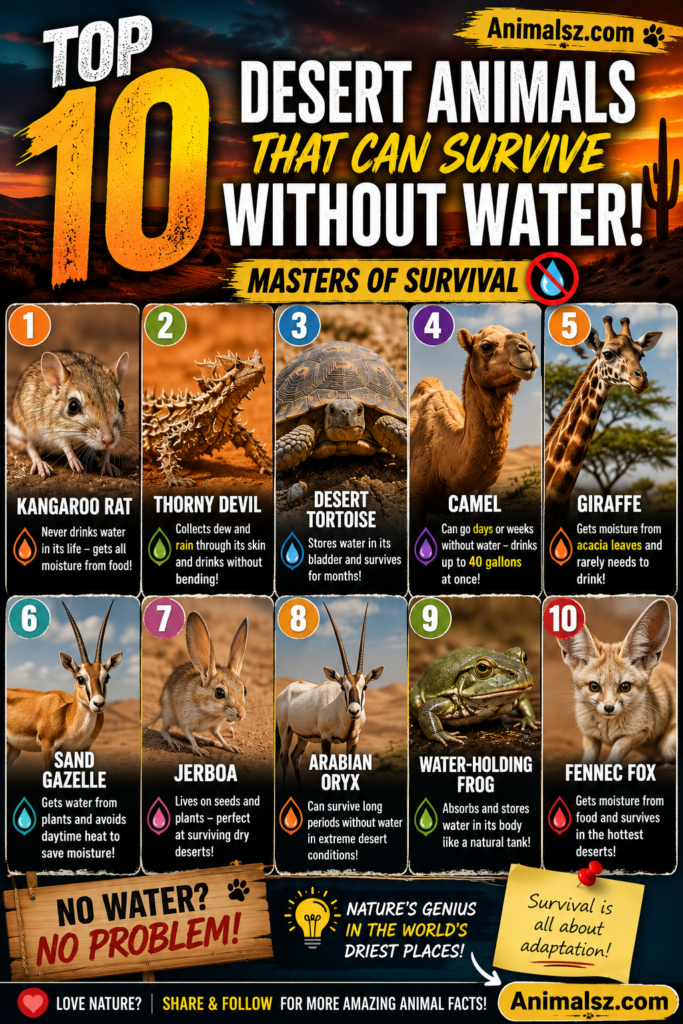
From the water-storing Water-Holding Frog to the remarkable Kangaroo Rat that never drinks water, these ten animals showcase the incredible power of evolution. Through unique adaptations such as water storage, metabolic water production, efficient kidneys, underground burrows, and specialized skin that captures dew, they have conquered some of the harshest and driest environments on Earth.
These extraordinary survivors remind us that life can flourish even where water is scarce. Every species on this list demonstrates nature’s endless creativity and resilience, proving that survival is often about adaptation rather than abundance.
Frequently Asked Questions (FAQ)
1. Which animal can survive the longest without drinking water?
The kangaroo rat can live its entire life without drinking liquid water, obtaining all its moisture from food and metabolism.
2. Do camels store water in their humps?
No. Camel humps store fat, not water. Their bodies conserve water through specialized physiological adaptations.
3. How do giraffes survive without drinking often?
Giraffes get most of their water from moisture-rich acacia leaves and conserve water with highly efficient kidneys.
4. Which reptile collects water through its skin?
The Thorny Devil uses microscopic channels between its scales to collect dew and rain, directing the water to its mouth.
5. Can desert tortoises really store water?
Yes. Desert tortoises store large amounts of water in their bladder and can survive many months without drinking.
6. Why do many desert animals come out at night?
Being nocturnal helps them avoid extreme daytime heat, reducing water loss and conserving energy.
7. What is metabolic water?
Metabolic water is water produced inside an animal’s body when nutrients such as fats and carbohydrates are broken down during digestion.
8. Are these animals endangered?
Some species, such as the Arabian Oryx and certain desert tortoise populations, have faced conservation challenges, but protection programs have helped improve their survival.
9. Which animal on this list is the smallest?
The kangaroo rat and jerboa are the smallest animals featured, yet both are among the most efficient at conserving water.
10. Why are desert animals so important?
They play vital roles in desert ecosystems by dispersing seeds, controlling insect populations, serving as prey for predators, and maintaining ecological balance.