
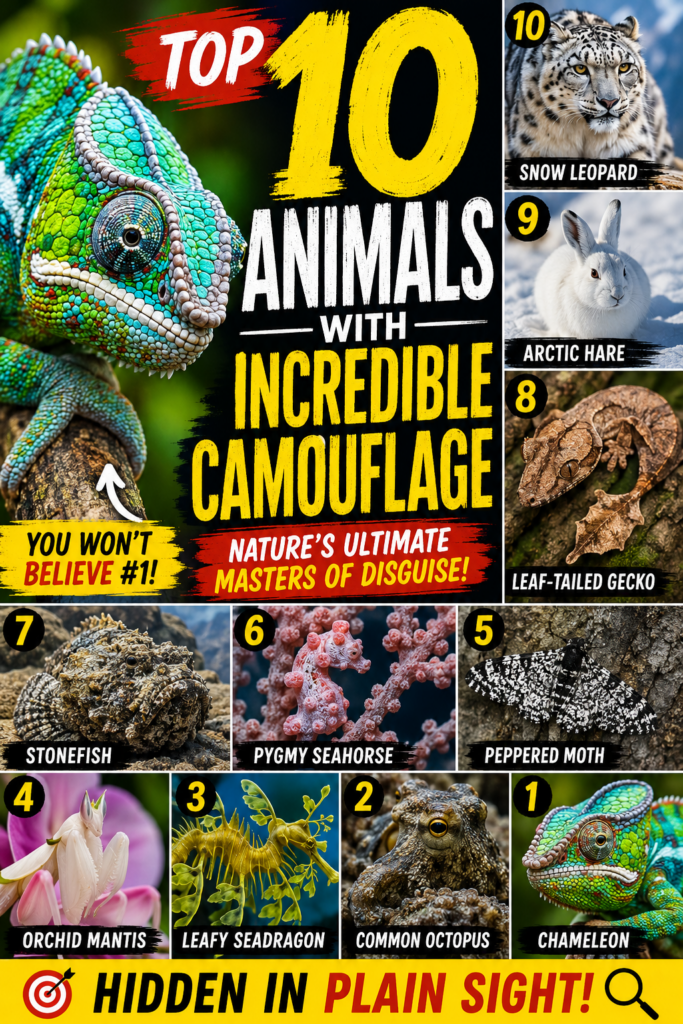
Top 10 Animals With Incredible Camouflage


Top 10 Animals With Incredible Camouflage: Nature’s Ultimate Masters of Disguise
Nature has evolved countless survival strategies, but few are as astonishing as camouflage. Across forests, deserts, mountains, oceans, and frozen landscapes, some animals have developed extraordinary ways to blend seamlessly into their surroundings. Their colors, patterns, textures, and even body shapes help them avoid predators, sneak up on prey, or simply survive another day.
Some camouflage experts remain perfectly still, while others can actively change their appearance in seconds. Whether resembling leaves, rocks, flowers, or snow, these animals demonstrate some of the most remarkable adaptations found anywhere on Earth.
In this countdown, you’ll discover ten incredible animals whose camouflage abilities seem almost magical. From hidden mountain predators to tiny ocean creatures that disappear into coral, each one showcases evolution at its finest.
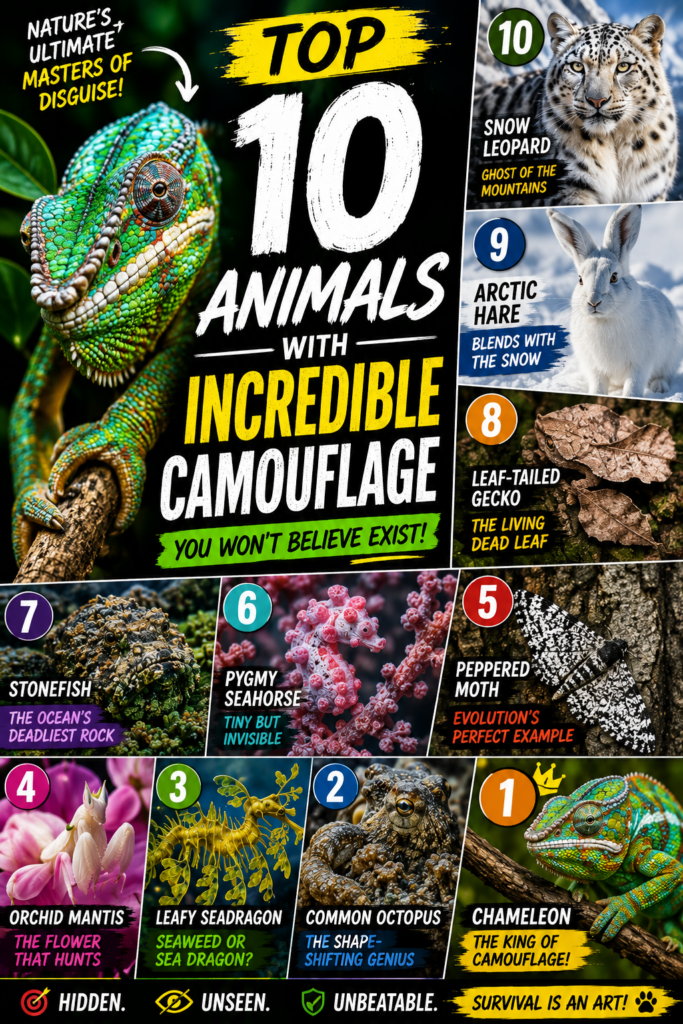
Table of Contents
- #10 – Snow Leopard
- #9 – Arctic Hare
- #8 – Leaf-tailed Gecko
- #7 – Stonefish
- #6 – Pygmy Seahorse
- #5 – Peppered Moth
- #4 – Orchid Mantis
- #3 – Leafy Seadragon
- #2 – Common Octopus
- #1 – Common Chameleon
Number 10: Snow Leopard


The Ghost of the Mountains
Known as the “Ghost of the Mountains,” the Snow Leopard is one of the hardest big cats to spot in the wild. Living high in the rugged mountain ranges of Central Asia, it inhabits steep cliffs, rocky slopes, and snowy peaks where few predators can survive.
Its thick gray-white coat is covered with black rosettes and spots that perfectly mimic the shadows cast by rocks and snow. Even experienced wildlife photographers can spend days searching without ever seeing one. The camouflage works so well that the cat often remains invisible until it moves.
Unlike lions or cheetahs that rely on speed, snow leopards depend on stealth. They patiently stalk prey such as wild sheep and mountain goats before launching powerful ambush attacks from above. Their camouflage dramatically increases hunting success while reducing the chances of being detected.
Their long tail also helps with survival by providing balance on steep cliffs and wrapping around their bodies for warmth during freezing nights.
Interesting Facts
- Lives at elevations over 18,000 feet (5,500 meters).
- Can leap more than six times its body length.
- Thick fur insulates against temperatures below -30°C.
- Extremely elusive, making population estimates difficult.
Number 9: Arctic Hare


A Master of Seasonal Camouflage
The Arctic Hare has perfected seasonal camouflage. During winter, its fur becomes brilliant white, allowing it to blend into endless fields of snow and ice. As spring arrives and the snow melts, it molts into grayish-brown fur that matches rocks, soil, and tundra vegetation.
This seasonal color change helps protect it from predators including Arctic foxes, wolves, and birds of prey. Because the Arctic has very little vegetation for hiding, camouflage is often the hare’s best defense.
Arctic hares also rely on their incredible speed. They can sprint across frozen ground at impressive speeds while remaining difficult to detect from a distance.
Their thick fur extends even to the bottoms of their feet, helping them stay warm while walking across snow and ice.
Interesting Facts
- Can reach speeds of about 40 mph (64 km/h).
- Lives in some of Earth’s coldest environments.
- Thick fur covers almost its entire body.
- Often gathers in groups during winter for extra protection.
Number 8: Leaf-tailed Gecko


Nature’s Perfect Leaf Impersonator
The Leaf-tailed Gecko from Madagascar is one of the world’s greatest camouflage experts. Its body looks astonishingly similar to a dried leaf lying on the forest floor.
Its flattened tail resembles a curled leaf complete with irregular edges and visible “leaf veins.” Even its skin coloration includes shades of brown, gray, and tan that imitate decaying vegetation.
During daylight hours, the gecko remains completely motionless against tree trunks or among fallen leaves. Predators often overlook it because it appears to be nothing more than part of the forest.
At night, it becomes an active hunter, feeding on insects while using darkness and camouflage to remain hidden.
Scientists consider this species one of the finest examples of mimicry in the animal kingdom because it copies not only color but also shape, texture, and posture.
Interesting Facts
- Found only on the island of Madagascar.
- Mostly active at night.
- Uses both camouflage and stillness to avoid predators.
- Can flatten its body against tree bark to reduce shadows.
Frequently Asked Questions
What is camouflage?
Camouflage is an adaptation that allows animals to blend into their surroundings using color, patterns, texture, body shape, or behavior.
Which animal has the best camouflage?
Many scientists consider the octopus, cuttlefish, and leaf-tailed gecko among the greatest camouflage specialists, each using different techniques.
Why do animals use camouflage?
Camouflage helps animals avoid predators, hunt prey more effectively, and increase their chances of survival.
Can camouflage change over time?
Yes. Some animals, such as the Arctic Hare, change with the seasons, while others, like octopuses, can change within seconds.
SEO Meta Description
Discover the top 10 animals with incredible camouflage, from the snow leopard to the chameleon. Learn amazing wildlife facts and survival secrets that make these masters of disguise nearly impossible to spot.


Welcome back to our countdown of the Top 10 Animals With Incredible Camouflage. In Part 1, we explored the amazing Snow Leopard, Arctic Hare, and Leaf-tailed Gecko. Now, let’s continue with three more masters of disguise that thrive in oceans and forests.
Number 7: Stonefish


The Ocean’s Most Dangerous Rock
If you were snorkeling over a tropical reef, you could easily swim right past a stonefish without ever noticing it. That’s because this remarkable fish is one of the best-camouflaged animals on Earth. Its rough skin, irregular bumps, algae-like texture, and mottled colors make it look almost identical to the rocks and coral surrounding it.
Rather than chasing prey, the stonefish relies on patience. It buries itself partially in sand or rests motionless among rocks, waiting for an unsuspecting fish or shrimp to swim within striking distance. When the opportunity comes, it can open its mouth and inhale its prey in less than a fraction of a second.
Its camouflage serves another purpose as well—defense. Predators often fail to recognize it as food, reducing the chance of attack. Unfortunately for humans, stepping on a stonefish can be extremely dangerous because it possesses venomous dorsal spines capable of delivering one of the most painful stings in the animal kingdom.
Despite its fearsome reputation, the stonefish rarely attacks unless disturbed. It prefers remaining hidden rather than confronting other animals.
Interesting Facts
- Considered one of the world’s most venomous fish.
- Can remain completely motionless for hours.
- Swallows prey in milliseconds using powerful suction.
- Found in shallow coastal waters throughout the Indo-Pacific.
Why Its Camouflage Works
Unlike many camouflaged animals that imitate leaves or branches, the stonefish imitates lifeless objects. Predators don’t see an animal—they simply see another rock on the reef.
Number 6: Pygmy Seahorse


Tiny, Colorful, and Nearly Invisible
The pygmy seahorse is one of the smallest seahorses in the world, measuring only about two centimeters long. Despite its tiny size, it has become famous for possessing one of nature’s finest examples of camouflage.
These miniature seahorses spend nearly their entire lives attached to sea fan corals. Their bodies develop bumps called tubercles that closely resemble the tiny polyps covering the coral itself. Even their colors match the exact shade of the coral colony they inhabit.
Marine biologists overlooked pygmy seahorses for many years because they blended so perfectly into their surroundings. In fact, the first specimens were discovered only after coral samples had been brought into laboratories for study.
Because they rarely leave their host coral, camouflage is essential for protection against predators. Remaining unnoticed is far easier than attempting to escape.
Interesting Facts
- Usually less than one inch long.
- Lives almost exclusively on sea fan corals.
- Excellent camouflage makes it difficult even for divers to spot.
- Males carry developing babies in a brood pouch.
Why Its Camouflage Works
Instead of merely matching the coral’s color, the pygmy seahorse copies its texture, shape, and even its tiny surface bumps, making it virtually indistinguishable.
Number 5: Peppered Moth


A Classic Example of Natural Selection
The peppered moth demonstrates how camouflage and evolution work together. During the day, this moth rests on tree trunks where its speckled wings closely resemble the texture and coloration of bark covered with lichens.
Birds searching for insects often overlook peppered moths because they blend so effectively into the background. Remaining perfectly still further enhances their disguise.
The peppered moth also became famous during the Industrial Revolution. As pollution darkened tree bark with soot, darker-colored moths became harder for predators to detect, while lighter moths became more visible. Over time, dark moths became much more common in polluted areas. When pollution later decreased and trees recovered, lighter moths once again became more abundant.
This remarkable shift became one of biology’s best-known examples of natural selection.
Interesting Facts
- Wingspan ranges from 45 to 62 millimeters.
- Active mainly at night.
- Rests motionless during daylight hours.
- Famous worldwide for illustrating evolutionary adaptation.
Why Its Camouflage Works
The peppered moth combines color, pattern, and behavior. Its bark-like wings make it difficult to distinguish from tree trunks, especially when it remains still.
Camouflage Comparison
| Animal | Habitat | Camouflage Type | Main Benefit |
|---|---|---|---|
| Stonefish | Coral reefs | Mimics rocks | Ambush hunting & defense |
| Pygmy Seahorse | Sea fan corals | Matches coral texture | Predator avoidance |
| Peppered Moth | Forests | Bark mimicry | Avoids birds |
Frequently Asked Questions
Can stonefish camouflage change?
Stonefish do not rapidly change color like octopuses, but their natural coloration closely matches the reef where they live.
Why are pygmy seahorses so difficult to find?
Their tiny size, matching colors, and coral-like body texture make them nearly invisible.
Why is the peppered moth famous?
It is one of the best-known examples showing how evolution can change populations through natural selection.
Do these animals rely only on camouflage?
No. They also depend on stillness, patience, and behaviors that reduce movement, making them even harder to detect.
SEO Keywords
Primary Keyword: Top 10 Animals With Incredible Camouflage
Related Keywords: animal camouflage, stonefish facts, pygmy seahorse, peppered moth, camouflage animals, wildlife facts, ocean camouflage, forest camouflage, amazing animal adaptations, masters of disguise.


Welcome back to our countdown of the Top 10 Animals With Incredible Camouflage. In Part 3, we enter the top four with three of the most astonishing camouflage specialists on Earth. These animals don’t just blend into their surroundings—they become part of them.
Number 4: Orchid Mantis


The Flower That Hunts
Imagine seeing a beautiful pink orchid in the rainforest. As a bee lands on the flower, it suddenly springs to life and captures its prey. That “flower” is actually the incredible Orchid Mantis.
Native to the tropical rainforests of Southeast Asia, the Orchid Mantis is one of nature’s greatest examples of aggressive camouflage. Instead of hiding from predators, it disguises itself to attract prey. Its legs resemble delicate flower petals, while its body displays shades of white, pink, and purple that closely resemble blooming orchids.
Flying insects such as bees, butterflies, and flies mistake the mantis for a real flower. When they land nearby, the mantis strikes with lightning-fast reflexes, grabbing its meal in less than a tenth of a second.
Scientists believe the Orchid Mantis doesn’t imitate just one flower species. Instead, its appearance resembles many different tropical blossoms, increasing its chances of attracting unsuspecting pollinators.
Interesting Facts
- Females can grow much larger than males.
- Captures prey in milliseconds.
- Uses camouflage for hunting rather than hiding.
- Among the most beautiful insects on Earth.
Why Its Camouflage Works
Rather than blending into the background, the Orchid Mantis becomes the attraction itself. It tricks insects into approaching voluntarily.
Number 3: Leafy Seadragon


The Floating Seaweed Illusion
At first glance, the Leafy Seadragon appears to be nothing more than drifting seaweed. Look closer, and you’ll discover one of the ocean’s most extraordinary fish.
Found along the southern coast of Australia, this relative of the seahorse has elaborate leaf-like appendages covering its entire body. These structures are not used for swimming but instead create the perfect disguise among kelp forests and underwater vegetation.
Unlike fast-swimming fish, Leafy Seadragons move slowly using nearly transparent fins. Combined with gentle ocean currents, they sway naturally with surrounding seaweed, making them almost impossible for predators to distinguish.
Their camouflage is so convincing that divers often swim directly past them without realizing they are there.
Interesting Facts
- Marine emblem of South Australia.
- Can reach about 35 centimeters in length.
- Males carry fertilized eggs until they hatch.
- Eats tiny shrimp and plankton-like crustaceans.
Why Its Camouflage Works
The Leafy Seadragon copies both the appearance and movement of seaweed, creating an incredibly realistic illusion underwater.
Number 2: Common Octopus


The Ultimate Shape-Shifting Genius
Few animals can rival the camouflage abilities of the Common Octopus. Unlike most species that rely on fixed colors or patterns, this intelligent cephalopod can transform its appearance within seconds.
Its skin contains millions of specialized pigment cells called chromatophores, along with reflective cells known as iridophores and leucophores. Working together, these cells allow the octopus to instantly change color, brightness, and pattern.
Even more astonishing, muscles beneath the skin alter its texture, allowing it to imitate rough rocks, smooth sand, coral, or even spiny algae. It can flatten its body, stretch its arms, or reshape itself to resemble entirely different objects.
Camouflage isn’t its only defense. If discovered, the octopus may release a cloud of ink before rapidly escaping to safety.
Researchers continue studying octopus camouflage because it remains one of the most advanced biological adaptations known.
Interesting Facts
- Possesses three hearts.
- Has blue blood due to copper-based hemocyanin.
- Extremely intelligent and capable of solving puzzles.
- Can squeeze through openings barely larger than its beak.
Why Its Camouflage Works
The Common Octopus combines rapid color change, skin texture changes, body reshaping, and intelligent behavior, making it one of the most effective camouflage experts on the planet.
Camouflage Comparison
| Animal | Habitat | Camouflage Strategy | Primary Purpose |
|---|---|---|---|
| Orchid Mantis | Tropical rainforest | Mimics flowers | Attract prey |
| Leafy Seadragon | Kelp forests | Mimics seaweed | Avoid predators |
| Common Octopus | Coral reefs & seabeds | Changes color, texture & shape | Hunting and defense |
Frequently Asked Questions
Which animal can change color the fastest?
The Common Octopus can change its appearance within seconds, making it one of the fastest camouflage specialists in nature.
Does the Orchid Mantis actually look like a flower?
Yes. Its body shape and colors closely resemble tropical blossoms, helping it lure pollinating insects.
Is the Leafy Seadragon related to seahorses?
Yes. It belongs to the same family as seahorses and pipefish.
Why is octopus camouflage considered unique?
Unlike most animals, octopuses can simultaneously change color, texture, pattern, posture, and body shape.
SEO Keywords
Primary Keyword: Top 10 Animals With Incredible Camouflage
Related Keywords: orchid mantis facts, leafy seadragon, octopus camouflage, color-changing animals, marine camouflage, rainforest insects, wildlife adaptations, ocean wildlife, amazing animals, animal disguise


You’ve reached the grand finale of our countdown! Throughout this series, we’ve explored some of nature’s greatest masters of disguise—from hidden mountain predators to invisible underwater hunters. Now it’s time to reveal the number one animal with incredible camouflage.
Number 1: Common Chameleon


The World’s Most Famous Master of Camouflage
When people think of camouflage, the chameleon is usually the first animal that comes to mind. For centuries, these remarkable reptiles have amazed scientists and nature lovers with their ability to rapidly change appearance.
Contrary to popular belief, chameleons do not change color solely to match every background they encounter. Instead, their color changes are influenced by several factors, including communication with other chameleons, body temperature, stress, mood, and, in some situations, camouflage.
Their skin contains specialized layers of pigment cells and microscopic crystal structures called iridophores. By changing the spacing between these crystals, chameleons can reflect different wavelengths of light, creating brilliant greens, yellows, blues, oranges, and darker shades.
Camouflage becomes especially effective because it combines with the chameleon’s slow, swaying movements. Rather than walking directly like most animals, chameleons gently rock back and forth, mimicking leaves moving in the wind. This subtle behavior makes predators much less likely to notice them.
Their independently moving eyes provide nearly 360-degree vision, allowing them to monitor predators while searching for prey. Once an insect comes within range, the chameleon launches its sticky tongue at incredible speed, often catching prey in less than one second.
Millions of years of evolution have made chameleons among the most specialized reptiles on Earth.
Interesting Facts
- Eyes move independently.
- Tongue can extend more than twice the body length.
- Feet are specially adapted for gripping branches.
- Many species can change color within minutes or even seconds.
- Excellent vision helps detect tiny insects from long distances.
Why It Ranks Number One
Although several animals outperform the chameleon in specific camouflage abilities, no animal is more famous or more versatile in combining color change, careful movement, specialized vision, and hunting behavior. Together, these adaptations make it one of nature’s greatest masters of disguise.
Honorable Mentions


Several incredible animals narrowly missed our Top 10 list.
Cuttlefish
Often considered the world’s greatest camouflage expert, cuttlefish can instantly change color, pattern, and texture while communicating with other cuttlefish.
Dead Leaf Butterfly
With closed wings, this butterfly looks exactly like a dried leaf, complete with veins and spots that resemble decay.
Stick Insect
Its body perfectly resembles twigs and branches, helping it remain unnoticed in forests.
Tawny Frogmouth
This Australian bird imitates broken tree branches so convincingly that predators rarely notice it.
Flounder
Living on sandy ocean floors, flounders can quickly adjust their skin color to match surrounding sediment.
Why Camouflage Is Essential
Camouflage is one of evolution’s most successful survival strategies. Animals use it to:
- Avoid predators.
- Ambush prey.
- Protect nests and young.
- Increase hunting success.
- Reduce energy spent escaping danger.
- Adapt to changing environments.
Some species depend on camouflage every day. Without it, many would struggle to survive.
Frequently Asked Questions
Which animal has the best camouflage overall?
Many scientists consider the Cuttlefish and the Common Octopus among the most advanced camouflage specialists, while the Common Chameleon remains the most iconic.
Can all chameleons completely match any background?
No. Chameleons primarily change color for communication, temperature regulation, and only partly for camouflage.
Which animal changes camouflage the fastest?
The Common Octopus and Cuttlefish can alter their appearance in just seconds.
Is camouflage the same as mimicry?
Not exactly. Camouflage helps animals blend into their surroundings, while mimicry makes them resemble another object or organism.
Which animal looks most like a leaf?
The Leaf-tailed Gecko and the Dead Leaf Butterfly are among the best leaf mimics.
Which ocean animal has the best camouflage?
The Common Octopus, Cuttlefish, and Leafy Seadragon are top contenders.
Why don’t predators always find camouflaged animals?
Camouflage disrupts outlines, matches colors and textures, and is often combined with perfectly still behavior.
Do baby animals use camouflage?
Yes. Many newborn birds, mammals, reptiles, and insects rely on camouflage from birth to avoid predators.
Conclusion
Nature has produced astonishing camouflage experts that disappear into forests, mountains, deserts, coral reefs, and oceans. Whether it’s the flower-like Orchid Mantis, the seaweed-mimicking Leafy Seadragon, the shape-shifting Common Octopus, or the world-famous Common Chameleon, each species demonstrates the incredible power of evolution.
Camouflage isn’t just about changing colors—it’s about surviving in a world where being seen can mean the difference between life and death.
The next time you’re hiking through a forest, exploring a coral reef, or watching a wildlife documentary, remember that some of nature’s most extraordinary creatures may be hiding in plain sight.
Related SEO Keywords
- animal camouflage
- camouflage animals
- masters of disguise
- wildlife facts
- amazing animals
- hidden animals
- color changing animals
- chameleon facts
- octopus camouflage
- nature adaptations
- predator camouflage
- prey camouflage
- camouflage in nature
- incredible wildlife
- educational animal facts
Internal Link Ideas
- Top 10 Animals That Look Like Aliens
- Top 10 Most Venomous Creatures
- Top 10 Tiny Animals That Are Extremely Dangerous
- Top 10 Creepiest Cave Creatures
- Top 10 Animals That Pretend to Be Dead
- Top 10 Animals That Survived Extinction
Thank you for reading! Which camouflage expert amazed you the most? Share your favorite in the comments and keep exploring the incredible world of wildlife.