
Top 10 Biggest Cats in the World
Meta Description: Discover the top 10 biggest cats in the world, from the agile clouded leopard to the mighty Siberian tiger. Learn their size, habitat, diet, fascinating facts, and conservation status with stunning images.
Introduction
Big cats have fascinated humans for thousands of years. Their incredible strength, speed, stealth, and beauty make them some of the most admired animals on Earth. While many people know lions and tigers, there are several other impressive feline species that deserve attention. Some are powerful hunters capable of taking down prey much larger than themselves, while others thrive in snowy mountains or dense rainforests.
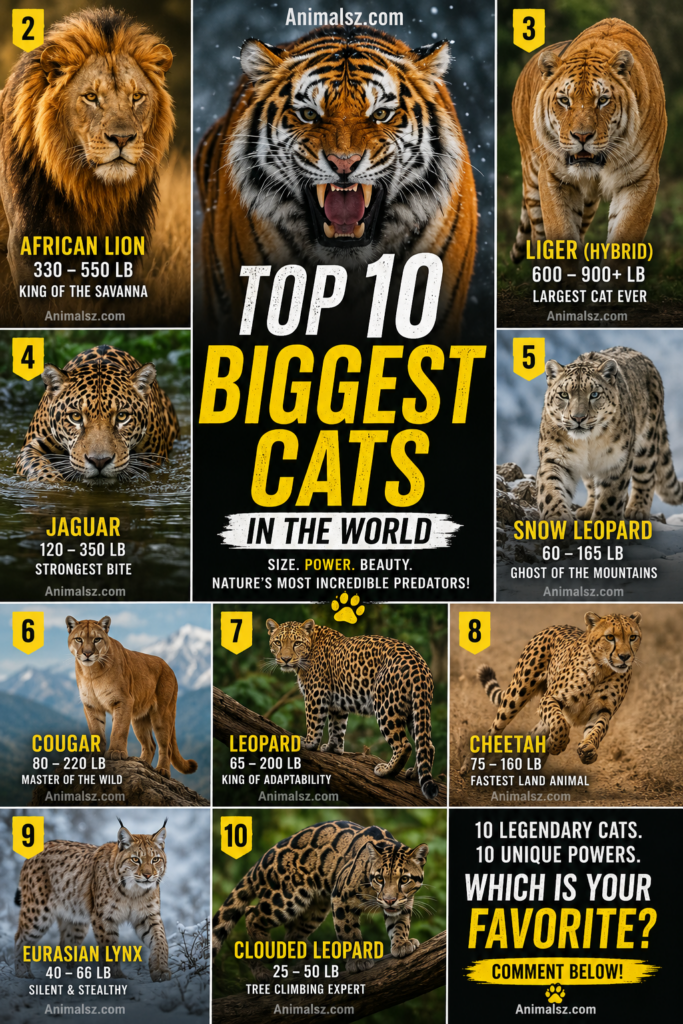
In this article, we’ll count down the Top 10 Biggest Cats in the World, starting with Number 10 and ending with the undisputed giant of the feline family.
Number 10: Clouded Leopard (Neofelis nebulosa)


The clouded leopard may rank tenth on this list, but it is one of the most fascinating members of the cat family. Native to the dense tropical forests of Southeast Asia, this elusive predator is famous for its beautifully patterned coat, which features large cloud-shaped markings that provide exceptional camouflage among the trees.
Unlike larger cats that rely on brute strength, clouded leopards are masters of agility. They spend much of their lives in trees and are among the best climbers of all wild cats. They can descend tree trunks headfirst, hang upside down from branches using their powerful hind legs, and leap effortlessly from one branch to another. These remarkable abilities allow them to hunt birds, monkeys, squirrels, and other small mammals high in the forest canopy.
One of the clouded leopard’s most unique features is its exceptionally long canine teeth. Relative to the size of its skull, these teeth are the longest of any living cat species, earning it comparisons to the extinct saber-toothed cats. Despite weighing only between 25 and 50 pounds (11–23 kg), it possesses a surprisingly powerful bite.
Clouded leopards are solitary and highly secretive, making them difficult for researchers to study in the wild. Most individuals prefer dense forests where they remain hidden during daylight hours before becoming active at dawn and dusk.
Unfortunately, clouded leopard populations continue to decline because of habitat destruction, illegal logging, and poaching. Their beautiful fur and body parts are still illegally traded in some regions despite legal protection.
Quick Facts
- Scientific Name: Neofelis nebulosa
- Weight: 25–50 lb (11–23 kg)
- Body Length: 28–43 inches (70–110 cm)
- Habitat: Tropical forests of Southeast Asia
- Diet: Monkeys, birds, rodents, deer, wild pigs
- Conservation Status: Vulnerable
Number 9: Eurasian Lynx (Lynx lynx)


The Eurasian lynx is the largest member of the lynx family and one of Europe’s most impressive predators. Easily recognized by its pointed ears with black tufts, thick winter coat, and short tail, this magnificent feline thrives across Europe and northern Asia.
Adult Eurasian lynxes typically weigh 40 to 66 pounds (18–30 kg), although exceptionally large males may exceed this range. Their long legs and wide paws act like natural snowshoes, allowing them to move silently through deep snow while hunting.
Unlike lions, lynxes live alone. They rely on stealth rather than speed, patiently stalking prey before launching a sudden attack. Roe deer make up much of their diet, but they also hunt hares, foxes, birds, and rodents.
Their eyesight is extraordinary. A Eurasian lynx can detect movement from remarkable distances, giving it a major advantage during nighttime hunts.
Thanks to conservation efforts, populations have recovered in several European countries, though habitat fragmentation and illegal hunting remain ongoing threats.
Quick Facts
- Scientific Name: Lynx lynx
- Weight: 40–66 lb (18–30 kg)
- Length: 31–51 inches (80–130 cm)
- Habitat: Europe and northern Asia
- Diet: Deer, hares, foxes, birds
- Conservation Status: Least Concern
Number 8: Cheetah (Acinonyx jubatus)


The cheetah is unlike any other cat on Earth. While it may not be the strongest, it is unquestionably the fastest. Capable of accelerating from 0 to 60 mph (97 km/h) in about three seconds, the cheetah can reach top speeds of 70 mph (113 km/h) during short chases.
Its slim body, lightweight frame, flexible spine, long legs, and oversized lungs are perfectly adapted for explosive speed. Every part of its body has evolved to help it outrun gazelles and other swift prey across the African savanna.
Adult cheetahs usually weigh between 75 and 160 pounds (34–72 kg). Unlike leopards or jaguars, they are not built for wrestling large prey. Instead, they rely on rapid acceleration and incredible agility to trip their targets before delivering a quick suffocating bite.
The black tear-like markings running from the eyes to the mouth reduce glare from the sun, helping improve focus during high-speed pursuits.
Sadly, fewer than 7,000 cheetahs remain in the wild. Habitat loss, declining prey populations, and conflicts with humans continue to threaten this remarkable species.
Quick Facts
- Scientific Name: Acinonyx jubatus
- Weight: 75–160 lb (34–72 kg)
- Top Speed: 70 mph (113 km/h)
- Habitat: African grasslands and parts of Iran
- Diet: Gazelles, impalas, rabbits, birds
- Conservation Status: Vulnerable
Number 7: Leopard (Panthera pardus)


The leopard is one of the most adaptable and widespread big cats in the world. Found across Africa and parts of Asia, this remarkable predator thrives in environments ranging from tropical rainforests and dry deserts to mountainous regions and open savannas. Its beautiful golden coat covered in distinctive black rosettes provides excellent camouflage, allowing it to blend seamlessly into its surroundings.
Adult male leopards typically weigh between 65 and 200 pounds (30–90 kg), although exceptionally large individuals can exceed this range. Despite being smaller than lions and tigers, leopards possess incredible strength. They are capable of lifting prey that weighs even more than their own body and carrying it high into trees. This unique behavior protects their meals from scavengers such as lions, hyenas, and wild dogs.
Leopards are solitary hunters that rely on patience, stealth, and surprise rather than endurance. They quietly stalk prey until they are close enough to launch a powerful ambush. Their diet is one of the most varied among all big cats and includes antelope, monkeys, birds, reptiles, rodents, fish, and even insects when necessary.
Unlike cheetahs, which hunt during daylight, leopards are primarily nocturnal. Their excellent night vision and silent movement make them highly effective predators after sunset.
Although leopards remain widespread, many populations are declining because of habitat destruction, poaching, and increasing conflict with humans. Several leopard subspecies are now endangered and require continued conservation efforts.
Quick Facts
- Scientific Name: Panthera pardus
- Weight: 65–200 lb (30–90 kg)
- Length: 3–6.2 ft (90–190 cm)
- Habitat: Africa and Asia
- Diet: Deer, antelope, monkeys, birds, reptiles, rodents
- Conservation Status: Vulnerable
Number 6: Cougar (Mountain Lion) (Puma concolor)


The cougar, also known as the mountain lion, puma, or panther, has the largest natural range of any wild land mammal in the Western Hemisphere. From the snowy mountains of Canada to the forests and grasslands of South America, this adaptable cat has successfully conquered a wide variety of habitats.
Adult cougars usually weigh between 80 and 220 pounds (36–100 kg), with males being significantly larger than females. Their muscular bodies, long tails, and powerful hind legs make them exceptional jumpers. A cougar can leap over 18 feet (5.5 meters) vertically and more than 40 feet (12 meters) horizontally in a single bound.
Unlike lions, cougars are solitary animals that spend most of their lives alone. They hunt mainly at dawn and dusk, feeding on deer, elk, sheep, rabbits, and smaller mammals. After making a kill, they often cover it with leaves or dirt and return over several days to continue feeding.
Although cougars are large and powerful predators, they generally avoid humans whenever possible. Attacks on people are extremely rare.
Conservation efforts have helped maintain stable populations in many regions, but habitat fragmentation and road construction continue to isolate cougar populations.
Quick Facts
- Scientific Name: Puma concolor
- Weight: 80–220 lb (36–100 kg)
- Length: 5–9 ft (1.5–2.7 m) including tail
- Habitat: North and South America
- Diet: Deer, elk, sheep, rabbits, rodents
- Conservation Status: Least Concern
Number 5: Snow Leopard (Panthera uncia)


The snow leopard is one of the most mysterious and breathtaking cats on Earth. Nicknamed the “Ghost of the Mountains,” it inhabits the rugged mountain ranges of Central Asia, including the Himalayas, where elevations often exceed 16,000 feet (4,900 meters).
Adult snow leopards typically weigh between 60 and 165 pounds (27–75 kg). Their thick smoky-gray fur, powerful legs, and extraordinarily long tail are perfectly adapted for surviving freezing temperatures and navigating steep rocky cliffs.
The long tail serves multiple purposes. It acts as a counterbalance during incredible leaps across rocky terrain and can also be wrapped around the cat’s face like a blanket while resting to protect against the cold.
Snow leopards are capable of jumping nearly 50 feet (15 meters) across deep mountain gaps. They primarily hunt wild sheep, ibex, blue sheep, marmots, and other mountain animals. Because prey is often scarce, these cats must patrol enormous territories covering hundreds of square miles.
Their naturally shy behavior makes them extremely difficult to observe in the wild, and many people spend years searching for a glimpse of one.
Despite living in remote areas, snow leopards still face threats from climate change, habitat loss, declining prey populations, and illegal hunting. International conservation programs are working to ensure these magnificent cats continue to survive.
Quick Facts
- Scientific Name: Panthera uncia
- Weight: 60–165 lb (27–75 kg)
- Length: 3–5 ft (90–150 cm)
- Habitat: Central Asian mountains
- Diet: Ibex, blue sheep, marmots, wild goats
- Conservation Status: Vulnerable
Number 4: Jaguar (Panthera onca)


The jaguar is the largest cat in the Americas and one of the most powerful predators on Earth. Found primarily in the rainforests, wetlands, and grasslands of Central and South America, especially the Amazon Basin, this magnificent feline is known for its muscular build, beautiful golden coat covered with black rosettes, and extraordinary strength.
Adult jaguars typically weigh between 120 and 350 pounds (54–158 kg), with males significantly larger than females. Although they are shorter than tigers and lions, jaguars are much more heavily built for their size. Their compact, muscular bodies give them tremendous power when wrestling prey.
Perhaps the jaguar’s most impressive feature is its bite. Pound for pound, it has the strongest bite of any big cat. While lions and tigers usually kill by suffocation, jaguars often bite directly through the skull or shell of their prey. Their crushing jaws can easily break turtle shells, crack bones, and even pierce the skulls of caimans.
Unlike many cats, jaguars are excellent swimmers and actually enjoy the water. They frequently hunt fish, turtles, caimans, and capybaras in rivers and wetlands. Their powerful limbs also make them exceptional climbers, allowing them to hunt both on the ground and in trees.
Unfortunately, jaguar populations have declined because of deforestation, illegal hunting, and habitat fragmentation. Conservation programs throughout Latin America are helping protect this iconic species and preserve vital wildlife corridors.
Quick Facts
- Scientific Name: Panthera onca
- Weight: 120–350 lb (54–158 kg)
- Length: 3.7–6 ft (112–185 cm)
- Habitat: Central and South America
- Diet: Capybaras, deer, peccaries, caimans, turtles, fish
- Conservation Status: Near Threatened
Number 3: Liger (Hybrid of Male Lion × Female Tiger)


The liger is the largest cat ever known. It is a rare hybrid created by breeding a male lion with a female tiger. Because lions and tigers rarely meet in the wild, ligers exist almost exclusively in wildlife sanctuaries and zoological facilities.
Adult ligers commonly weigh between 600 and 900 pounds (272–408 kg), with some exceptional individuals exceeding 900 pounds (408 kg). They can measure more than 12 feet (3.6 meters) from nose to tail, making them considerably larger than both lions and tigers.
Ligers inherit physical characteristics from both parents. Most have a sandy-colored coat similar to a lion but with faint tiger stripes. Male ligers may also develop a smaller mane than African lions.
One reason ligers become so enormous is related to genetics. In lions, genes that promote growth are usually balanced by growth-limiting genes from the mother. When a male lion breeds with a female tiger, this balance changes, allowing ligers to continue growing for much longer than either parent species.
Despite their impressive appearance, ligers are not recognized as a separate species because they are hybrids rather than naturally occurring wild cats. Many wildlife experts discourage intentional breeding due to concerns about animal welfare and conservation ethics.
Quick Facts
- Scientific Name: Hybrid (Lion × Tiger)
- Weight: 600–900+ lb (272–408+ kg)
- Length: Up to 12 ft (3.6 m)
- Habitat: Wildlife sanctuaries and zoos
- Diet: Meat
- Conservation Status: Not applicable (hybrid)
Number 2: African Lion (Panthera leo)


The African lion is one of the most recognizable and celebrated animals in the world. Often called the King of the Jungle, lions actually inhabit open grasslands, woodlands, and savannas across sub-Saharan Africa.
Large male lions typically weigh between 330 and 550 pounds (150–250 kg) and can measure up to 10 feet (3 meters) in total length, including the tail. Their muscular bodies and powerful forelimbs enable them to overpower prey much larger than themselves.
Unlike nearly every other cat species, lions are highly social animals. They live in family groups called prides, which usually consist of related females, their cubs, and one or more dominant males. Lionesses work together to hunt large animals such as zebras, buffalo, wildebeest, and antelope, while males defend the pride’s territory against rivals.
A lion’s roar is among the loudest sounds made by any cat. Under ideal conditions, it can be heard from up to 5 miles (8 kilometers) away, helping lions communicate and warn intruders.
Although lions remain powerful apex predators, wild populations have declined dramatically due to habitat loss, human conflict, and reduced prey numbers. Conservation organizations continue working to protect Africa’s remaining lion populations through habitat preservation and anti-poaching efforts.
Quick Facts
- Scientific Name: Panthera leo
- Weight: 330–550 lb (150–250 kg)
- Length: 8–10 ft (2.4–3 m)
- Habitat: African savannas and grasslands
- Diet: Buffalo, zebras, wildebeest, antelope
- Conservation Status: Vulnerable
Number 1: Siberian Tiger (Panthera tigris altaica)


The Siberian tiger, also known as the Amur tiger, is the largest wild cat on Earth. Native to the forests of eastern Russia and northeastern China, this magnificent predator has evolved to survive some of the harshest climates on the planet. Thick fur, a dense layer of body fat, and enormous paws help it move across deep snow while staying warm during freezing winters.
Adult male Siberian tigers typically weigh between 400 and 700 pounds (180–320 kg), although exceptionally large individuals have exceeded these weights. From nose to tail, they can measure 9 to 12 feet (2.7–3.7 meters) in length, making them longer and heavier than any other wild feline.
Despite their enormous size, Siberian tigers are surprisingly agile. They can sprint at speeds of up to 40 miles per hour (64 km/h) over short distances and leap more than 30 feet (9 meters) in a single bound. These powerful hunters prey on wild boar, elk, deer, and occasionally even bears when food is scarce.
Unlike lions, Siberian tigers are solitary animals. Each adult maintains a vast territory that can cover hundreds of square miles. They communicate through scent markings, scratches on trees, and deep vocalizations that warn rivals to stay away.
Once pushed to the brink of extinction due to hunting and habitat loss, the Siberian tiger has made a remarkable recovery thanks to strict protection laws, anti-poaching patrols, and conservation programs. Although their numbers have improved, they remain vulnerable because of illegal wildlife trade and shrinking habitats.
The Siberian tiger is truly the undisputed heavyweight champion of the wild cat world, combining immense power, stealth, intelligence, and beauty like no other feline.
Quick Facts
- Scientific Name: Panthera tigris altaica
- Weight: 400–700 lb (180–320 kg)
- Length: 9–12 ft (2.7–3.7 m)
- Habitat: Russian Far East and northeastern China
- Diet: Deer, elk, wild boar, bears
- Conservation Status: Endangered
Comparison Table
| Rank | Cat | Weight | Habitat |
|---|---|---|---|
| 1 | Siberian Tiger | 400–700 lb (180–320 kg) | Russia & China |
| 2 | African Lion | 330–550 lb (150–250 kg) | Africa |
| 3 | Liger (Hybrid) | 600–900+ lb (272–408+ kg) | Captivity |
| 4 | Jaguar | 120–350 lb (54–158 kg) | Central & South America |
| 5 | Snow Leopard | 60–165 lb (27–75 kg) | Central Asia |
| 6 | Cougar | 80–220 lb (36–100 kg) | North & South America |
| 7 | Leopard | 65–200 lb (30–90 kg) | Africa & Asia |
| 8 | Cheetah | 75–160 lb (34–72 kg) | Africa & Iran |
| 9 | Eurasian Lynx | 40–66 lb (18–30 kg) | Europe & Asia |
| 10 | Clouded Leopard | 25–50 lb (11–23 kg) | Southeast Asia |
Note: Although the liger is larger than all wild cats, it is a human-created hybrid and does not occur naturally. The Siberian tiger remains the largest naturally occurring wild cat.
Frequently Asked Questions (FAQ)
1. What is the biggest cat in the world?
The liger is the biggest cat ever recorded, with some individuals weighing over 900 pounds (408 kg). However, it is a hybrid created in captivity. The Siberian tiger is the largest naturally occurring wild cat.
2. Which wild cat is the heaviest?
The Siberian tiger is the heaviest wild cat, with large males weighing up to 700 pounds (320 kg).
3. Which big cat has the strongest bite?
The jaguar has the strongest bite relative to its size among all big cats. Its jaws are powerful enough to crush turtle shells and pierce crocodile skulls.
4. Which big cat is the fastest?
The cheetah is the fastest land animal on Earth, reaching speeds of up to 70 mph (113 km/h).
5. Which big cat is the best climber?
The clouded leopard is considered the most skilled climber among wild cats. It can climb down trees headfirst and hang upside down from branches.
6. Which cat has the widest range?
The cougar has the largest geographic range of any wild cat in the Americas, living from Canada to southern South America.
7. Are snow leopards actually leopards?
No. Despite their name, snow leopards are a distinct species with unique adaptations for life in cold, mountainous environments.
8. Why are lions the only social cats?
Lions evolved to live in prides, allowing them to hunt large prey cooperatively and defend territories more effectively than solitary cats.
9. Are all big cats endangered?
Not all are endangered, but many face threats from habitat loss, poaching, climate change, and conflicts with humans. Conservation efforts remain essential for their survival.
10. Can different big cats breed together?
Some species, such as lions and tigers, can produce hybrids like the liger or tigon in captivity. However, these hybrids are extremely rare in nature and are not separate species.
Conclusion
From the agile Clouded Leopard to the mighty Siberian Tiger, the world’s biggest cats showcase the incredible diversity of the feline family. Each species has evolved unique adaptations that allow it to thrive in forests, mountains, grasslands, deserts, and wetlands across the globe.
While their size and strength make them formidable predators, many of these magnificent animals face serious threats from habitat destruction, illegal hunting, and climate change. Supporting conservation programs and protecting natural habitats are vital to ensuring these iconic cats continue to roam the wild for generations to come.
Whether it’s the unmatched speed of the Cheetah, the crushing bite of the Jaguar, the social behavior of the African Lion, or the immense power of the Siberian Tiger, every one of these remarkable felines deserves our admiration and protection.
Final Thoughts
Nature has created some truly extraordinary predators—but each plays an essential role in maintaining healthy ecosystems. By learning more about these incredible cats, we can better appreciate their importance and help safeguard their future.
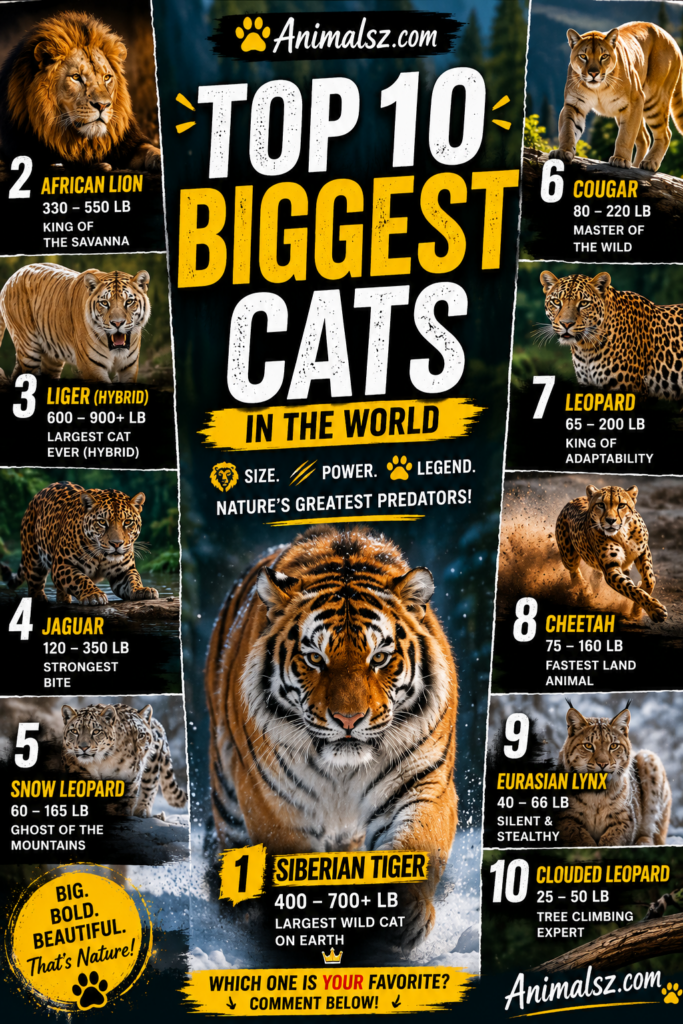
Which of these giant cats impressed you the most? Let us know in the comments below, and don’t forget to share this article with fellow wildlife enthusiasts!